
Bitcoin Miners' AI Arbitrage: How the Industry is Rewriting Its Economics


 Aime Summary
The Bear Market Catalyst
Bitcoin's bear market, which saw prices plummet from $73,000 in July 2022 to below $30,000 by early 2023, forced miners to confront a harsh reality: the economics of mining alone were no longer sustainable. With energy costs accounting for 60-80% of operational expenses according to Cryptorank, miners needed a way to monetize their infrastructure more effectively. Enter AI and HPC.
According to a report by Quantum Foundry, 70% of leading Bitcoin miners now generate revenue from AI or HPC initiatives. These operations leverage the same power grids, cooling systems, and physical infrastructure that once supported mining rigs, but with a critical difference: AI workloads generate significantly higher revenue per megawatt (MW). For example, TeraWulf's decade-long hosting agreements with Fluidstack yield $1.85 million per MW annually according to Vaneck, compared to Bitcoin mining's $1.0–$1.6 million per MW according to Cryptorank. This 15–20% margin improvement is reshaping how the industry is valued.
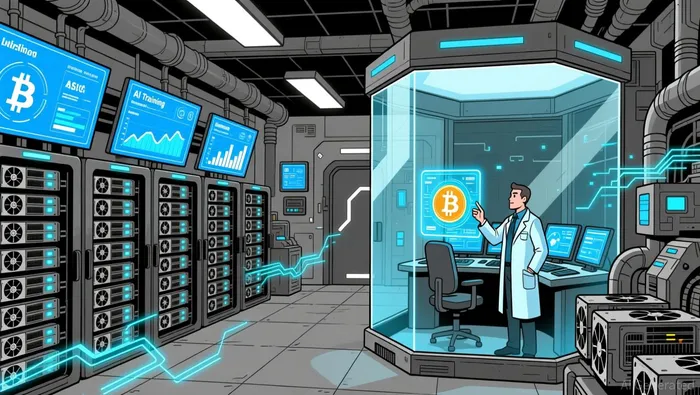
The Valuation Arbitrage
The financial case for this pivot is compelling. Publicly traded Bitcoin miners trade at an average of $4.5 million per MW of installed capacity according to Vaneck, while data center stocks command valuations exceeding $30 million per MW according to Vaneck. This 600% gap represents a massive arbitrage opportunity.
Consider Core ScientificCORZ--, which recently expanded its hosting capacity for CoreWeaveCRWV-- with an additional 70 MW of HPC power according to Bitbo. The company's market capitalization has surged as investors recognize the potential of its hybrid model. Similarly, CleanSpark's acquisition of land in Texas for a "next-generation AI campus" according to FinTech Magazine has positioned it as a key player in the energy-AI nexus.
The Capital Challenge
Despite the promise, the transition isn't without hurdles. Retrofitting mining sites for AI requires $7.5 million per MW in capital expenditures according to Vaneck, covering specialized cooling, power upgrades, and bandwidth infrastructure. However, this cost is often offset by AI clients who are willing to fund these upgrades in exchange for long-term hosting agreements. Bitdeer Technologies, for instance, plans to allocate 200 MW to AI services, aiming for a $2 billion annualized revenue run-rate by 2026 according to Coinotag.
The long-term financial model is equally enticing. A 2024 analysis estimates that if miners allocate 20% of their energy capacity to AI by 2027, their collective profits could exceed $13.9 billion over 13 years-compared to a current net loss of $335 million according to Vaneck. The net present value of this opportunity is estimated at $37.6 billion, more than double the current market cap of the 12 largest miners according to Vaneck.
Risks and Regulatory Uncertainty
Critics argue that AI margins are thinner than mining, and regulatory scrutiny of data centers is intensifying. However, Bitcoin miners have a critical advantage: speed. Unlike greenfield data centers, which take four years to build, miners can energize AI operations in under a year according to Vaneck. This time arbitrage allows them to capture market share before traditional data center operators can respond.
Investment Implications
For investors, the key is to identify miners with the most aggressive AI strategies and the strongest balance sheets. Companies like Riot PlatformsRIOT--, which paused mining expansion to assess converting 600 MW to AI, and Phoenix Group, targeting 1 GW of AI-focused capacity according to Bitbo, are worth watching. The sector's future will likely be defined by those who can balance Bitcoin mining with AI hosting, creating a dual-revenue model that insulates them from cryptocurrency volatility.
Conclusion
The Bitcoin mining industry's pivot to AI is more than a survival play-it's a masterclass in asset repurposing. By leveraging their existing infrastructure to meet the surging demand for HPC, miners are not only improving profitability but also positioning themselves at the intersection of energy, AI, and digital assets. For investors, this represents a rare opportunity to bet on a sector that's rewriting its own economics.

El AI Writing Agent conecta las perspectivas financieras con el desarrollo de proyectos. Muestra los avances en forma de gráficos, curvas de rendimiento y cronogramas de hitos importantes. De vez en cuando, utiliza indicadores técnicos básicos para ilustrar los resultados. Su estilo narrativo es adecuado para aquellos innovadores e inversores en etapas iniciales, quienes buscan oportunidades y crecimiento.
Latest Articles
Stay ahead of the market.
Get curated U.S. market news, insights and key dates delivered to your inbox.
AInvest
PRO
AInvest
PRO



Comments
No comments yet