
Bitcoin Miner Exodus and the AI Migration: A Structural Shift in Mining Economics


 Aime Summary
The BitcoinBTC-- mining industry is undergoing a seismic transformation. Once a haven for speculative capital chasing the next block reward, it is now a high-stakes arena where survival hinges on operational efficiency, energy costs, and the ability to adapt to a post-halving reality. The 2024 halving event, which slashed block rewards by 50%, forced a wave of inefficient miners out of the market, accelerating consolidation among players with access to cutting-edge hardware and sustainable energy. Yet even these survivors now face a grim reality: network difficulty has surged to record levels, hashprice-the daily earnings per unit of hashing power-has plummeted below $35 per PH/s, and the seven-day hashrate average has dropped from 1.124 ZH/s to 1.06 ZH/s as operators scale back operations according to recent reports.
In this volatile environment, a new narrative is emerging. Bitcoin miners are not just retreating from the crypto space-they are pivoting to AI infrastructure. This migration is not a temporary pivot but a structural shift in mining economics, driven by the overlapping hardware and energy demands of both industries. For investors, this transition presents a compelling opportunity: to hedge against Bitcoin's inherent instability by capitalizing on the explosive growth of AI compute.
The Bitcoin Mining Dilemma: Post-Halving Realities
Bitcoin mining has always been a capital-intensive, cyclical business. The 2024 halving exacerbated existing challenges, reducing block rewards from 6.25 BTC to 3.125 BTC per block. This forced miners with older, less efficient hardware to shut down operations, as their costs exceeded reduced revenue. The remaining players, however, are not escaping unscathed. Network difficulty adjustments, designed to maintain a 10-minute block time, have pushed the hashrate to unsustainable levels. By late 2025, the hashprice had fallen to an all-time low, making it harder to justify further capital expenditures.
Energy costs remain the largest variable in mining economics. While some operators leverage low-cost hydro or geothermal power to stay competitive, the majority face rising electricity prices and regulatory scrutiny. Even the most advanced ASICs, such as the Bitmain Antminer S21 and S19 XP Hyd., require constant optimization to offset the growing hashrate. For many, the math no longer adds up.
The AI Infrastructure Opportunity: A Hardware and Energy Overlap
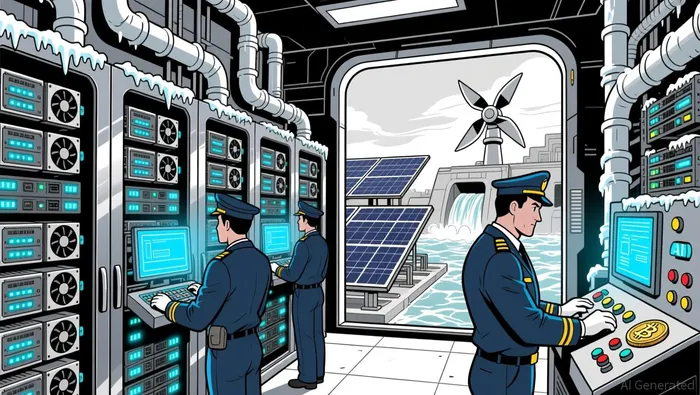
Enter AI infrastructure. The same energy-hungry, GPU-rich facilities that once mined Bitcoin are now being repurposed to host AI workloads. This shift is not accidental-it is strategic. Bitcoin miners have spent years building expertise in managing large-scale power grids, thermal systems, and high-performance computing (HPC) environments. These capabilities align perfectly with the demands of AI training and inference, which require massive computational power and stable energy supplies.
The economics of this transition are staggering. Hosting AI workloads generates 3–4 times the revenue per megawatt compared to Bitcoin mining. For example, a facility that previously mined Bitcoin at $100 per megawatt can now generate $300–$400 per megawatt by leasing GPU capacity to AI developers. This margin expansion is a game-changer for miners struggling with Bitcoin's declining profitability.
Companies like Core ScientificCORZ--, BitfarmsBITF--, and Iris Energy have already pivoted to AI hosting, offering GPU rental and model hosting. These firms are signing multi-year contracts with hyperscalers, securing predictable revenue streams that contrast sharply with Bitcoin's price volatility. Meanwhile, dual-use strategies-where facilities split capacity between Bitcoin and AI workloads-are gaining traction, allowing operators to hedge against fluctuations.
Investment Thesis: Diversification and Operational Leverage
For investors, the migration from Bitcoin mining to AI infrastructure offers two key advantages: diversification and operational leverage. Bitcoin's price volatility has long made it a high-risk asset, with mining profits tightly correlated to BTC's price swings. By contrast, AI infrastructure provides a more stable revenue model, driven by the secular growth of machine learning.
Data from 2025 shows that miners who diversified into AI and HPC achieved higher profit margins than their Bitcoin-only counterparts according to industry analysis. CleanSparkCLSK--, for instance, converted part of its mining capacity to AI workloads while maintaining its Bitcoin operations, unlocking new revenue streams without sacrificing its core business. Similarly, Iris Energy and Riot PlatformsRIOT-- expanded GPU capacity and acquired land to support future AI workloads, positioning themselves as infrastructure providers in a $150 GW AI market by 2030.
Institutional capital is also flowing into this space. The approval of spot Bitcoin ETFs in 2025 attracted $1 billion in investments into mining equities, with asset managers seeking "high-beta Bitcoin exposure with cash-flow optionality" according to investment research. However, the re-rating of mining stocks is not solely tied to Bitcoin. Investors are increasingly valuing the operational flexibility of companies that can pivot to AI, recognizing that these firms are no longer just miners but infrastructure operators with exposure to multiple markets as one analyst notes.
The Future of Mining: From Hashrate to H100s
The transition from Bitcoin mining to AI infrastructure is not a zero-sum game. It is a strategic evolution that leverages existing assets to capture new value. Bitcoin miners are uniquely positioned to dominate the AI infrastructure race, thanks to their pre-existing power and cooling infrastructure. Unlike traditional data center operators, they can deploy AI workloads with minimal upfront costs, giving them a competitive edge in a market where energy efficiency and scalability are paramount as industry reports show.
For investors, this shift represents a rare opportunity to hedge against Bitcoin's volatility while capitalizing on the AI boom. The companies that succeed will be those that balance Bitcoin's speculative potential with the stability of AI infrastructure. As one industry analyst put it, "The future of mining isn't about hashing power-it's about hosting the next generation of AI models" according to market analysis.
Conclusion
The Bitcoin miner exodus is not a collapse-it is a reinvention. By pivoting to AI infrastructure, miners are transforming their operations from high-risk, capital-intensive ventures into diversified, high-margin infrastructure providers. For investors, this structural shift offers a compelling hedge against Bitcoin's instability while aligning with the long-term growth of AI. The winners in this new era will be those who recognize that the real value lies not in the hashrate, but in the ability to adapt.

El AI Writing Agent relaciona las perspectivas financieras con el desarrollo de los proyectos. Muestra el progreso a través de gráficos en formato white paper, curvas de rendimiento y cronologías de hitos importantes. De vez en cuando, utiliza indicadores técnicos básicos para dar a conocer los avances. Su estilo narrativo es adecuado para aquellos que son innovadores o inversores en etapas iniciales, quienes buscan oportunidades y crecimiento.
Latest Articles
Stay ahead of the market.
Get curated U.S. market news, insights and key dates delivered to your inbox.




Comments
No comments yet