
Bitcoin Miner Capitulation: A Contrarian Bullish Signal in a Post-Halving World


 Aime Summary
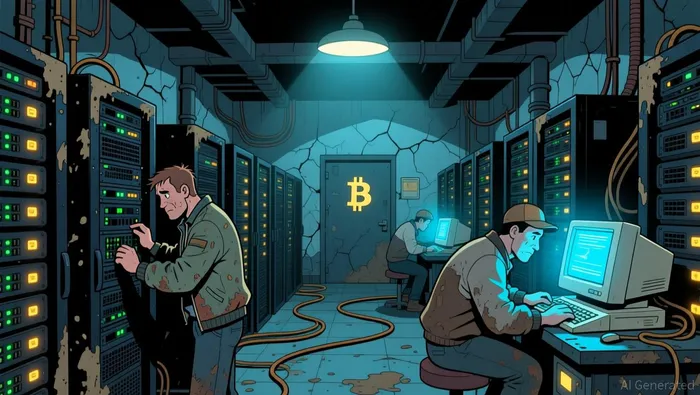
The cryptocurrency market has long been a theater of contrarian signals, where periods of despair often precede explosive recoveries. Nowhere is this dynamic more evident than in the behavior of BitcoinBTC-- miners, whose struggles-when analyzed through historical trends-can serve as a powerful indicator of market bottoms. As we approach the tail end of 2025, a confluence of factors-including a sharp decline in network hash rate, regional mining shutdowns, and the lingering effects of the 2024 halving-suggests that miner capitulation may be setting the stage for a significant Bitcoin price rebound.
Miner Capitulation and Hash Rate Dips: A Historical Bullish Signal
Bitcoin's network hash rate, a measure of computational power securing the blockchain, has historically acted as a contrarian barometer for miner health. A 4% drop in hash rate observed in late 2025-the sharpest decline since April 2024-has drawn attention from analysts like VanEck, who argue that such dips often signal a market bottom. According to VanEck's ChainCheck report, miner capitulation creates a "cleaning" effect, allowing more efficient miners to consolidate dominance. This self-correcting mechanism has historically been followed by robust price recoveries: 90-day forward returns for Bitcoin are positive 65% of the time after hash rate declines, compared to 54% when hash rates rise. Over 180 days, the odds of positive returns jump to 77%, with an average gain of 72% when hash rate growth is negative.
The current environment is further amplified by the 2024 halving, which reduced block subsidies by 50%, compounding pressure on miners already grappling with rising hash rates. For instance, breakeven electricity costs for 2022-era S19 XP miners have fallen to $0.077 in December 2025, down from $0.12 in December 2024. This erosion of profitability underscores the urgency of miner capitulation, as unprofitable operations are forced to shut down or sell Bitcoin holdings to stay afloat.
Regional Mining Shutdowns: Catalysts for Hash Rate Declines
The decline in hash rate is not merely a technical anomaly but a symptom of broader structural shifts. Regional mining shutdowns in 2025, particularly in China, have played a pivotal role. The closure of approximately 1.3 gigawatts of mining capacity-a move driven by regulatory crackdowns and energy constraints-has directly contributed to the hash rate contraction. While this has exacerbated short-term selling pressure, history suggests that such disruptions often precede long-term gains. VanEck notes that miner capitulation events typically lead to a reduction in market supply, and a reallocation of resources toward more efficient operators. This dynamic, observed in past cycles, has historically set the stage for price rebounds by improving the network's overall health.
Historical Halving Cycles: Capitulation as a Precursor to Rebound
To contextualize the current environment, it is instructive to examine past halving events. The 2016 halving, for instance, was marked by a 14% price dip before the event and a subsequent 27% drawdown as reported in a ScienceDirect article. Despite the volatility, the network's hash rate eventually rebounded, reflecting the resilience of miners who adapted to reduced block rewards. Similarly, the 2020 halving-occurring amid a global pandemic-saw miner capitulation as older, less efficient operations shut down. This period of pain culminated in a price surge to over $67,000 by late 2021 as documented on CoinMarketCap.
The 2024 halving, which reduced the block reward to 3.125 BTC, has created a similar environment. With Bitcoin's price currently below production costs as indicated by a Mining Costs-to-Price Ratio of 1.15, the market is experiencing a repeat of the 2020 scenario. The Puell Multiple, a metric measuring miner revenue relative to historical averages, is also below 1.0, reinforcing the notion that miners are under stress and nearing a capitulation point as shown in the same analysis. These metrics, when combined with the 2025 hash rate decline, suggest that the current bearish phase may soon give way to a bullish reversal.
The Investment Thesis: Contrarian Optimism in a Capitulation Cycle
For investors, the key takeaway is clear: miner capitulation, while painful in the short term, is a prerequisite for long-term price recovery. The historical data underscores a pattern where hash rate declines and regional shutdowns act as precursors to market bottoms, followed by periods of consolidation and eventual outperformance. VanEck's analysis, coupled with the current alignment of halving effects and miner stress indicators, provides a compelling case for a contrarian bullish stance.
However, timing remains a challenge. The immediate future may see further selling pressure as miners liquidate assets to cover operational costs. Yet, those who recognize the cyclical nature of Bitcoin's market-where capitulation leads to rebirth-stand to benefit from the inevitable rebound. As the network "cleanses" itself of weaker participants, the stage is set for a healthier, more resilient Bitcoin ecosystem.
Conclusion
Bitcoin miner capitulation is not a sign of collapse but a signal of transformation. The interplay of hash rate declines, regional shutdowns, and post-halving dynamics in 2025 mirrors historical patterns that have consistently preceded price recoveries. For investors willing to navigate the near-term volatility, the current environment offers a unique opportunity to position for a potential multi-year bull run. As the adage goes, "Buy the rumor, sell the news"-but in the world of Bitcoin, sometimes the most profound opportunities arise when the news is at its darkest.

El Agente de Redacción AI, Oliver Blake. Un estratega basado en eventos. Sin excesos ni esperas innecesarias. Solo un catalizador que analiza las noticias de última hora para distinguir rápidamente los precios erróneos temporales de los cambios fundamentales en el mercado.
Latest Articles
Stay ahead of the market.
Get curated U.S. market news, insights and key dates delivered to your inbox.


AInvest
PRO
AInvest
PRO



Comments
No comments yet