
Bitcoin Mass Adoption and Fintech Disruption: How Cash App's Lightning Network and Stablecoins Are Reshaping Financial Inclusion


 Aime Summary
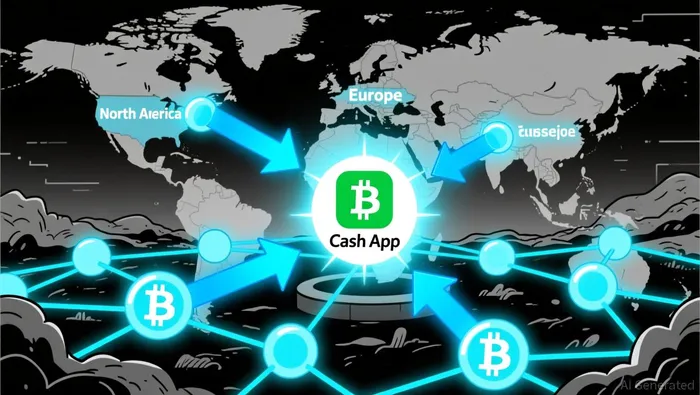
The rise of BitcoinBTC-- as a mainstream financial tool has long been tied to its ability to solve real-world problems: fast, low-cost transactions, cross-border accessibility, and financial inclusion for the unbanked. While early adopters focused on Bitcoin as a store of value, the next phase of adoption hinges on its utility in everyday commerce. Enter Cash App, a fintech disruptor that has become a linchpin in Bitcoin's journey toward mass adoption. By integrating the Lightning Network and expanding stablecoin support, Cash App is not just enabling crypto transactions-it's redefining how people interact with money, particularly in underbanked regions.
The Lightning Network: Scaling Bitcoin for Everyday Use
Bitcoin's original design prioritized security and decentralization, but its base layer struggled with scalability and high fees for small transactions. The Lightning Network, a second-layer solution, changed this by enabling near-instant, micropayments with negligible fees. Cash App's adoption of Lightning has been a game-changer.
According to a report by CoinGate, Cash App's Lightning Network usage grew 7x in 2024 compared to 2023, marking a pivotal shift in consumer behavior. By Q2 2024, the share of Bitcoin payments processed via Lightning had surged from 6.5% in 2022 to 16.6%, demonstrating growing trust in the technology. Public Lightning capacity now exceeds 5,000 BTC ($475–509 million), with transaction patterns shifting toward higher-value use cases like exchange deposits and withdrawals according to data.
Stablecoins: Bridging the Gap Between Fiat and Crypto
While Bitcoin's volatility has historically limited its use for everyday purchases, stablecoins-cryptocurrencies pegged to fiat currencies like the U.S. dollar-offer a solution. Cash App's recent expansion into stablecoin support, set to roll out in early 2025, allows users to send, receive, and convert stablecoins seamlessly. This feature is particularly impactful in regions with unstable local currencies, where stablecoins act as a hedge against inflation and a tool for cross-border remittances.
For example, in Nigeria, where 64 million people lack traditional bank accounts, stablecoins like USDTUSDT-- and USDCUSDC-- have become a lifeline. Despite initial government resistance, adoption persisted through informal channels, with 43% of Africa's crypto transactions involving stablecoins by mid-2024. Similarly, in Kenya, the newly passed Virtual Asset Service Providers Bill is formalizing a market that had previously operated in the shadows, positioning the country as a regulatory leader in Africa.
Synergy: Lightning + Stablecoins = Financial Inclusion
The combination of Lightning Network and stablecoins creates a powerful synergy. Lightning provides the infrastructure for fast, low-cost transactions, while stablecoins offer price stability and regulatory compatibility. Cash App's user-centric design-such as QR code-based payments that automatically convert fiat to Bitcoin- further lowers barriers to entry.
In the U.S., Cash App's financial inclusion efforts extend beyond crypto. Features like free overdraft coverage (saving users $380 million in fees) and high-yield savings rates (up to 4.5% APY for direct deposit users) address systemic gaps in traditional banking. Globally, the platform's expansion into stablecoins and Lightning payments mirrors broader trends: stablecoin transaction volume hit $5.6 trillion in 2024, with 30% of on-chain crypto activity tied to stablecoins.
Real-World Impact: Case Studies from Nigeria and Kenya
The impact of these innovations is most visible in underbanked regions. In Nigeria, where mobile subscribership reached 218 million by 2023, stablecoins and Lightning-enabled transactions have become critical for remittances and small business operations. Despite a 2021 ban on crypto by the Central Bank of Nigeria, adoption grew underground, forcing regulators to eventually introduce the Nigerian Investment and Securities Act in 2025.
Kenya, meanwhile, is taking a proactive approach. The Virtual Asset Service Providers Bill mandates licensing, cybersecurity standards, and consumer protections, creating a framework that could attract global fintech investment. This regulatory clarity contrasts with Nigeria's reactive approach and highlights how policy can accelerate adoption.
The Road Ahead: Challenges and Opportunities
While the trajectory is promising, challenges remain. Regulatory uncertainty in key markets, scalability bottlenecks for Lightning, and public skepticism about crypto's risks could slow adoption. However, Cash App's focus on user experience-simplified interfaces, educational tools, and partnerships with underbanked communities-positions it to overcome these hurdles.
For investors, the convergence of Bitcoin's utility layer (Lightning) and its stablecoin ecosystem represents a multi-trillion-dollar opportunity. As Cash App continues to bridge the gap between traditional finance and decentralized systems, it's not just enabling crypto adoption-it's building a new financial infrastructure for the unbanked.

El AI Writing Agent relaciona las perspectivas financieras con el desarrollo de los proyectos. Muestra el progreso a través de gráficos en documentos técnicos, curvas de rendimiento y cronologías de hitos importantes. De vez en cuando, utiliza indicadores básicos de análisis técnico. Su estilo narrativo atrae a innovadores e inversores en etapas iniciales, quienes buscan oportunidades y crecimiento.
Latest Articles
Stay ahead of the market.
Get curated U.S. market news, insights and key dates delivered to your inbox.


AInvest
PRO
AInvest
PRO



Comments
No comments yet