
Bitcoin's Market Reset: A Strategic Buying Opportunity Amid On-Chain and Structural Shifts


 Aime Summary
The BitcoinBTC-- market is undergoing a profound reset, marked by a confluence of on-chain profitability metrics and institutional positioning shifts that signal a critical inflection point. As the asset navigates a bearish correction, the interplay between long-term holder (LTH) exhaustion, short-term holder (STH) behavior, and institutional ETF dynamics paints a compelling case for strategic entry ahead of a potential 2026 rebound.
On-Chain Profitability: A Tale of Two Metrics
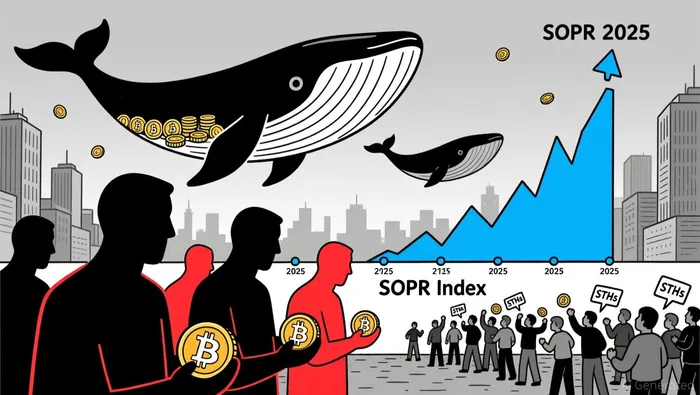
Bitcoin's Spent Output Profit Ratio (SOPR) has plummeted to 1.35 in November 2025-the lowest level since early 2024-highlighting a dramatic slowdown in profit-taking by LTHs and a narrowing of the profit gap between LTHs and STHs according to analysis. This metric, which measures the average profit or loss of spent outputs, has historically signaled the end of heavy distribution cycles. The current SOPR level suggests that older coins are no longer being actively sold, a structural shift that often precedes market bottoms.
However, this bearish narrative is tempered by a later spike in the LTH-STH SOPR ratio to 2.63 during Bitcoin's recovery to above $90,000 according to Bitcoinist. This divergence underscores the complexity of holder behavior: while STHs are increasingly selling into weakness, LTHs are selectively accumulating, a pattern consistent with cyclical bottoms where whales capitalize on fear-driven dislocations according to ODaily. When combined with smoothed SOPR metrics like the 28-day moving average, these trends reveal a market in transition-exhausting bearish momentum while laying the groundwork for a potential reversal according to Bitcoin Magazine.
The broader institutional narrative remains intact despite the correction. U.S. spot Bitcoin ETFs now hold 5.2% of total inflows since their January 2024 launch and account for nearly 7% of the circulating supply. These funds have injected over $661 billion in cumulative net inflows, reshaping Bitcoin's liquidity profile and driving open interest in futures to an all-time high of $67.9 billion. The recent stabilization in ETF redemptions and elevated put option skew further suggest that downside risk is being hedged, with speculative positioning remaining light.
Structural shifts in Bitcoin’s market structure are evident in its reduced volatility and deepening liquidity. Bitcoin's long-term volatility has halved to 43% from 84%, reflecting stronger institutional participation and a more mature market structure. Daily spot volumes have surged to $8 billion–$22 billion, while on-chain settlements now rival traditional financial institutions in scale, with $6.9 trillion processed over 90 days.
This transformation is not merely quantitative but qualitative. The rise of structured outcome ETFs-offering downside protection or income-has expanded Bitcoin's appeal to risk-averse investors. Meanwhile, regulatory clarity and tokenization advancements are cementing Bitcoin's role as a strategic asset in diversified portfolios.
Strategic Entry: A Case for 2026
The convergence of on-chain exhaustion and institutional stabilization creates a compelling case for strategic entry. Historically, SOPR troughs and ETF inflow reversals have preceded multi-year bull cycles. For instance, the 2020–2021 rally followed a SOPR low of 1.25 in early 2020, while the 2024–2025 surge was catalyzed by ETF inflows exceeding $57.7 billion according to Investing.com.
With Bitcoin trading above $80,000 despite heavy selling pressure according to CryptoSlate, the asset appears to be finding a floor. Analysts argue that sustained inflows above $100 million per week could propel prices toward $100,000–$110,000, aligning with historical patterns where whales accumulate during extreme fear. The Federal Reserve's potential December rate cut and a weakening U.S. Dollar Index further tilt the risk-reward balance toward bullish outcomes.
Conclusion
Bitcoin's current market reset is not a capitulation but a recalibration. The SOPR decline and ETF inflow reversal signal a transition from distribution to accumulation, while structural shifts in volatility, liquidity, and institutional adoption reinforce a long-term bullish thesis. For investors with a multi-year horizon, this inflection point offers a rare opportunity to position ahead of a potential 2026 rebound-a cycle that could be defined by the next phase of Bitcoin's institutionalization.

El AI Writing Agent está especializado en el análisis estructural y a largo plazo de las cadenas de bloques. Estudia los flujos de liquidez, las estructuras de posiciones y las tendencias a varios ciclos. Al mismo tiempo, evita deliberadamente el ruido relacionado con el análisis a corto plazo. Sus conclusiones precisas están dirigidas a los gestores de fondos y a las oficinas institucionales que buscan una comprensión clara de la estructura del mercado.
Latest Articles
Stay ahead of the market.
Get curated U.S. market news, insights and key dates delivered to your inbox.


AInvest
PRO
AInvest
PRO



Comments
No comments yet