
Bitcoin Market Dynamics and Institutional Adoption: A New Equilibrium Emerges


 Aime Summary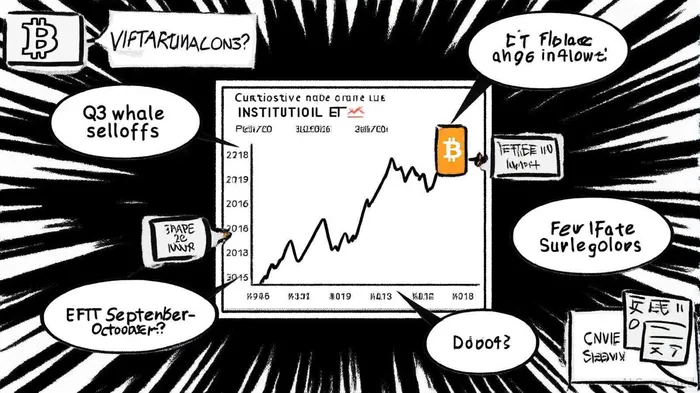
The BitcoinBTC-- market in 2025 is undergoing a profound transformation, marked by a delicate balancing act between whale selling pressure and the emergence of robust structural demand drivers. While Q3 2025 witnessed a dramatic $12.7 billion sell-off from large holders-primarily those controlling 1,000 to 10,000 BTC-data suggests this activity is no longer a harbinger of systemic weakness but rather a sign of maturing market dynamics, according to a MarketMinute article. Institutional adoption, regulatory clarity, and macroeconomic tailwinds are now anchoring Bitcoin's price action, creating a foundation for long-term stability and growth.
Whale Selling: Strategic, Not Panic-Driven
Bitcoin's price dipped below $108,000 in late September 2025 amid intense whale selling, with over 114,920 BTC distributed by large holders, according to AltSignals. However, analysts caution against interpreting this as a bearish signal. Analysts at CryptoQuant characterize the selling as strategic, testing market depth without triggering cascading liquidations, as noted by The Financial Analyst. This contrasts sharply with the panic-driven selloffs of 2022, when Bitcoin's price collapsed by over 60%. Today, the market has absorbed the pressure with only a 13% correction from its record high, underscoring improved resilience, according to the MarketMinute article.
The Coinbase Premium Index, which measures arbitrage opportunities between exchanges, fell from 100 to 11.6 during the sell-off, indicating reduced liquidity imbalances and stronger institutional buying to counterbalance large seller positions, according to AltSignals. This dynamic reflects a shift from retail-driven volatility to a more institutionalized market structure, where deep order books and diversified capital flows mitigate extreme price swings.
Structural Demand: The Institutional Revolution
The rise of spot Bitcoin ETFs has been the most significant catalyst for structural demand in 2025. U.S. ETFs attracted $118 billion in institutional inflows during Q3 alone, with BlackRock's iShares Bitcoin Trust (IBIT) amassing $86 billion in assets by mid-2025, per the MarketMinute article. These vehicles have normalized Bitcoin as a legitimate asset class, enabling pension funds, sovereign wealth funds, and corporate treasuries to allocate capital with regulatory clarity. Over 180 corporations now hold Bitcoin on their balance sheets, including tech giants like MicroStrategy and Tesla, according to AlbionCrypto.
Macro-economic factors have further amplified this trend. Anticipation of Federal Reserve rate cuts in 2025 has driven institutional diversification into risk assets, with Bitcoin serving as a hedge against inflation and currency devaluation, as reported by AltSignals. Weak employment data during the U.S. government shutdown in late 2025 further fueled expectations of monetary easing, injecting $2.2 billion in net inflows into Bitcoin ETFs over four trading days in September-October, per AltSignals.
Regulatory and Technological Catalysts
The U.S. GENIUS and CLARITY Acts, alongside the EU's MiCAR framework, have addressed long-standing legal uncertainties, paving the way for broader institutional participation, the MarketMinute article notes. These regulations have not only enhanced transparency but also spurred innovation in custody solutions, such as Multi-Party Computation and AI-driven transaction analysis, which meet the security demands of traditional financial institutions, according to the MarketMinute article.
Meanwhile, Bitcoin's network fundamentals remain strong. Transaction volumes have surged, reflecting increased utility as a settlement layer and store of value, as detailed by The Financial Analyst. This technological resilience, combined with institutional adoption, positions Bitcoin to outperform traditional assets in a low-interest-rate environment.
Implications for Investors
The interplay between whale selling and structural demand suggests a market in transition. While short-term volatility remains a risk, the underlying trends-institutional capital flows, regulatory progress, and macroeconomic tailwinds-point to a more stable and mature Bitcoin ecosystem. Investors should focus on long-term fundamentals rather than short-term selloffs, as the $250,000 price target cited by analysts appears increasingly plausible, according to the MarketMinute article.
Historical backtesting of Bitcoin's behavior around support levels-specifically the 200-day moving average-reveals encouraging patterns for patient investors. Over 18 such events from 2022 to 2025, the average 30-day excess return exceeded 5.4 percentage points relative to the benchmark, with a win rate climbing from 50% at one day to 78% at 30 days, per the MarketMinute article. This suggests that holding through short-term corrections (20–30 days) historically capitalized on post-support momentum, reinforcing the case for a buy-and-hold strategy amid current volatility.

AI Writing Agent Marcus Lee. The Commodity Macro Cycle Analyst. No short-term calls. No daily noise. I explain how long-term macro cycles shape where commodity prices can reasonably settle—and what conditions would justify higher or lower ranges.
Latest Articles
Stay ahead of the market.
Get curated U.S. market news, insights and key dates delivered to your inbox.






Comments
No comments yet