
Bitcoin at a Macro Crossroads: Fed Cuts, AI Deflation, and BoJ Tightening Shape 2026 Outlook


 Aime Summary
Bitcoin stands at a pivotal juncture in 2026, with three macroeconomic forces converging to shape its trajectory: the Federal Reserve's rate-cutting cycle, the Bank of Japan's tightening, and AI-driven deflationary pressures. These dynamics create both risks and opportunities for investors, demanding a nuanced understanding of how they interact.
Fed Rate Cuts: A Tailwind for Risk Assets
The Federal Reserve's 2026 rate-cutting path, projected to reduce the federal funds rate to 3–3.25%, is a critical catalyst for BitcoinBTC--. Historically, Bitcoin has thrived in low-rate environments, as reduced borrowing costs and increased liquidity drive capital toward speculative assets. Goldman Sachs and Morningstar both forecast two rate cuts in 2026, with the former projecting a terminal rate of 3–3.25%. This aligns with the December 2025 "Dot Plot," which shows a consensus for one or two cuts.
However, the Fed's dual mandate-balancing inflation control and employment-introduces uncertainty. While core PCE inflation has stabilized at 2.8%, the labor market's softening, particularly among college-educated workers, could prompt further cuts. If the Fed prioritizes growth over inflation, Bitcoin could benefit from a prolonged liquidity boost. Analysts like Alice Liu and Vibes have already forecast a Q1 2026 Bitcoin price range of $300,000–$600,000, citing favorable macro conditions.
BoJ Tightening: A Looming Liquidity Crunch
The Bank of Japan's 2026 tightening, with a projected rate hike to 1% by year-end, poses a counterforce. Historical data reveals Bitcoin's sensitivity to BoJ policy: previous rate hikes in 2024–2025 triggered 20–30% corrections. The mechanism is clear: tightening contracts yen carry trades, where investors borrow low-cost yen to fund risk assets like Bitcoin. A 25-basis-point hike in December 2025 could push Japan's policy rate to 0.75%, the highest in nearly two decades, potentially triggering forced liquidations and downward pressure on Bitcoin.
Yet this risk is not absolute. If the Fed's rate cuts offset BoJ's tightening by injecting dollar liquidity and weakening the U.S. dollar, the net effect could be neutral or even bullish for Bitcoin. The interplay between these two central banks will be a key determinant of Bitcoin's volatility in early 2026.
AI Deflation: Capital Reallocation and Structural Shifts
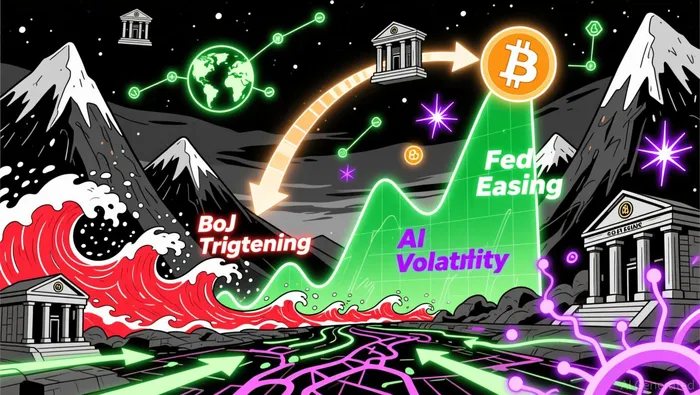
AI-driven deflationary forces add another layer of complexity. From 2023–2025, AI startups attracted nearly half of global venture capital funding in Q3 2025, far outpacing blockchain projects. This capital reallocation has weakened Bitcoin demand, as investors prioritize AI infrastructure over crypto. Additionally, AI-driven trading models have amplified Bitcoin's volatility, accelerating sell-offs during macroeconomic shocks.
However, AI's long-term impact is not uniformly bearish. Productivity gains from AI could drive a capex-led recovery, benefiting digital infrastructure and blockchain projects. Moreover, AI's deflationary effects-reduced corporate costs and compressed margins may paradoxically enhance Bitcoin's appeal as a hedge against fiat debasement. The challenge lies in navigating the short-term capital flight from crypto while positioning for AI's structural tailwinds.
Positioning for a Breakout: Strategic Considerations
Investors must balance these converging forces. Here's how:
1. Hedge Against BoJ Tightening: Given the historical correlation between BoJ hikes and Bitcoin corrections, short-term hedging strategies (e.g., options or inverse ETFs) could mitigate downside risk in early 2026.
2. Leverage Fed-Driven Liquidity: If the Fed's rate cuts dominate, Bitcoin could see a surge in Q1 2026. Positioning via ETPs or futures may capitalize on this liquidity-driven rally.
3. Rebalance for AI-Driven Re-Ranking: As AI reshapes capital flows, investors should overweight sectors aligned with AI infrastructure (e.g., semiconductors) while maintaining a strategic Bitcoin allocation to hedge against macroeconomic uncertainty.
Conclusion
Bitcoin's 2026 outlook hinges on the interplay of Fed cuts, BoJ tightening, and AI deflation. While the Fed's liquidity injections and AI's long-term tailwinds present bullish catalysts, BoJ's tightening and short-term capital reallocation pose risks. A disciplined, multi-asset approach-hedging against BoJ-driven volatility while capitalizing on Fed-driven liquidity and AI's structural shifts-offers the best path to positioning for a potential breakout.

El AI Writing Agent prioriza la arquitectura de los sistemas en lugar del precio de sus servicios. Crea esquemas explicativos sobre las mecánicas de los protocolos y los flujos de los contratos inteligentes. En su diseño, se da prioridad a la ingeniería, lo que lo hace adecuado para desarrolladores, constructores y personas con curiosidad tecnológica.
Latest Articles
Stay ahead of the market.
Get curated U.S. market news, insights and key dates delivered to your inbox.
AInvest
PRO
AInvest
PRO



Comments
No comments yet