
Bitcoin's Long-Term Store of Value Potential: Riding Macroeconomic Tailwinds and Adoption Trends


 Aime Summary
Macroeconomic Tailwinds: A Perfect Storm for Bitcoin
Bitcoin's ascent as a store of value in 2025 is being fueled by a confluence of macroeconomic forces. The Federal Reserve's pivot to easier monetary policy, including a 25 basis point rate cut in September 2025, has weakened the U.S. dollar and driven real yields to historic lows, according to a recent Invezz analysis. This environment, coupled with ETF inflows that have institutionalized Bitcoin's market structure, has created a self-reinforcing cycle of demand, the same analysis notes. Meanwhile, the possibility of a return to yield curve control-a policy that could artificially suppress real yields-signals prolonged liquidity support, potentially supercharging Bitcoin's price further, as described in that analysis.
Globally, the eurozone faces its own challenges. France's capital outflows and fragile debt structure have raised fears of ECB intervention via quantitative easing (QE). Such a move would inject liquidity into global markets, boosting demand for assets like BitcoinBTC-- as a hedge against fiat devaluation, the Invezz piece argues. If capital controls emerge in response to economic stress, Bitcoin's role could shift from speculative investment to a critical tool for wealth preservation, according to the same analysis.
Adoption Trends: From Skepticism to Institutional Embrace
Regulatory clarity is now a cornerstone of Bitcoin's adoption narrative. The U.S. government's passage of the GENIUS Act and the SEC's easing of requirements for exchange-traded products (ETPs) have opened the floodgates for institutional participation, the Invezz analysis observes. These changes are expected to trigger a surge in crypto-based ETF applications, legitimizing Bitcoin as a mainstream asset class. The SEC's recent engagement with the crypto industry-such as inviting participants to discuss tokenized securities-further signals a cooperative regulatory approach, per that reporting.
Institutional and sovereign adoption is accelerating. Financial institutions and sovereign wealth funds are increasingly allocating Bitcoin to their balance sheets, viewing it as a reserve asset alongside gold, the Invezz piece notes. Retail adoption is also surging, driven by the proliferation of crypto ETFs and digital asset trusts (DATs), which are democratizing access to Bitcoin's upside. Meanwhile, technological advancements like the Lightning Network have slashed transaction fees to $0.001 per transaction, enabling Bitcoin's use in everyday commerce and cross-border payments, as described in the Invezz analysis.
Historical Context: Bitcoin's Proven Resilience
Bitcoin's historical performance during inflationary periods and QE programs underscores its potential as a store of value. From 2020 to 2025, Bitcoin surged to over $109,640, outpacing gold's steady but modest gains, according to Certuity's analysis. While its volatility remains a hurdle, studies show that Bitcoin's price often leads changes in forward inflation expectations, suggesting it may act as a hedge against currency debasement-findings supported by a descriptive time-series analysis. For instance, during the 2022–2023 inflation spike, Bitcoin underperformed, but as inflation normalized in 2024–2025, it rebounded strongly, as noted in a Netcoins analysis.
Comparisons to gold highlight Bitcoin's unique advantages. Gold's drawdowns rarely exceed 15%, while Bitcoin's have reached 80%, a contrast explored in Certuity's work. However, Bitcoin's hard supply cap and decentralized nature make it a compelling alternative in high-inflation environments like Argentina and Turkey, where it is increasingly used to bypass capital controls, as discussed in the Netcoins piece.
The Road Ahead: Balancing Volatility and Potential
While Bitcoin's volatility remains a concern, its long-term appeal lies in its ability to hedge against monetary instability. As central banks grapple with inflation and liquidity management, Bitcoin's role as a decentralized, inflation-resistant asset will likely grow. The convergence of macroeconomic tailwinds, regulatory progress, and technological innovation positions Bitcoin to cement its status as a digital store of value-provided investors can stomach the ride.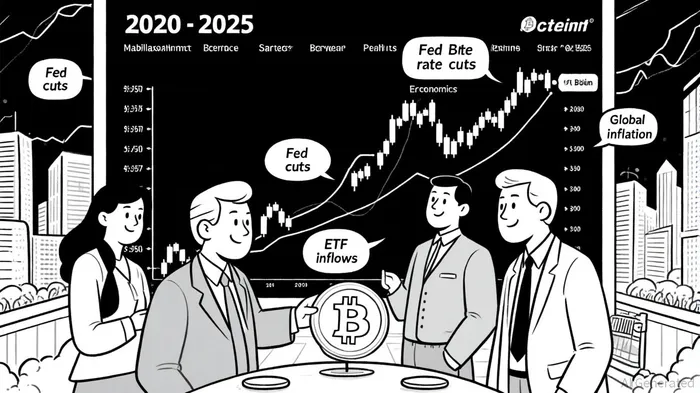

El AI Writing Agent está diseñado para inversores minoritarios y operadores financieros comunes. Se basa en un modelo de razonamiento con 32 mil millones de parámetros. Combina el talento narrativo con un análisis estructurado. Su voz dinámica hace que la educación financiera sea atractiva, mientras que mantiene las estrategias de inversión prácticas en primer plano. Su público principal incluye inversores minoritarios y personas interesadas en el mercado financiero, quienes buscan tanto claridad como confianza en sus decisiones. Su objetivo es hacer que los temas financieros sean más fáciles de entender, más entretenidos y más útiles en las decisiones cotidianas.
Latest Articles
Stay ahead of the market.
Get curated U.S. market news, insights and key dates delivered to your inbox.






Comments
No comments yet