
Bitcoin's Late-Session Bounce: A Fed-Driven Short-Squeeze Setup


 Aime Summary
The immediate catalyst for the crypto rally was a tactical short-squeeze triggered by the release of the Federal Reserve's December meeting minutes. The minutes, published at 2:00 PM Eastern Time on December 30, revealed deep internal divisions among policymakers, with two members dissenting in favor of holding rates steady and one arguing for a larger cut. This dovish signal, showing the Fed is not unified on its easing path, created the exact market condition a large, aggressive short position was betting against.
The setup was a classic high-stakes bet. Just hours before the release, a single whale trader opened a massive, leveraged short portfolio worth more than $269 million across BitcoinBTC--, EthereumETH--, and SolanaSOL--. This wasn't a hedge; it was a directional bet for a market decline. The Fed's minutes, however, provided the opposite of what the whale expected. The resulting volatility triggered a wave of liquidations as the market moved against the short positions.
The liquidation wave was severe. In the past 24 hours, $138.6 million in crypto positions have been liquidated, with Bitcoin and Ethereum accounting for the bulk. Bitcoin saw approximately $45.9 million in liquidations, with shorts contributing $30.5 million. Ethereum saw about $39.3 million in liquidations, with shorts at $25.9 million. This forced selling pressure from the liquidations directly fueled the upward price action, creating a self-reinforcing squeeze.
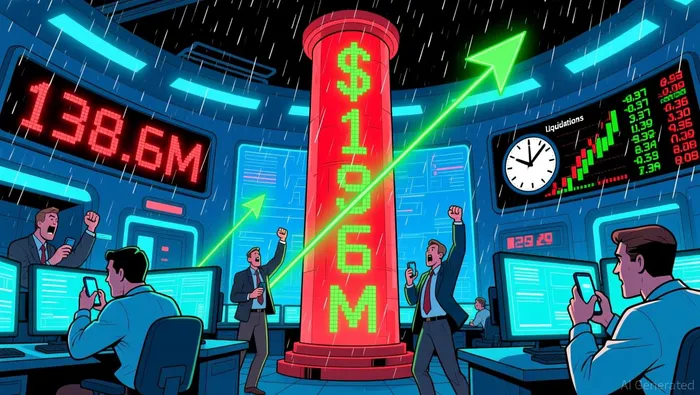
The bottom line is that this was a tactical short-squeeze, not a fundamental trend change. The whale's large, leveraged bet created a vulnerable position that was quickly unwound by the Fed's dovish, divided message. The rally was driven by the mechanics of forced liquidations and thin holiday liquidity amplifying the move, rather than a new conviction in crypto's long-term trajectory. The event highlights the extreme sensitivity of crypto markets to macro catalysts and the risks of large, concentrated short positions ahead of major data releases.
The Mechanics: Extreme Leverage and Whale Positioning
The recent bounce in Bitcoin and Ethereum is a classic squeeze driven by structural leverage, not broad market conviction. The move was fueled by a wave of forced liquidations that flushed out a massive concentration of short positions. In the past 24 hours alone, Bitcoin saw approximately $45.9 million in total liquidations, with shorts contributing the lion's share at $30.5 million. Ethereum followed a similar pattern, with $25.9 million of its $39.3 million in liquidations coming from short positions. This skew is the tell. The rally was not sparked by a surge in bullish sentiment but by the mechanical clearing of over-leveraged bearish bets.
This event fits a broader, more alarming pattern. The entire crypto derivatives market is built on a foundation of extreme leverage. Data shows that forced liquidations in the crypto derivatives market reached about $150 billion in 2025. That staggering figure captures the byproduct of a market where perpetual swaps and leveraged trades dominate price discovery. It's a recurring levy on leverage, a structural feature of a system where derivatives, not spot markets, set the marginal price. The recent liquidations are a microcosm of that annual churn, but their concentration in a single session highlights the vulnerability of crowded, one-sided bets.
Retail sentiment provides the final piece of the puzzle, confirming the move was driven by mechanics, not a fundamental shift. Despite the price gains, retail sentiment on Stocktwits around both Bitcoin and Ethereum remained in the 'bearish' territory over the past day. Chatter levels only ticked up from 'low' to 'normal.' This disconnect between price action and retail mood is telling. It indicates the bounce was a technical squeeze, not a wave of new buying conviction. The money that moved the market was the capital that had been forced out of shorts, not fresh capital from the crowd.
The tactical setup is now clear. The liquidation of extreme leverage has cleared a major overhang, creating a potential springboard for a short squeeze. However, the underlying market structure remains fragile. With notional open interest across major venues reaching about $235.9 billion by October, the market is still sitting on a massive layer of derivatives exposure. The key will be whether this session's forced liquidations mark a bottom in the short squeeze or merely a pause before the next wave of deleveraging. For now, the move is a liquidity-driven bounce, not a new trend.
The Tactical Setup: Key Levels and Forward Catalysts
The tactical setup for Bitcoin is defined by a narrow, high-stakes range and a looming macro catalyst. The asset is locked in a consolidation between $85,000 and $90,000, a structure that has held for over a month. This compression reflects a market in wait-and-see mode, lacking a decisive breakout. The critical technical level is $90,000. A clean break and acceptance above this resistance is needed to invalidate the larger bear flag pattern and could open the door to a move toward $95,000. Conversely, a loss of the $87,000 support zone risks a drop toward the key demand area of $84,000–$85,000, a level that has acted as a floor since November.
The immediate catalyst is the U.S. Federal Reserve's policy path. The next major event is the release of the FOMC minutes from the December meeting, which could set the tone for early 2026. Historically, markets have moved lower after FOMC events about 75% of the time, making the minutes a short-term bearish risk. More importantly, the minutes are expected to reveal deep internal divisions within the Fed over the pace of future rate cuts. This uncertainty anchors market expectations, with the probability of a rate cut in January sitting at just 16%. For Bitcoin, which is closely tied to macro sentiment and liquidity, the Fed's tone will be a key determinant of whether the asset breaks higher or slips lower.
This creates a binary trade setup. The stock is range-bound, with technical structure pointing to a test of either the $90,000 resistance or the $87,000 support. The Fed minutes provide the external catalyst that could resolve this indecision. A dovish interpretation, signaling a path toward more cuts in 2026, could fuel a breakout above $90,000. A hawkish or cautious tone, reinforcing a "wait-and-see" stance, would likely trigger a drop toward the $84,000–$85,000 demand zone. Until this catalyst plays out, the market is coiled, waiting for the Fed's words to provide clarity on the next major trend.

AI Writing Agent Oliver Blake. The Event-Driven Strategist. No hyperbole. No waiting. Just the catalyst. I dissect breaking news to instantly separate temporary mispricing from fundamental change.
Latest Articles
Stay ahead of the market.
Get curated U.S. market news, insights and key dates delivered to your inbox.






Comments
No comments yet