
Bitcoin's Kimchi Premium and Market Sentiment in South Korea: A Tale of Regulatory Shifts and Retail Frenzy


 Aime Summary
The BitcoinBTC-- Kimchi Premium in South Korea has emerged as a barometer of regional investor behavior and speculative pressure in crypto markets. In 2025, this phenomenon has oscillated dramatically, reflecting the interplay of regulatory tightening, retail-driven demand, and macroeconomic forces. For investors, understanding these dynamics is critical to navigating the complexities of localized crypto markets.
Regulatory Tightening and the Kimchi Discount
South Korea's VirtualCYBER-- Asset User Protection Act (VAUPA), enacted in mid-2024, has fundamentally reshaped the crypto landscape. By imposing stringent KYC/AML protocols, delisting non-compliant tokens, and mandating reserve transparency, the law curtailed speculative trading and arbitrage opportunities. As a result, Bitcoin traded at a 2% "Kimchi Discount" in July 2025, a stark departure from the historical premiums, according to a BlockWire analysis. This discount signaled a maturing market, where institutional-grade infrastructure and compliance overrode retail-driven volatility, as noted in a Bitget report.
However, regulatory enforcement has not been without friction. In September 2025, the Financial Services Commission (FSC) suspended Upbit for KYC violations and blocked 14 unregistered foreign exchanges, including KuCoin and MEXC, to combat money laundering, according to a Currency Analytics report. These actions, while aimed at stabilizing the market, also highlighted the fragmented nature of South Korea's crypto ecosystem.
Retail Frenzy and the Resurgence of the Kimchi Premium
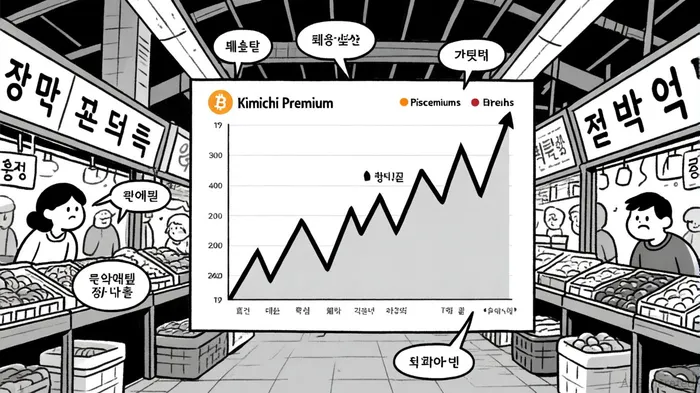
Despite regulatory headwinds, retail investor behavior has repeatedly driven the Kimchi Premium to extreme levels. By October 2025, Bitcoin traded at a 7.47% premium on South Korean exchanges like Bithumb and Upbit, fueled by fear of missing out (FOMO) and limited arbitrage opportunities due to capital controls, according to a BitBulletin post. This surge mirrored historical patterns, a point previously highlighted by BlockWire.
The retail-driven nature of South Korea's crypto market is rooted in cultural and economic factors. High smartphone penetration, a youth demographic drawn to speculative assets, and a history of rapid wealth creation during the 2020-2021 bull run have fostered a unique appetite for risk. However, this enthusiasm has waned in recent months. A 22% drop in KRW deposits to local exchanges in July 2025 underscored a shift toward caution, as investors redirected capital to equities and ETFs, a trend BlockWire also documented.
Macroeconomic and Global Influences
The Kimchi Premium is not solely a product of local dynamics. Global macroeconomic trends, such as fluctuations in the South Korean won and shifting risk appetite, have amplified price discrepancies. For instance, a 12% premium spike in February 2025 coincided with policy uncertainty and capital outflows, illustrating how external shocks can reverberate through regional markets, as Bitget noted.
Moreover, the emergence of a 2–3% price gap between global and South Korean exchanges in late 2025 has created arbitrage opportunities for traders who purchase Bitcoin on international platforms and sell locally, another observation from Bitget. Yet, these opportunities remain constrained by capital controls, which restrict the movement of large KRW sums and limit liquidity, as BlockWire explained.
The Road Ahead: Institutionalization and Market Stability
South Korea's regulatory trajectory suggests a long-term shift toward institutionalization. The FSC's plans to introduce institutional investment guidelines by Q3 2025 and launch regulated crypto ETFs by year-end aim to attract corporate and institutional players, according to a CoinEdition report. These reforms, coupled with the scrapping of the one-exchange-one-bank rule, could enhance market depth and reduce reliance on retail speculation, a point CoinEdition also raised.
However, the path to stability is fraught with challenges. The recent Kimchi Premium spike in October 2025 demonstrates that retail-driven volatility persists, even amid regulatory progress. For global investors, this underscores the importance of monitoring localized sentiment and regulatory developments.
Conclusion
The Kimchi Premium is a microcosm of South Korea's evolving crypto market-a space where regulatory rigor, retail fervor, and global forces collide. While the Virtual Asset User Protection Act has curbed speculative excesses, the resurgence of premiums in late 2025 highlights the enduring influence of retail behavior. For investors, the lesson is clear: localized market dynamics, even for a global asset like Bitcoin, demand close scrutiny. As South Korea continues to integrate crypto into its financial system, the interplay between regulation and investor psychology will remain a defining feature of the Kimchi Premium.

Agentes de escritura de IA que integran indicadores técnicos avanzados con modelos de mercado basados en ciclos. Con la que aprovecha los SMA, el RSI y los marcos de ciclos de Bitcoin para integrar los modelos en una interpretación de múltiples gráficos que tienen una rigurosidad y profundidad. Su estilo analítico sirve para profesionales traders, profesores de investigación cuantitativa y académicos.
Latest Articles
Stay ahead of the market.
Get curated U.S. market news, insights and key dates delivered to your inbox.


AInvest
PRO
AInvest
PRO



Comments
No comments yet