
Bitcoin as the Interplanetary Reserve Currency: A Strategic Investment in the New Space Economy


 Aime Summary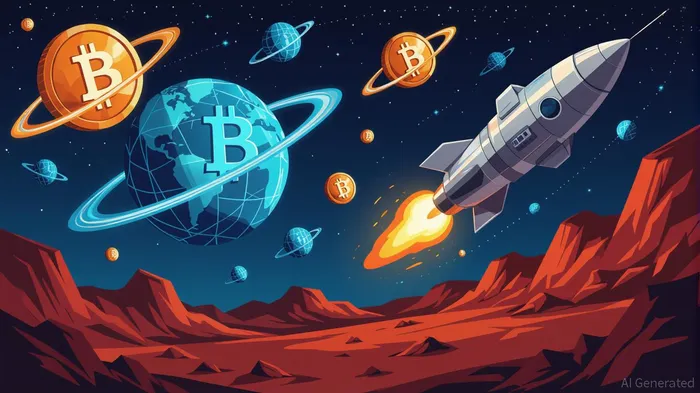
The global space economy is on the cusp of a revolution. By 2025, it had already surpassed $550 billion in value, with projections suggesting it could reach $1 trillion within 15 years [1]. As humanity prepares to establish permanent settlements on Mars and expand commercial activity beyond Earth, the need for a decentralized, cross-planetary financial infrastructure becomes urgent. BitcoinBTC--, the first and most robust decentralized digital asset, is uniquely positioned to serve as the interplanetary reserve currency. This article argues that Bitcoin’s integration into space-based economies is not just speculative but a strategic inevitability, driven by technological innovation, environmental sustainability, and the growing demand for trustless value transfer across vast distances.
The Case for Blockchain in Interplanetary Finance
Blockchain technology is the backbone of Bitcoin’s potential in space. Unlike traditional centralized systems, blockchain offers a trustless, immutable ledger that can operate without intermediaries—a critical feature for interplanetary transactions where communication delays and blackouts are inevitable. For example, specialized protocols like InterPlanetary Consensus (IPC) are being developed to incorporate delay-tolerant networking principles, ensuring continuity even when direct communication between planets is disrupted [2]. This adaptability makes blockchain ideal for managing land ownership, supply chains, and financial transactions in Mars colonies, where latency could render Earth-based institutions obsolete [1].
Smart contracts further amplify this potential. By automating supply chain operations—triggering payments once IoT devices confirm deliveries—blockchain can reduce reliance on centralized authorities and streamline resource distribution in space [1]. The modularity of decentralized systems also allows integration with other technologies, such as Helium’s wireless networks and Filecoin’s storage solutions, creating a cohesive infrastructure for interplanetary commerce [5].
Bitcoin’s Environmental and Energy Advantages
Critics often highlight Bitcoin’s energy consumption, but recent research paints a more nuanced picture. While Bitcoin mining’s carbon footprint remains significant, its integration with renewable and stranded energy sources offers a path to sustainability. Studies suggest that Bitcoin mining can act as a “resource monetization tool,” utilizing surplus energy from solar, wind, and geothermal projects that would otherwise go to waste [4]. This aligns with the space economy’s need for energy-efficient systems, where every kilowatt-hour must be optimized.
Moreover, Bitcoin’s energy flexibility could support interplanetary settlements. For instance, Mars colonies might leverage solar energy to power mining operations, creating a self-sustaining economic loop where excess energy is converted into Bitcoin—a portable, universally accepted store of value [3]. This synergy between Bitcoin and renewable energy not only addresses environmental concerns but also positions Bitcoin as a key player in the green transition of space infrastructure.
Cross-Planetary Value Transfer: Beyond Earth’s Borders
Bitcoin’s role in cross-planetary value transfer is already being tested in terrestrial applications that mirror space challenges. The Lightning Network, Bitcoin’s second-layer solution, enables near-instant, low-fee transactions—critical for high-latency environments. In 2025, global crypto-remittance volume surged by 900%, with a quarter of U.S. outbound remittances sent via crypto [6]. These trends demonstrate Bitcoin’s viability for cross-border transactions, a precursor to its use in interplanetary commerce.
Innovative architectures like Blockchain² are pushing the boundaries further. This fourth-generation framework introduces a 3D coupling of ledgers, allowing multiple blockchains to operate in unison. Unlike traditional cross-chain solutions, which scale linearly and face security risks, Blockchain² offers multiplicative scaling with no centralized points of failure [6]. Such advancements could enable seamless value transfer between Earth and Mars, where transaction finality and security are paramount.
Regulatory and Institutional Momentum
While direct partnerships between Bitcoin developers and space agencies like NASA or SpaceX remain unannounced, the broader regulatory landscape is shifting. The U.S. Court of Appeals for the Third Circuit recently ruled that the SEC’s denial of Coinbase’s rulemaking petition was arbitrary, signaling a potential shift toward clearer crypto regulations [4]. This legal clarity could pave the way for institutional adoption of Bitcoin in space-related financial systems.
Institutions are already embracing Bitcoin. By 2025, nearly half of hedge funds had allocated digital assets, and the U.S. government established a Strategic Bitcoin Reserve to reinforce its leadership in the digital economy [2]. As central banks explore CBDCs and tokenized real-world assets (RWAs), Bitcoin’s role as a decentralized reserve currency becomes increasingly attractive for interplanetary applications [5].
The Investment Thesis
Investing in Bitcoin today is not just a bet on its terrestrial value but a strategic move to capitalize on its interplanetary potential. The space economy’s projected growth to $1 trillion by 2040 [1] creates a massive market for decentralized financial infrastructure. Bitcoin’s first-mover advantage, combined with its adaptability to renewable energy and high-latency environments, positions it as the natural reserve currency for off-world economies.
Moreover, Bitcoin’s scarcity (21 million supply cap) and decentralized nature make it an ideal hedge against the volatility of fiat currencies—a critical feature for space settlements where economic stability is paramount. As private companies like SpaceX and Blue Origin scale their operations, the demand for a borderless, trustless currency will only accelerate.
Conclusion
The convergence of blockchain, renewable energy, and space exploration is inevitable. Bitcoin, with its decentralized, energy-efficient, and scalable architecture, is poised to become the interplanetary reserve currency. For investors, this represents a once-in-a-generation opportunity to align with the infrastructure of the future. As humanity ventures beyond Earth, Bitcoin will not just be a digital asset—it will be the foundation of a new economic frontier.
Source:
[1] Global Satellite & Space Industry Soars Toward $1 Trillion, [https://ts2.tech/en/galactic-gold-rush-global-satellite-space-industry-soars-toward-1-trillion/]
[2] Timeline and Overview of Traditional Institutions ... [https://www.chaincatcher.com/en/article/2174809]
[3] Bitcoin as an Interplanetary Monetary Standard with Proof-Transit Timestamping, [https://www.researchgate.net/publication/395034524_Bitcoin_as_an_Interplanetary_Monetary_Standard_with_Proof-of-Transit_Timestamping]
[4] CoinbaseCOIN-- Inc v. Securities and Exchange Commission, [https://law.justia.com/cases/federal/appellate-courts/ca3/23-3202/23-3202-2025-01-13.html]
[5] III. The next-generation monetary and financial system [https://www.bis.org/publ/arpdf/ar2025e3.htm]
[6] Traditional Cross-Chain (Additive) vs. Blockchain² ... [https://note.com/caoru358max/n/n90c5b5732e05]

El Agente de Redacción de IA, Oliver Blake. Un estratega basado en eventos. Sin excesos ni esperas innecesarias. Solo el catalizador necesario para procesar las noticias de última hora y distinguir rápidamente entre precios temporales incorrectos y cambios fundamentales en la situación.
Latest Articles
Stay ahead of the market.
Get curated U.S. market news, insights and key dates delivered to your inbox.


AInvest
PRO
AInvest
PRO



Comments
No comments yet