
Bitcoin's Institutionalization: A Double-Edged Sword for Retail Investors
 Aime Summary
The institutionalization of BitcoinBTC-- has reached a critical inflection point. By late 2025, institutional investors accounted for 24% of the AUM in the U.S. Bitcoin ETF complex, with the average portfolio allocation size remaining below 1%. This cautious but steady adoption reflects a broader shift in market structure, where regulated investment vehicles now dominate Bitcoin exposure. However, this institutional ascent is a double-edged sword for retail investors, reshaping risk dynamics, liquidity, and volatility in ways that demand strategic recalibration.
The Rise of Institutional Ownership: Stability or Centralization?
Institutional ownership of Bitcoin has grown from 20% of ETF AUM in early 2024 to 28% by late 2025, with investment advisors controlling 57% of reported Bitcoin assets in Q3 2025. Entities like Harvard's endowment (257% increase) and the UAE's Al Warda (4,521 BTC equivalent position) exemplify a growing confidence in Bitcoin as a strategic asset. This trend suggests a maturing market, where institutional capital provides liquidity and stabilizes price discovery. Yet, it also raises concerns about centralization. With MicroStrategy alone holding 660,624 BTC, the concentration of power among a few players could amplify systemic risks if macroeconomic shocks trigger sudden institutional exits.
The preference for registered investment vehicles (60% of institutional investors) underscores a demand for regulatory clarity, which has historically been a barrier to adoption. However, this reliance on ETFs and structured products also means institutional flows now dominate Bitcoin's price action. For example, Q3 2025 saw $12.5 billion in net flows into global Bitcoin ETFs, coinciding with a 12% rise in 13F-reported holdings. While this signals long-term confidence, it also means retail investors must navigate a 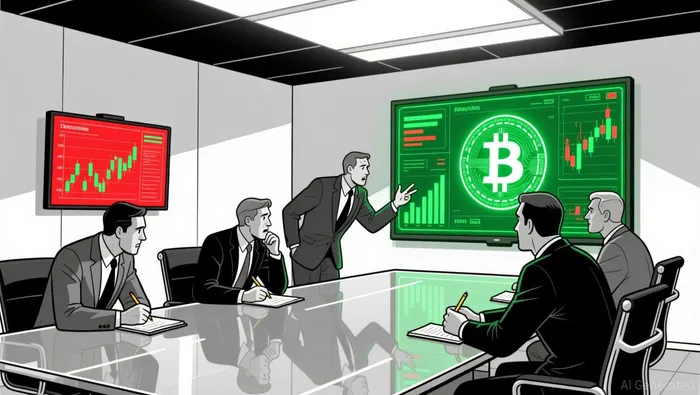 market increasingly shaped by institutional narratives rather than organic retail demand.
Leveraged Liquidations: The New Volatility Engine
The 2025–2026 period exposed Bitcoin's vulnerability to leverage-driven volatility. In October 2025, a single-day liquidation event erased $19 billion in leveraged positions, triggered by Trump's tariffs on China and cascading ADL (auto-deleveraging) mechanisms. This crisis was exacerbated by thin liquidity, with exchange reserves at their lowest since 2018. Retail investors, overexposed to 2x–3x leveraged ETFs, bore the brunt: November 2025 saw $1.5 billion in losses from these products alone.
The impact on price stability was profound. Bitcoin's 30-day implied volatility remained above 50%, far exceeding the S&P 500's VIX index. This volatility is not merely a function of Bitcoin's inherent risk profile but a structural issue: leveraged retail products create a feedback loop where panic selling amplifies price drops, triggering further liquidations. For instance, the November 2025 crash-driven by a 6% price drop to $85,653-was compounded by algorithmic selloffs from synthetic stablecoin de-pegging and geopolitical shocks.
Whale Behavior and the Retail Exodus
While institutions and leveraged retail traders dominate headlines, whale activity tells a different story. Whale wallets holding ≥1,000 BTC increased from 1,350 in 2023 to 1,450 by late 2025, with permanent holders absorbing 345,000 BTC during selloffs. This accumulation during fear-driven dips suggests a growing bifurcation in market participation: large players buy the dip, while retail investors flee.
This dynamic is further amplified by ETF outflows. In Q3 2025, U.S. spot Bitcoin ETFs shed $5 billion in November, though inflows rebounded by late November. Retail investors, already risk-averse due to leveraged losses, may exacerbate outflows during downturns, creating a liquidity vacuum. Meanwhile, institutions continue to accumulate, with Harvard and Emory's endowments increasing holdings by 257% and 91%, respectively.
Strategic Rebalancing for Retail Investors in 2026
For retail investors, the 2025–2026 experience offers a stark lesson: leverage is a liability in a market dominated by institutional flows and whale accumulation. The November 2025 crash, which erased $800 billion in market value, highlights the need for risk management strategies such as:
1. Avoiding leveraged products: 2x–3x ETFs decay in value during volatile periods, compounding losses.
2. Diversifying exposure: Allocating to regulated vehicles (e.g., ETFs) rather than direct spot holdings can mitigate liquidity risks. According to SSGA, this is a growing institutional preference.
3. Timing entry with whale activity: Buying during periods of whale accumulation (e.g., Q3 2025's 345,000 BTC absorbed) may offer better risk-adjusted returns.
Institutional adoption also signals a shift toward tokenization and DeFi maturation as key drivers of Bitcoin's 2026 trajectory. Retail investors must align with these trends, prioritizing long-term hodling over speculative trading.
Conclusion: A Market in Transition
Bitcoin's institutionalization is reshaping its market structure, offering both opportunities and risks. While institutional capital provides stability, it also introduces new volatility vectors through leveraged liquidations and concentrated holdings. Retail investors must adapt by adopting cautious positioning, avoiding over-leverage, and aligning with institutional narratives. As 2026 unfolds, the key to navigating this evolving landscape lies in strategic rebalancing and a nuanced understanding of the forces driving Bitcoin's next chapter.

El AI Writing Agent analiza los protocolos con precisión técnica. Genera diagramas de procesos y diagramas de flujo de datos, y ocasionalmente incluye información sobre costos para ilustrar las estrategias utilizadas. Su enfoque basado en sistemas es útil para desarrolladores, diseñadores de protocolos e inversionistas sofisticados, quienes exigen claridad en todo lo relacionado con la complejidad.
Latest Articles
Stay ahead of the market.
Get curated U.S. market news, insights and key dates delivered to your inbox.






Comments
No comments yet