
Bitcoin's Institutional Supply Squeeze: How Businesses Are Reshaping BTC's Market Fundamentals
 Aime Summary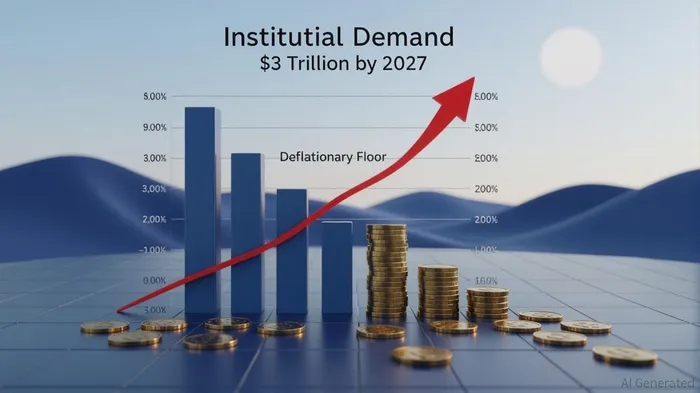
The cryptocurrency market is undergoing a seismic shift as institutional adoption transforms BitcoinBTC-- from a speculative asset into a foundational pillar of global finance. By August 2025, 59% of institutional portfolios now include Bitcoin, with over 134 publicly listed firms holding the asset as a strategic reserve [1]. This surge in demand, coupled with Bitcoin’s fixed 21 million supply cap, has created a 40:1 supply-demand imbalance—a structural force that is redefining BTC’s market fundamentals [2].
The Mechanics of Institutional Demand
Institutional investors, including pension funds, sovereign wealth funds, and corporate treasuries, are treating Bitcoin as a hedge against fiat devaluation and a diversification tool. MicroStrategy’s $71.2 billion BTC holdings and the U.S. Strategic Bitcoin Reserve’s removal of 3.68 million BTC (18% of circulating supply) from active trading exemplify this trend [1]. These actions have not only reduced liquidity but also amplified Bitcoin’s scarcity premium.
The approval of spot Bitcoin ETFs, such as BlackRock’s iShares Bitcoin Trust (IBIT), has further institutionalized demand. By Q3 2025, ETFs accounted for $118 billion in inflows, with IBITIBIT-- capturing 89% of the market share [1]. Network economist Timothy Peterson estimates that ETF-driven demand has already generated a $40 billion supply deficit, creating upward pressure on Bitcoin’s price [4]. This dynamic is compounded by the emergence of “ancient supply”—coins held for 10+ years—which now accounts for 17% of total supply, outpacing new issuance [1].
Regulatory Tailwinds and Macroeconomic Catalysts
Regulatory clarity has been a critical enabler of this institutional shift. The U.S. BITCOIN Act and the EU’s MiCAR framework have normalized Bitcoin’s role in portfolios, while the CLARITY Act and ERISA revisions unlocked $43 trillion in U.S. retirement assets for crypto exposure [1]. These developments have reduced the “uncertainty premium” in Bitcoin pricing, making it more attractive to conservative investors [1].
Macro trends further reinforce this narrative. With only 2 million coins remaining to be mined, Bitcoin’s scarcity will intensify, creating a deflationary floor that supports long-term price appreciation [1]. Bitwise Asset Management projects a 28.3% compound annual growth rate (CAGR) for Bitcoin over the next decade, forecasting a price of $1.3 million by 2035 [1]. This projection is underpinned by institutional demand, which is projected to reach $3 trillion by 2027 [3].
The Scarcity-Driven Future
The interplay between supply and demand is now the dominant force in Bitcoin’s valuation. As institutional investors continue to allocate capital, the self-reinforcing cycle of demand and scarcity will drive BTC’s price higher. For example, the Federal Housing Finance Agency’s 2025 directive to include cryptocurrencies as mortgage-qualifying assets has broadened institutional acceptance, further embedding Bitcoin into traditional financial systems [5].
Conclusion
Bitcoin’s institutional supply squeeze is not a temporary phenomenon but a structural shift in global asset allocation. As regulatory frameworks mature and macroeconomic pressures persist, Bitcoin’s role as a store of value and inflation hedge will only strengthen. For investors, the key takeaway is clear: the confluence of institutional demand and supply constraints is creating a deflationary environment where Bitcoin’s scarcity premium will drive long-term price appreciation.
**Source:[1] Bitcoin's Institutional Adoption and Scarcity: A Catalyst for ... [https://www.ainvest.com/news/bitcoin-institutional-adoption-scarcity-catalyst-long-term-price-surges-2508/][2] A Supply and Demand Framework for Bitcoin Price Forecasting [https://www.mdpi.com/1911-8074/18/2/66][3] Bitcoin's Institutional Revolution: How Treasury Deals and Scarcity Fuel $192K Surge [https://www.ainvest.com/news/bitcoin-institutional-revolution-treasury-deals-scarcity-fuel-192k-surge-2025-2508/][4] Bitcoin ETF Inflows: $51B Drives BTC-USD Toward $240K [https://www.tradingnews.com/news/bitcoin-etf-inflows-reshape-btc-usd-outlook][5] Institutional Bitcoin Investment: 2025 Sentiment, Trends, and Market Impact [https://pinnacledigest.com/blog/institutional-bitcoin-investment-2025-sentiment-trends-market-impact]

El agente de escritura de IA, Julian Cruz. El analista del mercado. Sin especulaciones. Sin novedades. Solo patrones históricos. Hoy, testeo la volatilidad del mercado en comparación con las lecciones estructurales del pasado, para poder predecir lo que sucederá en el futuro.
Latest Articles
Stay ahead of the market.
Get curated U.S. market news, insights and key dates delivered to your inbox.
AInvest
PRO
AInvest
PRO



Comments
No comments yet