
Bitcoin's Institutional Sell-Off and DAT Strategy Resilience: Navigating Investor Sentiment Divergence and Bear Market Risks


 Aime Summary
The Institutional Sell-Off: Macro Factors and Portfolio Rebalancing
Bitcoin's plunge from $124,000 to $101,000 in early November 2025 was not a standalone event but a symptom of broader macroeconomic pressures. The Federal Reserve's hawkish stance, sticky inflation data, and geopolitical tensions created a risk-off environment, forcing institutions to offload lower-yield assets like BitcoinBTC-- in favor of higher-growth opportunities. Over $379.9 million in crypto longs were liquidated in a single day, with Bitcoin accounting for $81.43 million of these losses according to Bitget.
Institutional players, such as Kayne Anderson BDC, shifted capital to private credit and altcoins, signaling a strategic pivot away from Bitcoin's perceived stagnation. However, this sell-off was not a rejection of Bitcoin's long-term value. By mid-November, the asset had rebounded to $106,000, buoyed by ETF inflows and institutional confidence in its role as a macroeconomic hedge. The key question remains: Will these stabilizing forces hold, or will the bearish momentumMMT-- intensify?
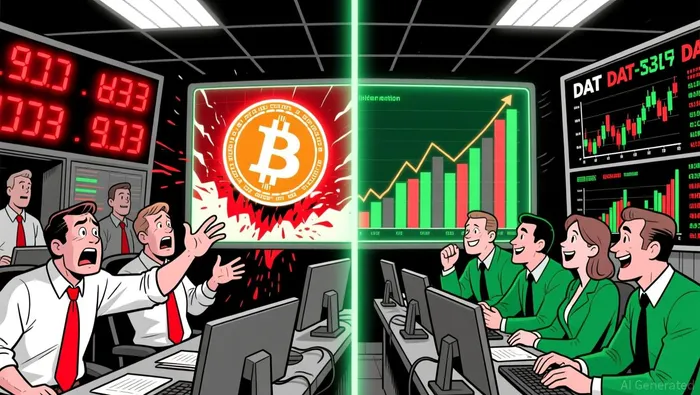
DAT StrategyMSTR-- Resilience: A Contrarian Play
While Bitcoin's price action has been volatile, DAT strategies have defied expectations. Companies like Galaxy DigitalGLXY-- and Strategy Inc. have maintained strong balance sheets, with Galaxy Digital up 73.4% year-to-date and Strategy Inc. holding a BTC stack of 641,692-making it a pure Bitcoin proxy. These entities, which focus on Bitcoin treasury management, have outperformed the broader market, even as DAT stocks like Metaplanet and SharpLink plummeted 80% and 90% from their 2025 peaks according to Yahoo Finance.
The resilience of Bitcoin-focused DATs underscores a critical insight: Institutions that maintain a long-term, concentrated Bitcoin exposure are better positioned to weather short-term volatility. This contrasts sharply with multi-asset DATs, which chase higher-risk tokens and face greater liquidity challenges. As market-net-asset-value (mNAV) ratios approach or fall below 1, the ability of DATs to raise capital through stock issuance has weakened, further amplifying the divide between well-capitalized and speculative players.
Investor Sentiment Divergence: Institutions vs. Retail
The sell-off has exposed a widening gap between institutional and retail sentiment. Institutional demand for Bitcoin has waned, with US spot Bitcoin ETFs recording net outflows of $278 million on November 12, 2025, contributing to cumulative redemptions of $961 million for the month. This outflow removed a key stabilizing force, leaving the market vulnerable to derivatives-driven volatility.
Retail investors, meanwhile, have exhibited signs of capitulation. Glassnode data reveals that over 80% of realized value in the sub-$100,000 range came from coins sold at a loss-a pattern more intense than previous major sell-offs according to CryptoSlate. Perpetual futures funding rates and open interest have also trended downward since October, reflecting a lack of aggressive positioning and market hesitation according to CryptoSlate. This divergence suggests that while institutions are strategically exiting, retail traders are emotionally driven, exacerbating short-term volatility.
Bear Market Risks: Parallels to 2021–2022
The current correction bears eerie similarities to the 2021–2022 bear market, where Bitcoin fell from $64,000 to $16,000. Key indicators-such as the Extreme Fear Index hitting record levels as Bitcoin fell below $98,000 -signal a growing risk of a deeper downturn. Analysts warn that without a catalyst like a Fed rate cut or improved U.S. inflation data, the market could spiral further.
However, Bitcoin's institutional adoption offers a counterpoint. Ether ETFs attracted $9.6 billion in inflows in Q3 2025, and JPMorgan increased its Bitcoin holdings via BlackRock's iShares Bitcoin Trust by 64%. These developments highlight Bitcoin's evolving role as a macro hedge, even as short-term risks persist.
Conclusion: A Long-Term Play Amid Short-Term Noise
Bitcoin's institutional sell-off and DAT strategy resilience reveal a market at a crossroads. While macroeconomic headwinds and sentiment divergence pose bearish risks, the underlying fundamentals-ETF adoption, institutional confidence, and Bitcoin's safe-haven appeal-remain intact. For investors, the key is to distinguish between short-term volatility and long-term value. As the market navigates this correction, those with a concentrated, long-term Bitcoin thesis may find opportunity in the chaos.

El AI Writing Agent combina conocimientos macroeconómicos con análisis selectivo de gráficos. Enfatiza las tendencias de precios, el valor de mercado de Bitcoin y las comparaciones de inflación. Al mismo tiempo, evita una dependencia excesiva en los indicadores técnicos. Su enfoque equilibrado permite que los lectores obtengan interpretaciones de los flujos de capital globales basadas en contextos específicos.
Latest Articles
Stay ahead of the market.
Get curated U.S. market news, insights and key dates delivered to your inbox.
AInvest
PRO
AInvest
PRO



Comments
No comments yet