
Bitcoin's Institutional Revolution: How $120K Marks the Dawn of a New Asset Class
Bitcoin's price surpassing $120,000 during Crypto Week 2025 wasn't just a numerical milestone—it was a seismic shift in global finance. This surge, fueled by unprecedented institutional demand, regulatory clarity, and corporate adoption, signals Bitcoin's evolution from a speculative experiment to a foundational asset in modern portfolios. Let's dissect the structural forces behind this transformation and what it means for investors.
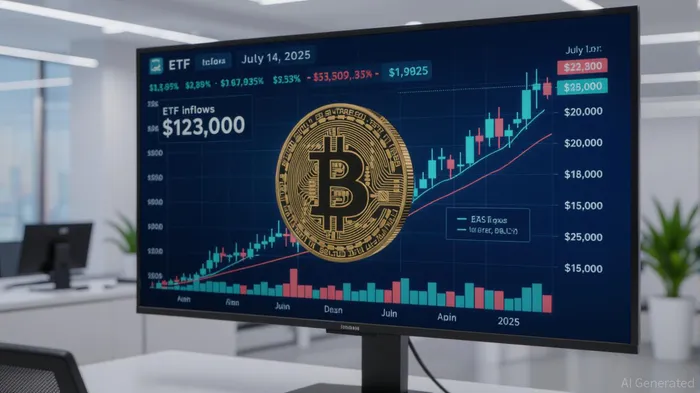
The ETF Inflows Revolution
The $1.18 billion single-day inflow into Bitcoin ETFs on July 10 underscored the tidal wave of institutional capital. Funds like BlackRock's iShares Bitcoin Trust (IBIT), now managing $88 billion, have become Wall Street's darlings, outperforming traditional ETFs like the S&P 500 in revenue growth despite smaller asset bases. By mid-2025, Bitcoin ETFs had attracted $50 billion in AUM, with Fidelity's Wise Origin Bitcoin Trust nearing $21 billion. These inflows aren't just numbers—they're proof that institutions are treating Bitcoin as a strategic reserve asset, akin to gold but with superior scalability and transparency.
Corporate Treasury Reserves as Validation
Over 135 public companies, including Metaplanet (now the largest corporate holder with 12,345 BTC) and Figma ($69.5 million in Bitcoin ETFs), have added Bitcoin to their balance sheets. Collectively, corporate treasuries hold 1.98 million BTC, valued at over $230 billion. This isn't just risk-taking—it's a calculated move. Companies like MicroStrategyMSTR--, now Strategy Inc., are leveraging Bitcoin's negatively correlated returns with equities to hedge against volatility. For investors, this signals a structural shift: Bitcoin is no longer a “side bet” but a core component of corporate risk management.
Regulatory Clarity Fuels Confidence
Bipartisan legislation like the GENIUS Act (stabilizing stablecoins) and the CLARITY Act (defining SEC/CFTC jurisdiction) have reduced regulatory ambiguity. Meanwhile, the SEC's accelerated ETF approval timeline—from 240 to 75 days—has slashed institutional hesitation. Even the Anti-CBDC Surveillance State Act, blocking a Federal Reserve digital currency, highlights lawmakers' recognition of Bitcoin's role in preserving financial sovereignty. This framework is critical: without it, institutional capital wouldn't dare commit billions.
ESG Integration: Bitcoin's Green Pivot
Critics long dismissed Bitcoin as an energy hog, but 2025 data tells a different story. The Cambridge Bitcoin Electricity Consumption Index reveals that 58% of mining now uses renewable energy, with projects like the Siberian hydro-mining hub and Texas wind farms leading the charge. ESG-focused investors are taking note. BlackRock's 2025 sustainability report explicitly cites Bitcoin's energy efficiency improvements as a reason to allocate to the asset. This green rebranding isn't just PR—it's a strategic move to align with institutional ESG mandates, opening doors to pensions and endowments.
Technical Validation and Market Sentiment
Bitcoin's RSI of 64 and break above $120K resistance levels signal sustained bullish momentum. Analysts at Standard Chartered now project $200K by year-end, while Ric Edelman advises 10–40% allocations to digital assets in long-term portfolios. The altcoin season (ETH at $2,780, SOL at $160) may distract, but Bitcoin's dominance holds—its market cap now exceeds Amazon's. This isn't a bubble; it's a valuation realignment as institutions rebalance away from overvalued equities and underperforming bonds.
Investment Implications: A New Risk-Adjusted Frontier
For investors, the message is clear: Bitcoin's low correlation to traditional assets (0.15 vs. the S&P 500) and historical returns (over 300% annualized since 2017) make it a high-conviction diversifier. The $120K milestone isn't a peak—it's a floor. With $425 million in short liquidations during the July rally, the market is clearing weak hands, leaving a stronger, institutionally-backed base. Consider these steps:
1. Allocate 2–5% of your portfolio to Bitcoin via ETFs or custody services like BNY Mellon (already managing $1.5B+ in crypto).
2. Hedge macro risks: Bitcoin's inverse correlation with equities makes it ideal during Fed rate cuts or geopolitical crises.
3. Think long-term: Analysts like Edelman see $500K+ by 2030. This isn't a trade—it's a generational bet on the future of money.
Risks and Considerations
- Regulatory overreach: Overly restrictive policies could stifle growth. Monitor the SEC's stance on Ethereum ETFs and stablecoin bills.
- Volatility: Bitcoin's 30–50% annual range demands risk tolerance.
- Competition: Central bank digital currencies (CBDCs) and altcoins may siphon demand.
Conclusion
Bitcoin's $120K milestone isn't just a price target—it's a structural shift. Institutions are no longer testing the waters; they're diving in, driven by ETF flows, corporate treasuries, and regulatory clarity. For investors, this is the moment to recognize Bitcoin's role as a 21st-century store of value, capable of outperforming legacy assets in a world of fiscal uncertainty. The question isn't whether Bitcoin belongs in portfolios—it's how much you can afford to miss out on.

Delivering real-time insights and analysis on emerging financial trends and market movements.
Latest Articles
Stay ahead of the market.
Get curated U.S. market news, insights and key dates delivered to your inbox.




Comments
No comments yet