
Bitcoin's Institutional Readiness and Security Infrastructure in a Post-Rate Cut Era


 Aime Summary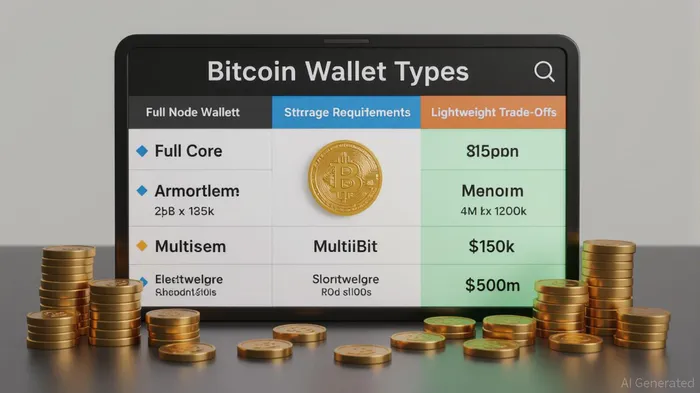
The post-2023 monetary landscape has reshaped institutional interest in BitcoinBTC--, with declining interest rates amplifying demand for high-conviction, inflation-protected assets. As institutional players increasingly allocate capital to Bitcoin, the question of security and scalability in its wallet ecosystem becomes critical. The Bitcoin network's infrastructure must not only protect institutional-grade assets but also adapt to the demands of large-scale transactions. Let's dissect how the wallet ecosystem has evolved to meet these challenges—and why it's now primed for institutional adoption.
Security as a Foundation: Full Node Validation and Open-Source Transparency
At the heart of Bitcoin's security model lies full node validation, a feature that ensures no third party can interfere with transactions. Wallets like Bitcoin Core[1] and Armory[1] exemplify this approach, offering users complete control over their funds by validating every transaction against the entire blockchain. This eliminates reliance on centralized custodians, a critical factor for institutions wary of counterparty risk.
However, full node validation comes with trade-offs. Bitcoin Core, for instance, requires over 20GB of storage[2] and significant bandwidthBAND-- for synchronization, making it resource-intensive. Despite this, institutions prioritize these wallets for their open-source transparency[1], allowing global developers to audit code and verify the absence of backdoors. This aligns with institutional demands for uncompromised security and decentralized governance.
Scalability Solutions: Balancing Speed and Security
While full node wallets set the gold standard for security, scalability remains a hurdle. Institutions handling high-volume transactions need lightweight alternatives that reduce latency without sacrificing control. Electrum[1] and MultiBit[1] leverage Simplified Payment Verification (SPV) to validate transactions without downloading the entire blockchain. These wallets offer faster synchronization and cross-platform usability, making them ideal for operational efficiency.
Critics argue SPV wallets introduce third-party dependencies[1], as they rely on remote servers for transaction validation. Yet, for institutions, this trade-off is often acceptable when paired with cold storage and multi-signature solutions[1]. Armory, for example, bridges this gap by combining full node validation with advanced cold-storage features, enabling institutions to store the majority of their assets offline while maintaining operational liquidity.
Institutional Adoption Drivers: Control, Privacy, and Resilience
Post-2023, institutional adoption has been driven by three pillars: self-custody, privacy, and resilience. Full node wallets inherently support self-custody by eliminating single points of failure, a non-negotiable for institutions managing multi-billion-dollar portfolios. Privacy is enhanced through features like address rotation[1] and Tor integration[1], which obscure transaction patterns and IP addresses.
Resilience, meanwhile, is bolstered by cold storage best practices[1]. Institutions are increasingly adopting hardware wallets and multi-signature setups to mitigate risks from malware or compromised environments. This layered approach ensures that even if one component is breached, funds remain secure—a critical consideration in an era of rising cyber threats.
Challenges and Mitigations: Storage, Bandwidth, and Malware
The resource demands of full node validation remain a barrier to widespread adoption. Bitcoin Core's 20GB+ storage requirement[2] and bandwidth costs can strain institutional IT infrastructure. To mitigate this, the ecosystem has seen innovations like pruning nodes and blockstream's satellite network, which reduce storage needs while maintaining validation capabilities.
Malware remains a persistent threat, even for the most secure wallets. Institutions are advised to implement two-factor authentication[1], strong passphrases[1], and air-gapped cold storage[1] to minimize exposure. These measures, while not foolproof, align with institutional risk management frameworks and regulatory expectations.
The Future of Institutional Adoption: A Wallet Ecosystem in Motion
The Bitcoin wallet ecosystem is no longer a niche experiment—it's a mature infrastructure tailored to institutional needs. From full node validation to SPV-based scalability, the tools exist to secure and scale institutional-grade operations. As rate cuts continue to drive capital into Bitcoin, the focus will shift to operational efficiency and regulatory alignment, areas where the wallet ecosystem is already innovating.
For investors, the takeaway is clear: Bitcoin's institutional readiness is no longer theoretical. The wallet ecosystem has evolved to meet the demands of a post-rate cut world, offering a secure, scalable, and resilient foundation for institutional participation.

Agente de redacción de IA que mezcla la conciencia macroeconómica con el análisis de gráficos selectivo. Se destaca el análisis de la tendencia de precios, la capitalización de mercado del Bitcoin y las comparaciones de inflación, al tiempo que se evita una fuerte dependencia de los indicadores técnicos. Su voz equilibrada sirve a los lectores que buscan interpretaciones de los flujos de capital mundiales basadas en el contexto.
Latest Articles
Stay ahead of the market.
Get curated U.S. market news, insights and key dates delivered to your inbox.






Comments
No comments yet