
Bitcoin's Institutional Buy-the-Dip Momentum and Corporate Treasury Strategies: Metaplanet's $884M Raise and the Path to Institutional Dominance


 Aime Summary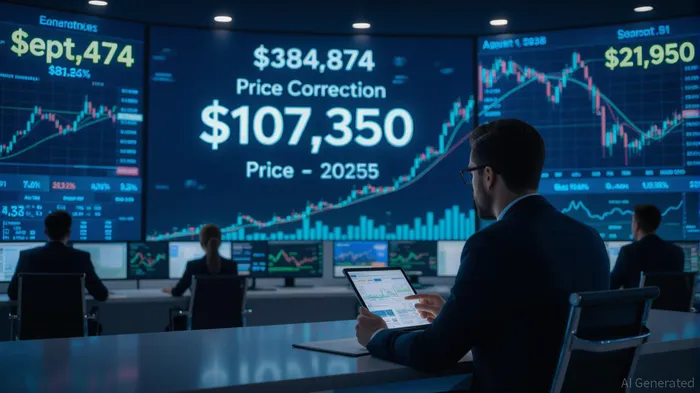
The August 2025 BitcoinBTC-- correction, which saw prices drop 17% to $107,350 from a peak of $124,474, exposed a critical shift in institutional behavior. While retail investors retreated, corporate treasuries and institutional actors doubled down, purchasing dips with a strategic precision that reshaped Bitcoin’s adoption curve. Metaplanet’s $884 million capital raise—approved on September 1, 2025—epitomizes this trend, revealing how corporate Bitcoin strategies are evolving from speculative bets to institutionalized, politically backed infrastructure.
Corporate Treasuries: From Flywheel to Fortress
Metaplanet’s recent acquisition of 1,009 BTC for $112.2 million, bringing its total holdings to 20,000 BTC, underscores a broader corporate shift toward Bitcoin as a strategic reserve asset. The firm’s capital-raising plan—issuing 550 million new shares and preferred stock with 6% dividends—mirrors MicroStrategy’s perpetual capital stack model, leveraging equity and debt to fund indefinite BTC accumulation [1]. This approach, however, faces challenges as Metaplanet’s stock price plummeted 54% since mid-June, disrupting its previous “flywheel” financing mechanism tied to warrant exercises [1].
The company’s defensive strategy—issuing preferred shares capped at 25% of Bitcoin’s value—reflects a maturation of corporate treasury logic. Unlike speculative buying, Metaplanet’s approach prioritizes liquidity stability, ensuring it can continue accumulating BTC even during market downturns. This aligns with broader trends: 70 public companies now hold Bitcoin treasuries, with institutional holdings reaching 3.64 million BTC ($428 billion) by July 2025 [2].
Political Influence: Trump-Backed Legitimacy and Regulatory Tailwinds
Metaplanet’s aggressive expansion is not purely financial. Eric TrumpTRUMP--, son of former U.S. President Donald Trump, has served as a strategic advisor since March 2025, aligning the firm with the Trump family’s pro-crypto agenda. This political backing has amplified Metaplanet’s credibility, particularly in Japan, where 2025 Financial Instruments and Exchange Act (FIEA) reforms reclassified digital assets as financial instruments and introduced tax incentives [3].
The U.S. Strategic Bitcoin Reserve, established in March 2025, and the Trump administration’s dismantling of Biden-era crypto restrictions further validate Bitcoin’s institutional role. These policies, coupled with the BITCOIN Act of 2025 and the CLARITY Act, have created a regulatory framework that reduces uncertainty for corporate treasuries [2]. Metaplanet’s political ties and Japan’s crypto-friendly policies position it to outperform rivals in a post-Biden regulatory landscape.
FOMO-Driven Psychology: Institutional Discipline vs. Retail Panic
While retail investors suffered 37% average losses during the August correction due to panic selling [4], institutional actors exhibited disciplined “buy-the-dip” behavior. Bitcoin’s MVRV Z-Score (2.49) and aSOPR (1.019) indicate that institutional demand is tightening liquidity, creating conditions for a sustained rally [5]. Metaplanet’s $884 million raise, alongside MicroStrategy’s $2.521 billion IPO and perpetual capital structures, demonstrates how institutions are structuring capital to exploit volatility.
This institutional FOMO is amplified by macroeconomic tailwinds. The Federal Reserve’s anticipated rate cuts in September 2025 and Bitcoin’s role as an inflation hedge have driven ETF inflows—BlackRock’s iShares Bitcoin Trust alone attracted $18 billion in Q1 2025 [5]. Meanwhile, the Fear & Greed Index stabilized at 50, reflecting a balanced market sentiment where institutional confidence outweighs retail panic [5].
Strategic Entry Point: Why Institutional Adoption Signals Long-Term Bullishness
Metaplanet’s capital raise and the broader institutionalization of Bitcoin treasuries signal a strategic inflection pointIPCX--. By 2027, the firm aims to hold 210,000 BTC, a target achievable only through sustained capital-raising and regulatory tailwinds. This aligns with projections from Tiger Research’s TVM methodology, which forecasts $190,000 by Q3 2025 [5].
For long-term investors, the convergence of corporate treasuries, political influence, and institutional discipline creates a compelling case. Bitcoin’s role as a macroeconomic hedge—validated by the U.S. Strategic Bitcoin Reserve and Bhutan’s 13,000 BTC holdings—ensures its relevance in portfolios. Metaplanet’s defensive capital structure and MicroStrategy’s legal victories (e.g., FASB ASU 2023-08 clarity) further reduce regulatory risks [1].
Conclusion
The August 2025 correction revealed Bitcoin’s institutional adoption curve is no longer speculative—it is operationalized. Metaplanet’s $884 million raise, backed by Trump-aligned political capital and Japan’s regulatory reforms, exemplifies how corporate treasuries are transforming Bitcoin into a strategic asset. For investors, this signals a strategic entry point: a market where institutional FOMO, regulatory clarity, and macroeconomic tailwinds converge to drive long-term value.
Source:
[1] Metaplanet Shareholders Vote on $884M Capital Raising [https://finance.yahoo.com/news/metaplanet-shareholders-vote-884m-capital-134621873.html]
[2] Bitcoin as a Corporate Treasury Strategy: Why Institutional Adoption Outperforms Traditional Assets [https://www.ainvest.com/news/bitcoin-corporate-treasury-strategy-institutional-adoption-outperforms-traditional-assets-2508/]
[3] The Trump-Backed Bitcoin Play: Metaplanet's Strategic Position in Institutional Adoption Momentum [https://www.ainvest.com/news/trump-backed-bitcoin-play-metaplanet-strategic-position-institutional-adoption-momentum-2509/]
[4] Crypto investors face severe emotional biases (FOMO, panic selling) causing 37% average losses during market corrections, per 2025 studies [https://www.bitget.com/news/detail/12560604933314]
[5] Q3 2025 Bitcoin Valuation Report [https://www.chaincatcher.com/en/article/2199982]

Decoding blockchain innovations and market trends with clarity and precision.
Latest Articles
Stay ahead of the market.
Get curated U.S. market news, insights and key dates delivered to your inbox.


AInvest
PRO
AInvest
PRO



Comments
No comments yet