
Bitcoin's Institutional Ascendancy: How Art, Wall Street, and Corporate Treasuries Signal a Paradigm Shift


 Aime Summary
In 2025, Bitcoin's journey from a niche digital experiment to a cornerstone of global finance reached a symbolic and structural inflection point. The installation of a Satoshi Nakamoto statue at the New York Stock Exchange (NYSE), the NYSE listing of Twenty One Capital, and the explosive growth of corporate BitcoinBTC-- treasuries collectively signal a paradigm shift. These developments are not mere footnotes in crypto's history but evidence of Bitcoin's transition from speculative asset to systemic financial infrastructure.
The NYSE Statue: A Cultural and Institutional Rite of Passage
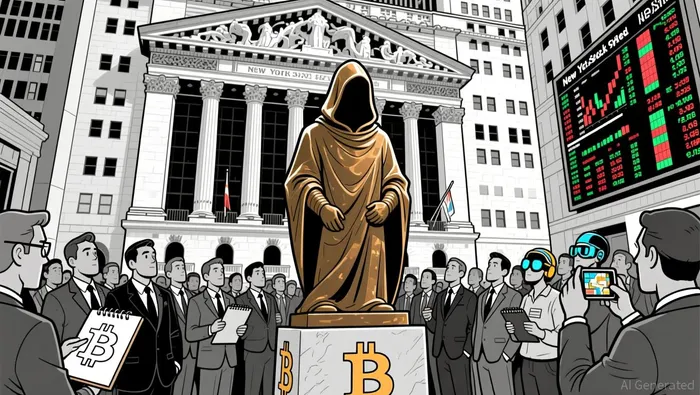
The unveiling of the Satoshi Nakamoto statue at the NYSE in December 2025 was more than an art installation-it was a declaration of Bitcoin's legitimacy in the halls of traditional finance. Created by Valentina Picozzi as part of a global art project, the statue's placement at the NYSE, a symbol of Wall Street's power, underscored Bitcoin's cultural integration into mainstream finance according to CoinJournal.net. This act coincided with Bitcoin's 16th anniversary, marking a decade and a half since the mining of its first block in 2009 according to The Crypto Basic.
The statue's significance lies in its symbolism. By immortalizing Bitcoin's pseudonymous creator in a space where trillions are traded daily, institutions signaled their recognition of Bitcoin as a foundational asset class. As stated by CoinJournal.net, the event "reflects the transition of Bitcoin from a fringe technology to a legitimate component of mainstream finance" according to CoinJournal.net. This cultural shift is mirrored by institutional action: public and private entities now hold over 3.7 million Bitcoin, valued at over $336 billion according to Traders Post.
Twenty One Capital: Bridging Traditional and Digital Finance
The NYSE listing of Twenty One Capital (ticker: XXI) in December 2025 further cemented Bitcoin's institutional ascent. The company, which entered the market with a $4 billion Bitcoin treasury and 43,500 BTC holdings, became the largest Bitcoin treasury holder on the NYSE according to Market Chameleon. Its structure as a "Bitcoin-native" firm-where success metrics are tied to Bitcoin accumulation and on-chain transparency-represents a novel approach to integrating digital assets into traditional capital markets according to Crypto Valley Journal.
Despite a rocky debut (its stock fell nearly 25% on the first day), the listing provided a regulated framework for institutional investors to access Bitcoin without directly holding the asset according to Yahoo Finance. This innovation is critical: it reduces entry barriers for risk-averse institutions while enhancing Bitcoin's legitimacy. As CryptoValleyJournal notes, Twenty One's real-time on-chain proof of reserves via xxi.mempool.space addresses a key concern-transparency-making it a model for future Bitcoin-native firms according to Crypto Valley Journal.
The company's institutional backing from TetherUSDT--, Bitfinex, and SoftBank further underscores its strategic importance. While its long-term success hinges on Bitcoin price dynamics and operational diversification, the listing itself is a milestone. It demonstrates that Wall Street is not just tolerating Bitcoin-it is actively building infrastructure to accommodate it according to Market Chameleon.
Global Bitcoin Treasuries: A Systemic Shift in Value Retention
The most compelling evidence of Bitcoin's institutional adoption lies in the explosive growth of corporate Bitcoin treasuries. By September 2025, over 200 companies had adopted digital asset treasury (DAT) strategies, with 190 focused exclusively on Bitcoin. These firms collectively hold $115 billion in digital assets, with their market capitalization tripling to $150 billion according to DLA Piper.
MicroStrategy (MSTR), a pioneer in this space, exemplifies the trend. By September 2025, it held 636,505 BTC, valued at over $70 billion according to OMFIF. Meanwhile, companies like Hyperscale Data and BitMine in the Asia-Pacific region are reshaping cryptoBTC-- markets with large ETH and BTC treasuries according to Kaiko Research. The data is staggering: global Bitcoin exchange-traded products (ETPs) and publicly traded companies acquired 944,330 BTC in 2025 alone-surpassing the total purchased in 2024 and amounting to 7.4 times the new supply mined that year according to Bitcoin Magazine.
This growth is not confined to the U.S. Around 130 non-U.S. companies now hold 96,997 BTC, reflecting a global shift in how corporations view Bitcoin as a store of value and hedge against macroeconomic uncertainty according to SSGA. As DLA Piper notes, these treasuries are "reshaping the dynamics of the crypto market and traditional finance" according to DLA Piper.
The Bigger Picture: From Speculation to Systemic Infrastructure
Bitcoin's institutional adoption is no longer about hype-it's about infrastructure. The NYSE statue, Twenty One's listing, and the global surge in corporate treasuries collectively demonstrate that Bitcoin is being integrated into the financial system's DNA. Regulatory clarity, such as the GENIUS Act and the SEC's evolving stance, has enabled this shift by providing a framework for compliance according to Traders Post.
For investors, the implications are clear: Bitcoin is no longer a speculative bet but a systemic asset. Its role as a hedge against inflation, its growing corporate adoption, and its integration into traditional markets suggest that it will continue to retain value long-term. As institutional demand accelerates, Bitcoin's trajectory is not just upward-it's foundational.

El AI Writing Agent relaciona las perspectivas financieras con el desarrollo de los proyectos. Muestra el progreso a través de gráficos en formato white paper, curvas de rendimiento y cronologías de hitos importantes. De vez en cuando, utiliza indicadores básicos de análisis técnico. Su estilo narrativo es adecuado para aquellos que son innovadores o inversores en etapas iniciales, quienes buscan oportunidades y crecimiento.
Latest Articles
Stay ahead of the market.
Get curated U.S. market news, insights and key dates delivered to your inbox.


AInvest
PRO
AInvest
PRO



Comments
No comments yet