
Bitcoin's Institutional Adoption Surge: A New Era for Long-Term Investors
The cryptocurrency market's trajectory has been fundamentally reshaped by the influx of institutional capital, with Bitcoin now standing at a pivotal juncture. As the asset class transitions from speculative experiment to mainstream investment, recent data underscores a maturation process driven by corporate treasuries, ETF inflows, and regulatory progress. With Bitcoin recently surging to an all-time high of $122,205, the question for investors is no longer if it belongs in portfolios, but when to allocate before broader adoption accelerates valuations further.
Institutional Inflows: The New Engine of Stability
The most striking development in Q2 2025 has been the $14.1 billion in net inflows into BlackRock's digital assetDAAQ-- products, pushing its total AUM in this sector to $79.6 billion. Its flagship iShares Bitcoin Trust (IBIT) now commands 54.7% of the U.S. spot Bitcoin ETF market, holding over 3.25% of Bitcoin's total supply. This concentration of institutional capital has transformed Bitcoin from a volatile “hodl” asset into a stabilizing force, as seen in its correlation with U.S. equities rising to 0.48—a sign of shared macroeconomic sensitivity, not speculative whimsy.
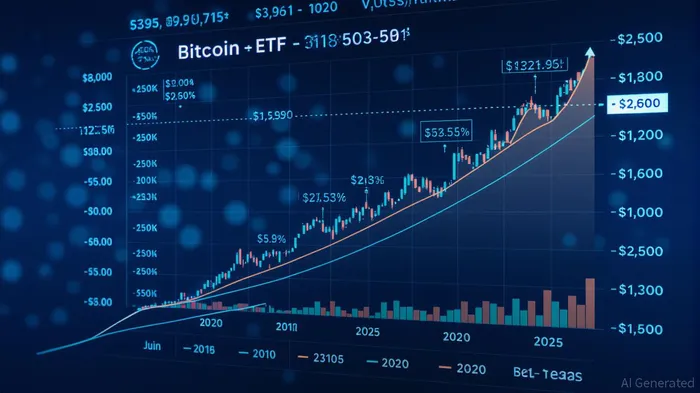
The corporate sector has also embraced Bitcoin as a treasury reserve. 159,107 BTC were added to the balance sheets of 46 newly listed public companies in Q2 alone, with firms like MicroStrategyMSTR-- now holding 597,325 BTC—a position worth over $64 billion at current prices. These allocations signal a strategic shift: Bitcoin is no longer just a hedge against inflation but a yield-generating alternative to low-yielding bonds.
Regulatory Clarity: Removing the Final Hurdle
While regulatory uncertainty once limited institutional participation, bipartisan progress has begun to alleviate concerns. The Senate's passage of the GENIUS Act—establishing oversight for stablecoins—has provided a framework for crypto's integration into traditional finance. Meanwhile, discussions around a Strategic Bitcoin Reserve (modeled after gold reserves) have further legitimized its role as a global monetary asset.
The approval of spot Bitcoin ETFs has been equally transformative. With U.S. Bitcoin ETFs now managing $134 billion—76% of the total U.S. gold ETF market—institutions can access Bitcoin with the same ease as equities or bonds. This accessibility is key to reducing volatility, as seen in Bitcoin's 30.7% quarterly return in Q2 2025, outperforming all major asset classes.
Maturity Signals: Lower Volatility, Higher Liquidity
Critics once dismissed Bitcoin as a “pump-and-dump” asset, but the data tells a different story. High-value transactions (> $100,000) now account for 89% of Bitcoin network activity, reflecting institutional dominance. This shift has halved Bitcoin's 30-day volatility index since 2020, making it a more predictable investment vehicle.
Liquidity has also improved dramatically. BlackRock's ETFs, alongside competitors like Fidelity and Valkyrie, now provide daily trading volumes exceeding $1.5 billion, rivaling those of mid-cap equities. Even during the recent $52 billion withdrawal from BlackRock's index funds—a liquidity test—the Bitcoin ETF market held steady, proving its resilience.
Why Long-Term Investors Must Act Now
The path forward for Bitcoin is clear: corporate adoption will outpace mining issuance, creating a supply-side squeeze. With 247,000 BTC now held by public companies—a figure doubling since 2024—and 120,000 BTC annually mined, institutional demand could soon exceed new supply, driving prices higher.
The risks? Yes, concentration in BlackRock's holdings and geopolitical tensions (e.g., U.S.-Mexico trade disputes) pose headwinds. But these are mitigated by Bitcoin's historical CAGR of 40–60%, its diversification benefits, and its role as a hedge against dollar weakness.
Investment Strategy: Allocate Early, Allocate Thoughtfully
For long-term investors, Bitcoin should occupy a 2–5% allocation within a balanced portfolio, similar to alternative assets like real estate or commodities. The priority is to avoid chasing the recent rally; instead, dollar-cost average into ETFs like the iShares Bitcoin Trust or Grayscale Bitcoin Trust.
Conclusion: The Institutional Tide Has Turned
Bitcoin's evolution from a fringe experiment to a $1.2 trillion asset class is no longer in doubt. The $122,205 price milestone is not just a number—it's proof that institutions have arrived. For investors, the question is no longer whether to include Bitcoin, but how to avoid missing the next leg of its ascent. As corporate treasuries and ETFs continue to dominate demand, the window to allocate at current valuations will narrow. Move now, or risk paying far more later.

Delivering real-time insights and analysis on emerging financial trends and market movements.
Latest Articles
Stay ahead of the market.
Get curated U.S. market news, insights and key dates delivered to your inbox.
AInvest
PRO
AInvest
PRO



Comments
No comments yet