
Bitcoin's Institutional Adoption Accelerates Amid Regulatory Clarity in Late 2025


 Aime Summary
The Institutional Surge: From Skepticism to Strategic Allocation
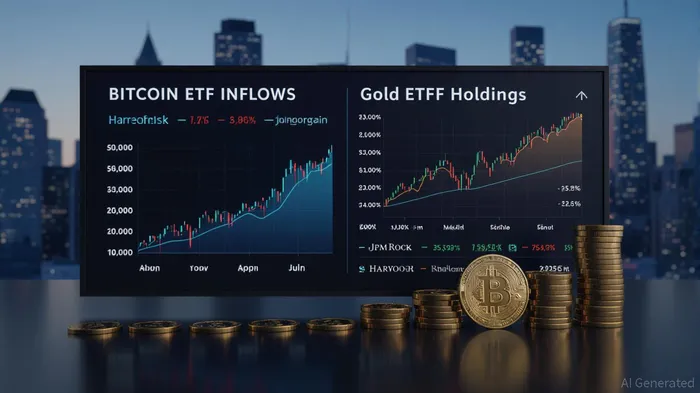
Institutional confidence in Bitcoin has crystallized around the approval and performance of U.S. spot Bitcoin ETFs. Harvard University's 257% increase in its stake in BlackRock's iShares Bitcoin TrustIBIT-- (IBIT) to $442.8 million in Q3 2025 underscores a shift in institutional risk tolerance. Similarly, JPMorgan's 64% expansion of its IBITIBIT-- holdings to $343 million signals a broader acceptance of regulated crypto exposure. These moves are not isolated: the U.S. spot Bitcoin ETF category has attracted $60.8 billion in cumulative net inflows since its January 2024 launch, with BlackRock's IBIT capturing 35% of that total.
The diversification strategy is telling. Harvard's simultaneous near-doubling of its gold allocation via the SPDR Gold Shares ETF (GLD) to $235.1 million reflects a hedging approach, balancing Bitcoin's volatility with the time-tested stability of precious metals. This duality-embracing both digital and traditional stores of value-highlights how institutions are redefining their "safe haven" allocations in an era of fiat currency debasement and geopolitical uncertainty.
Market Dynamics: Volatility, Valuation, and the Long-Term Playbook
Bitcoin's price trajectory in late 2025 has been anything but smooth. A 30% correction from October's highs has tested investor resolve, yet this volatility has also created opportunities. Michael Saylor's Strategy, for instance, has continued its aggressive accumulation, purchasing 8,178 BTC for $835.6 million in a single week at an average price of $102,171. Such moves, while costly in the short term, reinforce the "bitcoin-as-treasury" model, where price dips are seen as buying opportunities rather than existential threats.
Valuation metrics paint a cautiously optimistic picture. Bitwise Asset Management's long-term capital market assumptions project a 28.3% compound annual growth rate for Bitcoin, with a target price of $1.3 million by 2035. While this forecast assumes a 32.9% average annual volatility, it also notes a 0.39 correlation to U.S. stocks, suggesting Bitcoin's role as a non-correlated asset in diversified portfolios. For long-term investors, this means Bitcoin's price swings are less about timing the market and more about tolerating noise in pursuit of structural gains.
Regulatory Clarity and the Road Ahead
Regulatory developments in 2025 have gone beyond ETF approvals. The U.S. Securities and Exchange Commission's (SEC) continued focus on enforcement has pushed firms to adopt more transparent practices, while the Commodity Futures Trading Commission's (CFTC) oversight of derivatives markets has added another layer of institutional comfort. Bernstein analysts argue that the recent 25% price drop is not a cycle peak but a consolidation phase, with Bitcoin likely to stabilize around $80,000-a level seen post-2024's presidential election.
Innovative strategies are also emerging. Milliman's launch of healthcare inflation-hedging ETFs illustrates how institutions are tailoring crypto exposure to macroeconomic risks. While these products are not Bitcoin-specific, they reflect a broader trend: investors are no longer treating crypto as a standalone bet but as a tool to address systemic financial challenges.
Strategic Entry Points for Long-Term Investors
For investors seeking to capitalize on Bitcoin's maturing market, the key lies in balancing patience with pragmatism. Sygnum's Future Finance 2025 report reveals that 61% of institutional investors plan to increase digital-asset allocations by year-end, with 57% citing diversification as the primary driver. For individual investors, this suggests a window to enter before 2026's anticipated regulatory and market volatility.
- Dollar-Cost Averaging (DCA): Given Bitcoin's volatility, spreading purchases over time reduces the risk of overpaying. With the current price near $93,000, a DCA strategy could lock in gains as the market absorbs selling pressure.
- Portfolio Allocation: Experts recommend allocating 1% to 5% of a diversified portfolio to Bitcoin. This aligns with Sygnum's finding that 70% of investors view cash as a high-opportunity-cost asset over five years.
- Staking and Active Strategies: As interest in crypto ETFs beyond Bitcoin and Ethereum grows, investors should explore products offering staking yields to enhance returns.
Conclusion: A New Era of Institutional Confidence
Bitcoin's journey from fringe asset to institutional staple is far from complete, but the milestones of late 2025-ETF inflows, regulatory clarity, and strategic allocations-signal a market in transition. For long-term investors, the challenge is no longer about proving Bitcoin's legitimacy but about navigating its complexities with discipline. As Harvard and JPMorganJPM-- have shown, the future of finance is not a binary choice between old and new but a synthesis of both.

Blending traditional trading wisdom with cutting-edge cryptocurrency insights.
Latest Articles
Stay ahead of the market.
Get curated U.S. market news, insights and key dates delivered to your inbox.
AInvest
PRO
AInvest
PRO



Comments
No comments yet