
Bitcoin’s Imminent $110K–$112K Test: A High-Probability Breakout Setup for Aggressive Bullish Entry


 Aime Summary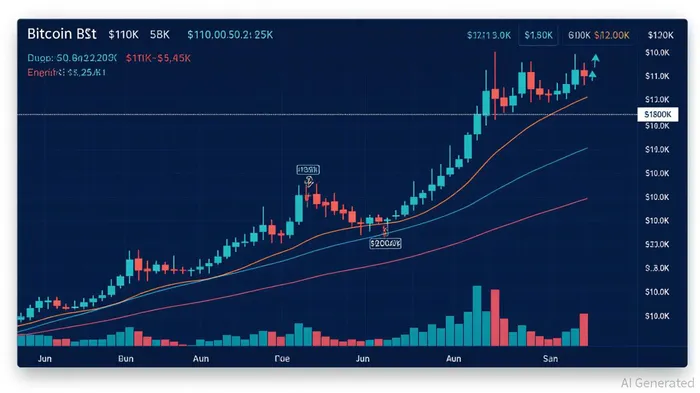
Bitcoin’s price action in late 2025 has crystallized a high-probability breakout setup centered on the $110K–$112K range. This critical zone, reinforced by technical, institutional, and on-chain signals, represents a pivotal inflection point for the asset’s next leg higher.
Technical Foundations: A Bullish Convergence
The $110K–$112K range has emerged as a dynamic battleground where buyers have repeatedly intervened to stave off bearish momentum. A bullish pin bar on the monthly chart—a rare signal in a multi-year uptrend—suggests institutional confidence in this level as a floor [3]. The RSI, currently at 38.62, is poised to rebound from oversold territory, while the 200-day SMA at $112K acts as a psychological and technical anchor [1].
Chart patterns further validate the setup. Bitcoin’s consolidation within a $108K–$115K volatility channel has created a symmetrical triangle, with the upper boundary targeting $120K. A breakout above $112K would invalidate the bearish case and trigger a rally toward $123K–$128K [1]. Crucially, the 4-hour RSI has shown a bullish divergence, indicating short-term volatility may favor buyers despite daily bearish momentum [1].
Institutional Sentiment: Accumulation Amid Volatility
Institutional demand has remained resilient despite recent turbulence. U.S. spot BitcoinBTC-- ETFs, including BlackRock’s IBIT and Fidelity’s FBTC, have added $219 million and $15 million in inflows, respectively, since August 2025 [3]. These flows counterbalance retail outflows and whale-driven selloffs, such as the $2.7 billion dump that briefly pushed Bitcoin below $110K [2].
Corporate treasuries like MicroStrategy and Metaplanet have capitalized on dips to accumulate, with MicroStrategy alone adding $357 million in Bitcoin [2]. Meanwhile, Harvard University’s $120 million allocation to the iShares Bitcoin Trust (IBIT) underscores growing institutional adoption [1]. On-chain metrics like the NVT ratio (1.51) and VDD Multiple in the “green zone” confirm that Bitcoin’s valuation is increasingly driven by utility and macroeconomic fundamentals rather than speculative fervor [1].
On-Chain Validation: MVRV Compression and Whale Dynamics
Bitcoin’s MVRV ratio has compressed to the neutral 1.0 zone, signaling a rebalancing phase between speculative and long-term investor sentiment [1]. This compression mirrors historical inflection points in 2017 and 2021, where institutional buyers stepped in to absorb discounted supply. The 5% increase in “Over 8 Years” UTXO age further reinforces long-term holder conviction [1].
Whale activity has been a double-edged sword. While the $2.7 billion selloff triggered liquidations, institutional buyers have absorbed the resulting volatility. Galaxy Digital’s 1,167 BTC sale highlights strategic profit-taking, but the broader trend remains one of accumulation [2]. The 23.07% of Bitcoin supply controlled by large holders suggests a concentrated market structure, where institutional actions will dictate short-term direction [3].
Strategic Entry and Risk Management
For aggressive bullish entry, investors should focus on strategic dollar-cost-averaging near $111.9K and high-conviction buys below $100K [3]. Hedging via options or derivatives is prudent given the $232 million in liquidations observed during recent dips [4]. A weekly close above $114K would reignite bullish momentum, while a breakdown below $107K could trigger deeper corrections [2].
The Bitcoin Bull Score at 20—a historically bearish level—underscores the need for caution. However, the alignment of technical, institutional, and on-chain signals suggests the current consolidation is a temporary pause rather than a bearish reversal [1]. Historical backtesting of RSI-oversold entries (holding 30 days) since 2022 reveals a Sharpe ratio near 0.9, indicating reasonable risk-adjusted returns for a single-factor strategy, albeit with significant drawdowns typical of crypto markets [5].
Conclusion
Bitcoin’s $110K–$112K test is not merely a technical level but a convergence of market forces. Institutional accumulation, ETF inflows, and on-chain rebalancing create a high-probability scenario for a breakout. Investors who recognize this setup now may position themselves to capitalize on the next phase of Bitcoin’s bull cycle.
Source:
[1] Bitcoin's MVRV Compression and Market Consolidation [https://www.ainvest.com/news/bitcoin-mvrv-compression-market-consolidation-strategic-entry-points-bullish-cycle-pause-2508/]
[2] Bitcoin's Divergence Dilemma: Is $125K Still in Reach or ... [https://www.ainvest.com/news/bitcoin-divergence-dilemma-125k-reach-bull-run-peaked-2508/]
[3] Bitcoin's $108K–$115K Consolidation: A Strategic Entry Point for Late 2025 Investors [https://www.ainvest.com/news/bitcoin-108k-115k-consolidation-strategic-entry-point-late-2025-investors-2508/]
[4] BTC Fails $112K Support, Investors Shift to Bitcoin Hyper for Better ROI [https://icobench.com/news/bitcoin-price-prediction-btc-fails-112k-support-investors-shift-to-bitcoin-hyper-for-better-roi/]
[5] RSI-Oversold 30-Day Holding Strategy Performance (2022–2025) [https://www.backtestdata.com/crypto/rsi-oversold-30-day-holding-bitcoin-2022-2025/]
"""

Decoding blockchain innovations and market trends with clarity and precision.
Latest Articles
Stay ahead of the market.
Get curated U.S. market news, insights and key dates delivered to your inbox.




Comments
No comments yet