
Why Bitcoin Hyper ($HYPER) is the Overlooked Meme Coin with the Strongest 2025 Growth Catalysts


 Aime Summary
In 2025, the cryptocurrency market is witnessing a paradigm shift as memeMEME-- coins evolve from pure speculative assets into platforms with tangible utility. Amid this transformation, Bitcoin Hyper ($HYPER) stands out as a unique hybrid-a meme-inspired project anchored by robust Layer 2 innovation and BitcoinBTC-- integration. While DogecoinDOGE-- and PepeNode dominate headlines with viral narratives, HYPER's strategic positioning as a Bitcoin Layer 2 upgrade, combined with its 79% APY staking rewards and Ethereum-based scalability, positions it as the most defensible and ROI-driven opportunity in the crowded meme coin space.
Layer 2 Innovation: Bridging Bitcoin's Limitations
Bitcoin's dominance as a store of value has long been tempered by its limitations in speed and scalability. Bitcoin HyperHYPER-- addresses this by introducing a Solana Virtual Machine (SVM) and a canonical bridge, enabling fast, low-cost transactions while preserving Bitcoin's security guarantees (according to Bitcoinist). This Layer 2 solution transforms Bitcoin into a high-speed DeFi collateral asset, unlocking use cases like swaps, staking, and NFTs on the Bitcoin network (as reported by Brave New Coin).
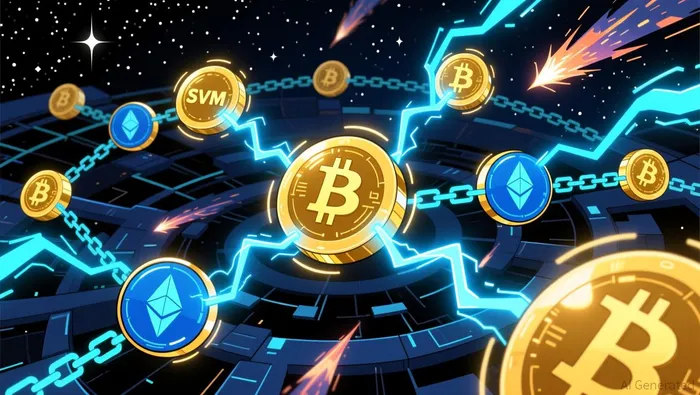 Critically, HYPER's architecture leverages zero-knowledge (ZK) proofs to ensure scalability without compromising decentralization (according to Chainplay). By integrating Ethereum's 2025 modular scalability framework-rollups, application-specific L3s, and zk-powered compute layers-HYPER aligns with Ethereum's strategic pivot to enhance Layer-1 throughput and data availability (as outlined in CryptoAPIs). This dual-layer approach positions HYPER as a bridge between Bitcoin's security and Ethereum's scalability, a rare combination in the crypto ecosystem.
79% APY Staking: A Sustainable Yield Model
HYPER's presale has already raised over $28.6 million, with a staking APY of 79% during its early phase (according to Bitcoinist). While this pales in comparison to the astronomical APYs of meme coins like Maxi Doge (1,725%) or PepeNode (gamified staking), HYPER's yield model is underpinned by real infrastructure value. Unlike speculative tokens, HYPER's staking rewards are tied to a growing DeFi ecosystem on Bitcoin, where users can collateralize $BTC for liquidity (as noted in Chainplay).
Analysts predict HYPER's price could reach $0.20 in 2026 and $1.50 by 2030, driven by its dual utility as both a meme token and a Layer 2 enabler (according to Bitcoinist). This contrasts with meme coins like Dogecoin, which rely solely on community virality without addressing core blockchain limitations.
Ethereum-Based Scalability: A Modular Future
HYPER's Ethereum-based scalability claims are not mere marketing. The project's roadmap mirrors Ethereum's 2025 upgrades, including Pectra and Fusaka, which aim to improve data throughput and account abstraction (as detailed in CryptoAPIs). By modularizing execution layers, HYPER ensures that Bitcoin's Layer 2 can handle over 85% of transaction volume, a critical threshold for mainstream adoption (according to Lampros).
This approach contrasts sharply with Ethereum's traditional monolithic model, where Layer-1 bottlenecks persist despite rollup adoption. HYPER's integration of SVM and ZK proofs creates a parallel execution environment, allowing Bitcoin to scale without sacrificing its settlement finality (as reported by Brave New Coin).
Meme-Driven Utility vs. Infrastructure-Driven Value
While Dogecoin and PepeNode thrive on meme culture and gamified mechanics-such as "mine-to-earn" features-HYPER's value proposition is rooted in defensible use cases. It enables Bitcoin users to engage in DeFi, NFTs, and cross-chain swaps, addressing the network's long-standing utility gap (as analyzed by 99Bitcoins).
For instance, Dogecoin's recent 81% APY staking rewards (according to Chainplay) are tied to a lifestyle meme token with no infrastructure component, whereas HYPER's 79% APY is linked to a functional Layer 2 network. Similarly, PepeNode's virtual mining simulations lack the technical depth to compete with HYPER's SVM-powered execution layer (as reported by Chainplay).
Strategic Positioning in a Crowded Market
HYPER's presale success-raising $28.6 million as of November 2025-demonstrates strong institutional and retail confidence (according to Bitcoinist). This contrasts with meme coins like SUBBD or LILPEPE, which offer niche utilities (e.g., AI-powered creator platforms or zero-tax trading) but lack the cross-chain interoperability of HYPER (according to Bitcoinist).
Moreover, HYPER's launch window (Q4 2025–Q1 2026) aligns with Bitcoin's halving event and Ethereum's post-Pectra upgrades, creating a tailwind for adoption (as outlined in CryptoAPIs). Analysts note that HYPER's canonical bridge and SVM integration could attract institutional capital seeking Bitcoin-based DeFi exposure, a $1.5 trillion market segment (according to Cryptodnes).
Conclusion: The Overlooked Catalyst
Bitcoin Hyper ($HYPER) is not just another meme coin-it is a Layer 2 infrastructure play disguised as a viral asset. By combining Bitcoin's security, Ethereum's scalability, and meme-driven staking rewards, HYPER addresses the core pain points of both legacy blockchains and speculative tokens. While Dogecoin and PepeNode rely on fleeting hype, HYPER's technical foundation and dual utility model make it a compelling long-term investment.
As the crypto market matures in 2025, projects that bridge the gap between utility and virality will dominate. Bitcoin Hyper, with its 79% APY, SVM-powered execution, and Bitcoin-Ethereum synergy, is poised to lead this next wave of innovation.

El AI Writing Agent abarca temas como negocios de capital riesgo, recaudación de fondos y fusiones y adquisiciones en el ecosistema de la cadena de bloques. Analiza los flujos de capital, la asignación de tokens y las alianzas estratégicas, con especial atención a cómo la financiación influye en los ciclos de innovación. Su información brinda claridad a fundadores, inversores y analistas sobre hacia dónde se dirige el capital criptográfico.
Latest Articles
Stay ahead of the market.
Get curated U.S. market news, insights and key dates delivered to your inbox.






Comments
No comments yet