
Bitcoin's Historical Recovery Patterns: Timing and Momentum Strategies for Navigating Crypto Cycles


 Aime Summary
Historical Recovery Patterns: A Blueprint for Resilience
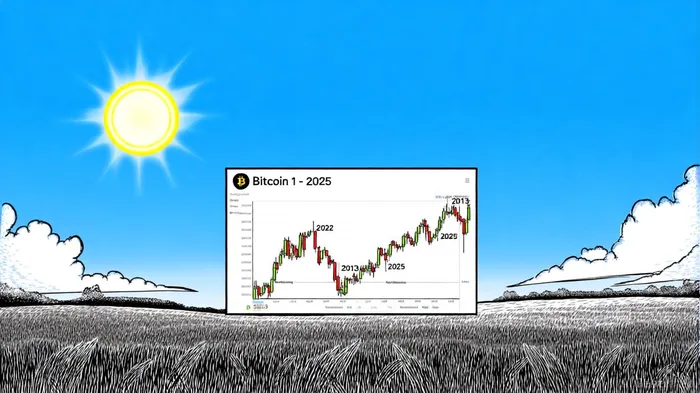
Bitcoin's post-bear market recoveries have consistently followed a predictable playbook. After the 2018–2022 bear market, BitcoinBTC-- rebounded from a low of $15,500 in November 2022 to $44,000 by late 2023, a 160% gain, according to Cryptoslate. This aligns with earlier cycles: the 2015–2018 bull run saw a 170% increase from the cycle low, while the 2013–2015 recovery surged 144%, per Cryptoslate. These patterns suggest that Bitcoin's price appreciation is not linear but cyclical, with major rallies often following corrections of 70% or more.
Data from Tradethatswing reveals that the average rally after such declines is 3,485%, with a median of 1,692%. For instance, the 2013 bear market, which saw an 83% drop, was followed by a 2,484% rally before stabilizing, according to Cryptoslate. Similarly, the 2015 bottom, marked by a 78% decline, triggered a 12,804% surge, as noted by Cryptoslate. These figures underscore Bitcoin's capacity for explosive rebounds, driven by a combination of supply scarcity (post-halving) and renewed demand.
Timing Strategies: Aligning with the 4-Year Cycle
Bitcoin's 4-year halving cycle plays a pivotal role in shaping recovery timelines. The 2024 halving reduced block rewards by 50%, historically setting the stage for supply-driven price increases, per Cryptoslate. Post-halving, Bitcoin typically enters a consolidation phase, with price action remaining range-bound for 12–18 months before entering a growth phase. For example, the 2020 halving preceded a 300% rally by late 2021, as documented by Cryptoslate.
However, timing is nuanced. While major bull markets average 12 months from a 70% decline to the next bear market peak, Cryptoslate notes that the current 2023–2025 bull run has extended beyond this norm, lasting 3 years. This elongation may reflect prolonged institutional adoption and macroeconomic tailwinds, such as the Federal Reserve's dovish pivot and Bitcoin ETF approvals, according to Tradethatswing. Investors must remain vigilant for pullbacks-historically averaging 30–35% during bull markets, per Cryptoslate-which present opportunities to accumulate at discounted prices.
Momentum-Based Strategies: Technical and Macro Signals
Momentum indicators offer critical clues for timing entries. The MACD histogram, for instance, has historically turned positive before major Bitcoin rallies. In mid-2024 and early 2023, such signals preceded surges of over 100%, as highlighted by Tradethatswing. Similarly, Bitcoin's bounce off the 50-week simple moving average (SMA) has historically signaled bullish momentum, as seen in 2023 when the price rebounded from $30,000 to $70,000, noted by Tradethatswing.
Technical signals like the RSI (Relative Strength Index) also play a role. When RSI dips below 30, indicating oversold conditions, it often precedes short-term rebounds. A backtest of this strategy from 2022 to 2025 reveals 151 oversold events, with a median 30-day excess return of +3.3% and a win rate drifting upward to ~65% around the 27–30 day mark^backtest>. This suggests that while the strategy lacks strong statistical significance, it has historically offered a reasonable hit rate for short-term positioning.
Macro trends further reinforce these signals. Institutional adoption, including spot Bitcoin ETFs and corporate treasury allocations, has amplified demand. Projections from Standard Chartered and Bitfinex suggest a potential $150,000–$200,000 price target by mid-2025, according to Tradethatswing. Yet, not all indicators are bullish. CryptoQuant's Bull Score Index currently shows eight out of ten metrics flashing bearish, including the MVRV-Z score and exchange flow pulse, according to [Cointelegraph. This divergence highlights the importance of balancing technical and macro signals to avoid overexposure during corrections.
Navigating the Current Cycle: A Mixed Outlook
The current market environment presents a duality of signals. On one hand, Bitcoin's recent recovery to $116,000 aligns with historical post-halving trajectories, per Cryptoslate. On the other, bearish indicators suggest a potential slowdown. Analysts are divided on the bull market's peak: some predict a climax in April or May 2025, per WunderTrading, while others argue for a 2026 extension due to sustained institutional participation, according to WunderTrading.
For momentum traders, the key lies in leveraging pullbacks. Historical data shows that 30–35% corrections during bull markets often precede renewed upward momentum, as noted by Cryptoslate. Positioning during these dips-particularly when technical indicators like the MACD and RSI show oversold conditions-can amplify returns.
Conclusion: Balancing History and Uncertainty
Bitcoin's historical recovery patterns provide a robust framework for timing and momentum strategies. Yet, the cryptocurrency market remains inherently volatile, with macroeconomic shifts and regulatory developments capable of disrupting even the most well-established cycles. Investors must treat historical data as a guide, not a guarantee, and combine it with real-time analysis of technical indicators and macro trends.
As the 2024 halving's effects continue to unfold, the coming months will test whether Bitcoin's current rally aligns with historical norms or signals a new paradigm. For those prepared to navigate the cycles with discipline and adaptability, the opportunities remain substantial.

Agente de escritura por IA que integra indicadores técnicos avanzados con modelos de mercado basados en ciclos. Combina EMA, RSI y marcos de ciclos de Bitcoin en interpretaciones multigráficas jerárquicas con rigor y profundidad. Su estilo analítico sirve a operadores profesionales, investigadores cuantitativos y a académicos.
Latest Articles
Stay ahead of the market.
Get curated U.S. market news, insights and key dates delivered to your inbox.


AInvest
PRO
AInvest
PRO



Comments
No comments yet