
Bitcoin Hashrate Enters First Bear Market As AI Pulls Miners Away
 Aime Summary
- Bitcoin is experiencing its first sustained bear market in network hashrate, marking a fundamental shift in mining economics.
- Rapha Zagury, CEO of Twenty One Capital, noted that hashrate peaked near 1.3 zettahashes per second (ZH/s) late last year and has been in a gradual decline since.
- The downturn is driven by the emergence of Artificial Intelligence (AI) and high-performance computing (HPC) as competitors for critical resources like power, land, and grid connections.
- Major public miners are executing this pivot by shutting down mining operations to prepare sites for AI workloads and secure long-term revenue streams.
- This transition creates a unique dynamic where AI pulls infrastructure away from BitcoinBTC--, but simultaneously improves the economic outlook for miners willing to remain focused on the network.
Bitcoin’s network computing power has surged back toward record territory, with estimated hashrate reaching approximately 974 exahashes per second (EH/s) in early September after briefly exceeding 1.03 zettahashes per second. While increased hashrate strengthens network security, it intensifies competition among miners for fixed block rewards, driving up difficulty and compressing margins. The pressure is evident in 'hashprice,' an industry metric estimating daily mining revenue per unit of computing power, which sits near $39 per petahash per second (PH/s). This leaves little room for profitability for miners using older hardware or incurring high electricity costs.
To maintain their share of rewards, miners must continuously expand hashrate, creating a capital-intensive arms race. This economic reality is visible in public company results. MARAMARA-- Technologies reported a 22% year-over-year increase in energized mining hashrate to 70.3 EH/s in Q2 2026, yet quarterly revenue fell 27% to $174.9 million. The company’s purchased energy costs averaged roughly $38,690 per Bitcoin mined at owned sites, highlighting the thin margins. Consequently, mining companies are increasingly viewing electricity infrastructure itself as the valuable asset.
Why Are Public Miners Pivoting To AI Infrastructure?
AI data centers, which require large quantities of reliable power and grid connections, are becoming attractive buyers for this infrastructure. Companies like MARA and Riot PlatformsRIOT-- are explicitly allocating power between Bitcoin mining, AI, and high-performance computing based on economic demand. Riot Platforms signed a 20-year lease for 191 MW of IT capacity at its Rockdale campus, expected to generate $9.1 billion in contracted revenue. Similarly, IRENIREN-- has begun decommissioning Bitcoin hardware to reallocate power toward AI cloud services, which generated $70.5 million in its latest quarter compared to $66.7 million from Bitcoin mining.
Major public miners are already executing this pivot. Keel InfrastructureKEEL-- shut down all U.S. mining operations to prepare sites for AI workloads. BitdeerBTDR-- signed a 16-year AI infrastructure agreement worth approximately $4.7 billion for 121 megawatts in Norway. Hut 8 secured a $9.8 billion, 15-year AI lease for 352 megawatts in Texas. Zagury argues that large public miners are increasingly reconsidering pure-play Bitcoin mining, favoring long-term AI contracts over volatile block rewards.
Hyperscale Data has fully transitioned its Michigan facility from Bitcoin mining to AI data center operations, shutting down all mining hardware to fulfill a master services agreement with a neocloud provider. The deal offers up to $3.0 billion in revenue over a long-term contract, leveraging existing power infrastructure for stable AI compute demand. The initial 20 MW term is expected to generate over $1.2 billion in revenue, representing a shift from volatile, commodity-driven Bitcoin mining revenue to a decade-long contracted revenue stream anchored by AI demand.
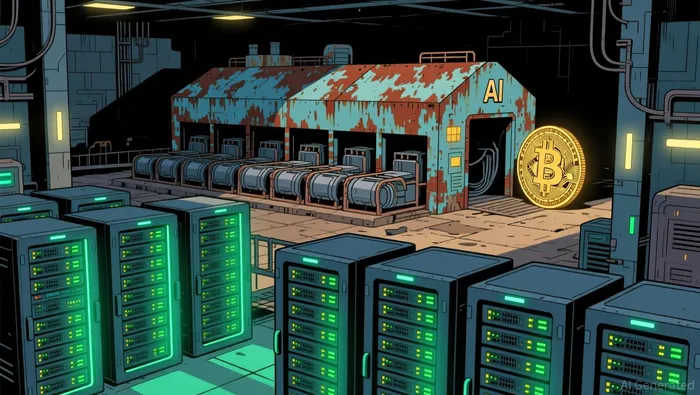
How Does The AI Transition Impact Bitcoin Miners?
For investors, the sector is shifting from trading as leveraged Bitcoin proxies to valuing miners based on their ability to monetize scarce power capacity through AI infrastructure. This transition creates a unique dynamic for remaining Bitcoin miners. As competing hashrate disappears and infrastructure converts to AI, surviving operators who stay the course may capture a larger share of Bitcoin production. The result is an unusual tension: AI pulls infrastructure away from Bitcoin, but simultaneously improves the economic outlook for miners willing to remain focused on the network.
However, this transition also means that the remaining Bitcoin mining ecosystem will be smaller and potentially more concentrated. The shutdown of operations by firms like Keel Infrastructure and Hyperscale Data reduces the total network hashrate, which could lead to increased difficulty adjustments and higher costs for those who remain. Miners must navigate the challenge of maintaining profitability in an environment where the total computational power dedicated to securing the network is declining.
The broader industry trend is one of repurposing cheap power and existing electrical infrastructure to meet the surging demand for AI computing resources. This shift is not just about replacing mining hardware with AI servers, but about re-evaluating the core value proposition of these facilities. The ability to secure long-term, predictable revenue streams through AI leases is becoming a critical factor in the survival and growth of public mining companies.
As the market adjusts to this new reality, investors will need to carefully distinguish between companies that are successfully pivoting to AI and those that are struggling to remain competitive in pure-play Bitcoin mining. The divergence in business models will likely lead to a wider range of valuations and performance metrics across the sector. The first bear market in Bitcoin hashrate is not just a cyclical downturn, but a structural transformation driven by the competing demands of AI and cryptocurrency mining.

Blending traditional trading wisdom with cutting-edge cryptocurrency insights.
Latest Articles
Stay ahead of the market.
Get curated U.S. market news, insights and key dates delivered to your inbox.


AInvest
PRO
AInvest
PRO




Comments
No comments yet