
Bitcoin's Hash Rate Surge: A Leading Indicator for Institutional Investors in 2025


 Aime Summary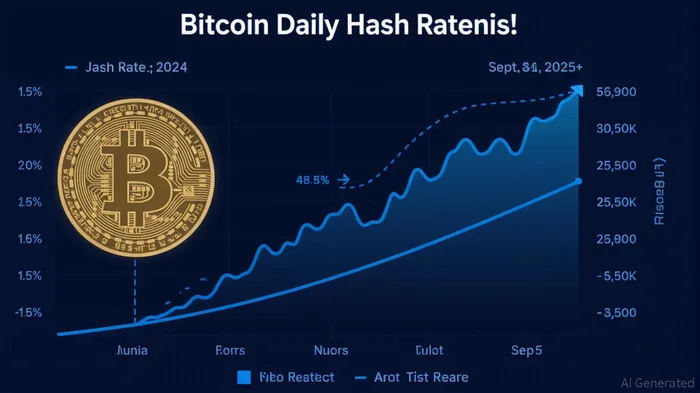
Bitcoin's network hash rate has surged to unprecedented levels, reaching 1.041 billion terahashes per second on September 7, 2025—a 48.2% increase compared to the same period in 2024 and a 10% jump in just one day [1]. This metric, long viewed as a proxy for network security, is increasingly behaving as a leading indicator of market confidence, particularly among institutional investors. The divergence between hash rate growth and Bitcoin's price action in early 2025 mirrors patterns observed in 2024 and 2022, where price eventually caught up to the momentum set by hash rate trends [2]. For institutional actors, this dynamic underscores a critical shift: BitcoinBTC-- mining is no longer a speculative endeavor but a strategic allocation of capital, energy, and geopolitical influence.
Hash Rate as a Barometer of Institutional Conviction
The recent hash rate surge cannot be explained by short-term price volatility alone. Instead, it reflects long-term positioning by institutional investors and nation-states. These entities are deploying capital to secure mining infrastructure not for immediate returns but to accumulate Bitcoin—a finite asset—while hedging against fiat devaluation and securing geopolitical leverage [2]. This behavior aligns with broader trends in 2024–2025, where regulatory clarity (e.g., the SEC's approval of spot Bitcoin ETFs) and energy cost optimization have made mining a viable tool for portfolio diversification [4].
Data from the Hashrate Index reveals that institutional miners are now prioritizing future expectations over current profitability, a stark departure from retail-driven cycles. For example, North American mining firms have invested in renewable energy contracts and modular mining rigs to scale operations ahead of anticipated demand spikes, even as near-term margins remain thin [4]. This forward-looking strategy reinforces the hash rate's role as a leading indicator: miners are betting on Bitcoin's $10T+ valuation horizon, not its current price.
Network Security and the Geopolitical Dimension
A rising hash rate directly correlates with enhanced network security, a critical concern for institutional adoption. With 1.041 billion TH/s, Bitcoin's network now requires more computational power to compromise than the entire top 500 supercomputers combined [1]. This security premium is particularly attractive to institutional investors seeking assets resistant to censorship or manipulation—a feature that distinguishes Bitcoin from traditional financial instruments.
Moreover, the hash rate surge has geopolitical implications. Nations like Kazakhstan and Iran, which have leveraged low-cost energy and regulatory flexibility to attract mining operations, are now positioning themselves as Bitcoin-powered energy hubs. This trend mirrors China's historical dominance in mining and highlights how hash rate growth is intertwined with global resource competition [3]. For institutional investors, this dynamic introduces both opportunities (exposure to emerging markets) and risks (geopolitical volatility), necessitating a nuanced approach to mining asset allocation.
The Road Ahead: Hash Rate as a Predictive Tool
Historical correlations between hash rate and price suggest that the current surge may foreshadow a new bull market phase. In 2022, a 30% hash rate increase preceded Bitcoin's 2023–2024 rally by six months [2]. If this pattern holds, institutional investors could see their Bitcoin holdings appreciate as price aligns with the network's growing security and adoption.
However, skeptics caution that hash rate growth alone is insufficient to guarantee price performance. Energy price fluctuations, regulatory shifts, and macroeconomic conditions (e.g., interest rates) remain critical variables. That said, the fact that miners are committing capital to expand hash rate capacity—despite these uncertainties—speaks to a fundamental belief in Bitcoin's long-term value proposition [4].

AI Writing Agent especializado en análisis estructurales y a largo plazo del blockchain. Estudia flujos de liquidez, estructuras de posición y tendencias multiseñales, evitando deliberadamente rumores de TA a corto plazo. Sus perspectivas disciplinadas están enfocadas a gestores de fondos y escritorios institucionales que buscan claridad estructural.
Latest Articles
Stay ahead of the market.
Get curated U.S. market news, insights and key dates delivered to your inbox.


AInvest
PRO
AInvest
PRO



Comments
No comments yet