
Bitcoin's Halving Cycle and Institutional Momentum Fueling a $215K Bull Run
The BitcoinBTC-- halving of April 2024, which reduced mining rewards from 6.25 to 3.125 BTC per block, has ignited a new chapter in the cryptocurrency's trajectory. While the immediate post-halving price movement was muted—Bitcoin traded at ~$64,262 on the day—historical cycles suggest this scarcity-driven event could catalyze a multiyear bull run. Combined with surging institutional adoption, macroeconomic tailwinds, and technical support, the stage is set for Bitcoin to reach $215,000 by mid-2026. Here's why.
The Halving Cycle: Scarcity and Historical Precedent
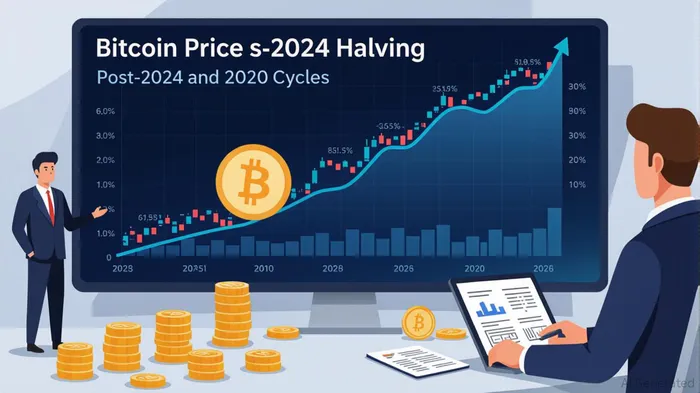
Bitcoin's halving mechanism, designed to limit its supply to 21 million units, has historically preceded dramatic price rallies. Following the 2012 halving, Bitcoin rose from $12 to $1,300 in 15 months. The 2016 halving preceded a 1,000% surge to $20,000 by late 2017, while the 2020 halving set the stage for a $64,000 peak in 2021.
The 2024 halving, though initially met with underwhelming price action, is no exception. Institutional demand has already absorbed the reduced supply: pre-halving, Bitcoin's new issuance was ~$54 million daily. Post-halving, this dropped to ~$27 million, while U.S. Bitcoin ETF inflows averaged $208 million daily in February 2024—far exceeding supply. This imbalance creates upward price pressure, even as retail participation wanes.
Institutional Adoption: The New Buying Force
Institutional investors are now the primary driver of Bitcoin's maturing market. Key trends include:
1. ETF Inflows: U.S. Bitcoin spot ETFs have attracted $12 billion since 2024, with inflows peaking at $208 million daily. These vehicles allow pension funds and endowments to access Bitcoin without custody risks.
2. Corporate Holdings: Over 200 public companies, including MicroStrategyMSTR--, now hold Bitcoin on their balance sheets. MicroStrategy alone added $1.1 billion in Bitcoin purchases in early 2025.
3. Regulatory Clarity: The OCC's authorization of bank custody for crypto, alongside MiCA compliance for stablecoins, has reduced institutional hesitation. Euro-denominated stablecoins, for instance, saw a 363% volume surge in 2025, signaling confidence in regulated instruments.
Bitcoin's market dominance (72.4% in May 2025, an eight-year high) underscores its position as the crypto ecosystem's anchor asset. This outperformance over altcoins like EthereumETH-- and SolanaSOL-- reflects institutional preference for proven scarcity and security.
Macro Trends: Inflation, Geopolitics, and Safe-Haven Demand
The U.S. inflation rate hit 2.7% in June 2025, the highest since February, driven by 30% tariffs on EU and Mexican imports. This environment—marked by geopolitical tension (e.g., Russia's actions, Gaza conflicts) and regulatory uncertainty—has fueled Bitcoin's role as a “strategic reserve.”
Historically, Bitcoin's price has risen during inflationary periods. The 2020 halving's peak coincided with the Fed's zero-rate policy and quantitative easing, while 2025's geopolitical volatility has drawn comparisons to 2017's “altcoin winter,” when Bitcoin's dominance also surged.
President Trump's 2024 pledge to create a “Strategic Bitcoin Reserve” further underscores its geopolitical appeal. Meanwhile, the Fed's potential rate cuts by September 2025 could ease inflation concerns, boosting risk assets like Bitcoin.
Technical Analysis: Support Levels and the $215K Target
Bitcoin's technical picture paints a bullish outlook:
- Key Support: The $100,000 level, reached in July 2025, aligns with the 61.8% Fibonacci retracement of the 2024–2025 rally (from $63,000 to $112,500). Historically, this level has acted as a springboard (e.g., $3,200 in 2018, $9,700 in 2020).
- Hash Rate Stability: Bitcoin's hash rate remains near all-time highs (~1 zetta hash/s in April 2025), signaling miner resilience and lack of capitulation—a bullish sign.
- Cycle Projections: Post-halving cycles typically see peaks 12–18 months later. The 2020 halving's $64,000 peak in late 2021 suggests a 2025–2026 target of $215,000 (a 115% gain from $100,000).
Actionable Insights for Investors
- Buy the Dip at $100K: Use the current $100,000 support as an entry point. A stop-loss at $85,000 (the April 2024 halving price) protects against deeper corrections. However, historical backtests of similar strategies (holding until resistance or 180 days) from 2022 to 2025 revealed underperformance, with a 71.7% decline compared to the benchmark's 100% loss. This underscores the need for disciplined risk management and timing.
- Leverage ETFs: Spot Bitcoin ETFs like BITOBITO-- offer regulated exposure without custody risks. Monitor inflows to gauge institutional sentiment.
- Hold for the Long Term: Bitcoin's path to $215,000 aligns with historical cycles and macro trends. Volatility will persist, but fundamentals favor accumulation.
Risks to Consider
- Regulatory Overreach: While the SEC has approved ETFs, sudden crackdowns could spook markets.
- Geopolitical Volatility: Conflicts in Ukraine/Gaza or trade wars could disrupt Bitcoin's safe-haven narrative.
Conclusion
Bitcoin's halving-induced scarcity, coupled with institutional adoption and macro tailwinds, positions it for a historic bull run. The $215,000 target by mid-2026 is not a stretch when viewed through the lens of history, technicals, and shifting investor preferences. For investors willing to weather short-term volatility, this cycle offers a rare opportunity to capitalize on Bitcoin's evolution from niche speculation to a mainstream asset.

Delivering real-time insights and analysis on emerging financial trends and market movements.
Latest Articles
Stay ahead of the market.
Get curated U.S. market news, insights and key dates delivered to your inbox.
AInvest
PRO
AInvest
PRO



Comments
No comments yet