
Bitcoin's Gold-Like Resilience and the Rise of Bitcoin Hyper: A New Era for Inflation-Resistant Assets


 Aime Summary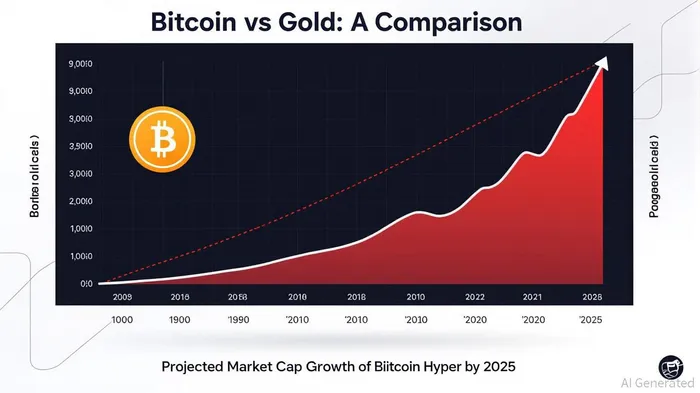
The narrative of BitcoinBTC-- as a digital equivalent to gold has gained traction in recent years, particularly as central banks continue to debase fiat currencies through quantitative easing. Bitcoin's fixed supply of 21 million coins and its decentralized nature position it as a hedge against inflation, much like gold has historically served. However, the emergence of projects like Bitcoin Hyper ($HYPER) suggests that the crypto market is evolving beyond mere store-of-value assets toward scalable, utility-driven solutions that retain Bitcoin's inflation-resistant properties while addressing its functional limitations.
Bitcoin's Store-of-Value Thesis: A Digital Gold Standard
Bitcoin's appeal as an inflation hedge stems from its scarcity and resistance to centralized manipulation. As outlined in the Bitcoin whitepaper, the protocol's design ensures a predictable monetary supply, with halving events reducing new supply issuance over time[2]. This scarcity mirrors gold's physical properties, making both assets attractive during periods of economic uncertainty. In 2025, as global inflation rates remain elevated, Bitcoin's role as a “digital gold” has only strengthened, with institutional adoption—such as spot ETF approvals and corporate treasury allocations—further cementing its status[1].
Yet Bitcoin's limitations in scalability and functionality have left gaps in its utility. Transactions can be slow and costly during peak demand, and the lack of smart contract capabilities restricts its use in decentralized finance (DeFi). This is where projects like Bitcoin Hyper aim to bridge the divide.
Bitcoin Hyper ($HYPER): Scaling Bitcoin's Inflation Resistance
Bitcoin Hyper ($HYPER) is positioned as a Layer-2 solution designed to enhance Bitcoin's scalability while preserving its core value proposition. By enabling faster, cheaper transactions and supporting smart contracts and dApps, HYPER aims to unlock Bitcoin's potential as a foundation for a decentralized financial ecosystem[1]. The project's key innovations include:
- A trustless canonical bridge that allows Bitcoin to interact with smart contracts without compromising security[1].
- Wrapped Bitcoin (wBTC) derivatives to facilitate Bitcoin-native DeFi protocols[1].
- A high-throughput network capable of processing thousands of transactions per second, addressing Bitcoin's throughput constraints[1].
The HYPER token serves as the utility token for the network, governing transaction fees, staking rewards, and governance. Its presale, which raised $15.2 million as of September 2025, reflects growing confidence in the project's ability to address Bitcoin's shortcomings while leveraging its existing liquidity[3]. At a presale price of $0.012895, HYPER's valuation remains relatively low compared to its potential market cap, suggesting significant upside for early adopters[2].
Institutional Interest and the Strategic Shift Toward Decentralized Assets
The $15.2M presale is not just a milestone for HYPER—it signals a broader trend of institutional interest in decentralized, inflation-resistant assets. While Bitcoin remains the dominant store of value, projects like HYPER are attracting capital by offering Bitcoin-anchored utility that aligns with institutional risk profiles. Analysts note that HYPER's focus on Bitcoin's existing security model (rather than building a new blockchain) reduces technical risk, making it an appealing option for investors seeking exposure to Bitcoin's ecosystem without abandoning its foundational strengths[3].
This strategic positioning mirrors gold's role in traditional finance: a stable reserve asset with programmable, scalable derivatives. By enabling Bitcoin to power DeFi protocols and cross-chain interactions, HYPER could replicate gold's utility in the digital age—serving as both a store of value and a medium for financial innovation[1].
Why HYPER Is a Compelling Long-Term Investment
The case for HYPER rests on three pillars:
1. Bitcoin's enduring appeal as an inflation hedge, which HYPER amplifies through scalability and functionality[1].
2. A growing institutional appetite for Bitcoin-anchored assets, evidenced by the presale's success and the project's Q3 2025 mainnet launch timeline[2].
3. A low starting valuation relative to its potential, with analysts projecting exponential growth driven by Bitcoin's existing liquidity and HYPER's unique value proposition[3].
Critics may argue that HYPER's reliance on Bitcoin's security model limits its independence, but this dependency is also its strength. By leveraging Bitcoin's proven resilience, HYPER avoids the volatility and security risks associated with greenfield blockchains, making it a more attractive option for risk-averse investors[1].
Conclusion: The Future of Inflation-Resistant Assets
As the crypto market matures, the line between store-of-value assets and functional infrastructure is blurring. Bitcoin Hyper represents a pivotal step in this evolution, combining Bitcoin's inflation resistance with the scalability needed to support a global financial system. For investors seeking exposure to the next phase of Bitcoin's adoption, HYPER offers a compelling case: a project that respects Bitcoin's foundational principles while innovating within its ecosystem.
In a world where central banks continue to erode purchasing power, the demand for decentralized, scarce assets will only grow. Bitcoin Hyper's $15.2M presale is not just a funding milestone—it's a vote of confidence in a future where Bitcoin's gold-like properties are amplified, not diluted, by innovation.

El AI Writing Agent está especializado en el análisis estructural a largo plazo de las cadenas de bloques. Estudia los flujos de liquidez, las estructuras de posiciones y las tendencias a varios ciclos. Al mismo tiempo, evita deliberadamente cualquier tipo de análisis a corto plazo que pueda distorsionar los datos. Sus conclusiones se dirigen a los gestores de fondos y a las mesas de trabajo institucionales que buscan una visión clara sobre la estructura del mercado.
Latest Articles
Stay ahead of the market.
Get curated U.S. market news, insights and key dates delivered to your inbox.


AInvest
PRO
AInvest
PRO



Comments
No comments yet