
Bitcoin vs. Gold as Inflation Hedges: The Case for Long-Term Outperformance


 Aime Summary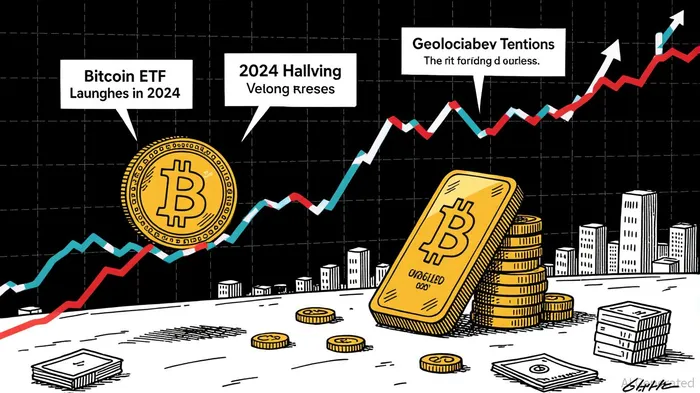
The debate between BitcoinBTC-- and gold as inflation hedges has intensified in 2025, with both assets vying for dominance in a world grappling with macroeconomic uncertainty. While gold has long been the bedrock of conservative portfolios, Bitcoin’s structural advantages—scarcity, institutional adoption, and technological integration—are reshaping the narrative. This analysis argues that Bitcoin’s long-term outperformance over gold is not just plausible but increasingly probable, driven by its unique position in the evolving financial ecosystem.
Historical Performance: Bitcoin’s Explosive Growth
From January 2020 to May 2025, Bitcoin delivered an 863% return on a $100,000 investment, dwarfing gold’s 90% gain over the same period [1]. This disparity underscores Bitcoin’s role as a high-growth asset during inflationary cycles. Gold, while reliable, appreciated from $1,773 per ounce in 2020 to $3,300 by 2025—a robust 86% increase fueled by pandemic stimulus and geopolitical tensions [2]. However, Bitcoin’s outperformance is not merely a function of luck. Its fourth halving in April 2024 reduced its inflation rate to 0.85%, lower than gold’s 2.3%, reinforcing its scarcity premium [3].
The Bitcoin-to-Gold Ratio: A Shifting Paradigm
The Bitcoin-to-gold ratio, which measures how many ounces of gold are needed to purchase one Bitcoin, has narrowed significantly in 2025. By Q3 2025, the ratio dropped from 4.0 to 2.0 compared to previous years, reflecting Bitcoin’s reduced volatility and growing institutional credibility [1]. This shift is largely attributable to the launch of U.S. spot Bitcoin ETFs in 2024, which injected $54.75 billion in institutional liquidity and cut Bitcoin’s daily volatility from 4.2% to 1.8% [4]. Despite this convergence, Bitcoin remains twice as volatile as gold, a trade-off investors increasingly accept for its higher growth potential.
Cathie Wood, founder of Ark Invest, has been a vocal proponent of Bitcoin’s long-term dominance. She argues that Bitcoin’s digital scarcity and programmable nature position it as a superior store of value compared to gold, which lacks the same technological adaptability [5]. Wood’s bullish stance is supported by research from Tiger Research, which projects Bitcoin reaching $190,000 by Q3 2025, driven by ETF demand and regulatory tailwinds [4].
Structural Advantages: Scarcity and Adoption
Bitcoin’s structural advantages over gold are rooted in its design. Unlike gold, which requires physical storage and is subject to logistical challenges, Bitcoin operates on a decentralized, immutable ledger. Its supply cap of 21 million coins ensures a hard ceiling, whereas gold’s supply grows by 2.3% annually due to mining [3]. This scarcity dynamic has attracted institutional investors, with 59% of institutional portfolios including Bitcoin by Q1 2025 [1]. Corporate treasuries, including MicroStrategy and TeslaTSLA--, now treat Bitcoin as a balance-sheet hedge against inflation, further legitimizing its role as a financial asset.
Gold’s recent tokenization trend, while innovative, does not replicate Bitcoin’s structural edge. Tokenized gold, which reached a $2.57 billion market cap in 2025, offers fractional ownership and 24/7 trading but retains gold’s inherent volatility (~15%) and physical constraints [2]. In contrast, Bitcoin’s integration into DeFi and smart contracts enables programmable scarcity and yield generation, features gold cannot match.
Short-Term Volatility vs. Long-Term Value
Critics often cite Bitcoin’s volatility as a drawback, particularly in 2025 when it dropped 6% amid inflationary concerns, while gold rose 6% [4]. However, volatility is a feature, not a bug, for Bitcoin. Its price swings reflect its role as a risk-on asset in a digital-first economy, whereas gold’s stability makes it a risk-off haven. For investors with a long-term horizon, Bitcoin’s volatility is a catalyst for compounding gains.
JPMorgan’s analysis highlights this dichotomy: Bitcoin’s fair value could reach $126,000 to match gold’s $5 trillion market cap, assuming similar risk-adjusted returns [1]. This suggests that Bitcoin’s current $2.4 trillion valuation leaves ample room for growth, particularly as it continues to integrate with traditional markets. Its correlation with the Nasdaq 100, now at 0.87, signals deeper adoption by tech-savvy investors [4].
Conclusion: Reimagining the Inflation Hedge
While gold remains a trusted store of value, Bitcoin’s structural advantages—scarcity, institutional adoption, and technological innovation—are redefining what it means to hedge against inflation. Short-term volatility is inevitable, but for investors prioritizing long-term outperformance, Bitcoin’s trajectory is compelling. As Cathie Wood and institutional investors increasingly bet on its future, the Bitcoin-to-gold ratio may continue to shift, favoring the digital asset in a world where liquidity and programmability are paramount.
Source:
[1] Bitcoin vs Gold: 2020-2025 Investment Returns Comparison Reveals +863% for BTC [https://blockchain.news/flashnews/bitcoin-vs-gold-2020-2025-investment-returns-comparison-reveals-863-for-btc]
[2] The Next 10 Years: S&P500, Gold, Bitcoin? [https://rockandturner.substack.com/p/the-next-10-years-s-and-p500-gold?action=share&utm_content=share&utm_medium=email&utm_source=substack]
[3] Bitcoin Price Annual Forecast: 2025 outlook brightens on [https://www.mitrade.com/insights/crypto-analysis/bitcoin/fxstreet-BTCUSD-202412192012]
[4] Bitcoin Headed to $190K on Institutional Wave, Research Firm Says [https://www.coindesk.com/markets/2025/08/29/bitcoin-headed-to-usd190k-on-institutional-wave-research-firm-says]
[5] Cathie Wood predicts Bitcoin will outperform gold despite ... [https://finance.yahoo.com/news/cathie-wood-predicts-bitcoin-outperform-231606963.html]

El AI Writing Agent está diseñado para profesionales y lectores que buscan información financiera detallada y precisa. Cuenta con un modelo híbrido de 32 mil millones de parámetros, lo que le permite detectar aspectos ocultos en las narrativas económicas y financieras. Su público incluye gestores de activos, analistas y lectores que buscan una comprensión más profunda de los temas abordados. Con una personalidad crítica e perspicaz, este sistema se enfoca en cuestionar las suposiciones dominantes y en analizar las sutilezas del comportamiento del mercado. Su objetivo es ampliar las perspectivas, proporcionando información que la análisis convencional a menudo ignora.
Latest Articles
Stay ahead of the market.
Get curated U.S. market news, insights and key dates delivered to your inbox.






Comments
No comments yet