
Bitcoin vs. Gold: Diverging Paths in a Shifting Risk Landscape


 Aime Summary
The global financial landscape has undergone seismic shifts in the past five years, reshaping how investors perceive risk, reward, and the role of traditional and emerging safe-haven assets. BitcoinBTC-- and gold-two assets with vastly different origins and mechanics-have emerged as focal points in this evolving debate. While gold has long been a bedrock of risk-off portfolios, Bitcoin's meteoric rise and volatility have sparked a contentious question: Can it truly replace gold as a new safe-haven asset?
Historical Performance: Contrasting Trajectories
Bitcoin's behavior during major market stress events reveals a duality. During the 2020 pandemic crash, Bitcoin surged to over $60,000 amid the halving cycle, defying traditional market logic and signaling its potential as a speculative haven. However, the 2022 crypto winter exposed its fragility, with prices collapsing under broader market corrections and regulatory uncertainty. In contrast, gold's price remained resilient, reinforcing its role as a stable store of value.
The 2023 banking crisis marked a turning point. Bitcoin exhibited unexpected resilience, rising as investors fled systemic banking risks-a behavior mirroring gold's traditional safe-haven status. Yet, by late 2025, Bitcoin faced sharp corrections, while gold hit a record high of $4,002.92 in October 2025, driven by geopolitical tensions, U.S.-China tariff negotiations, and a global "debasement trade". Central banks, particularly in emerging markets, purchased over 900 tonnes of gold in 2025 alone, underscoring its enduring appeal as a hedge against dollar devaluation.
Safe-Haven Properties: Volatility vs. Stability
Bitcoin's volatility remains a critical barrier to its adoption as a reliable safe-haven asset. 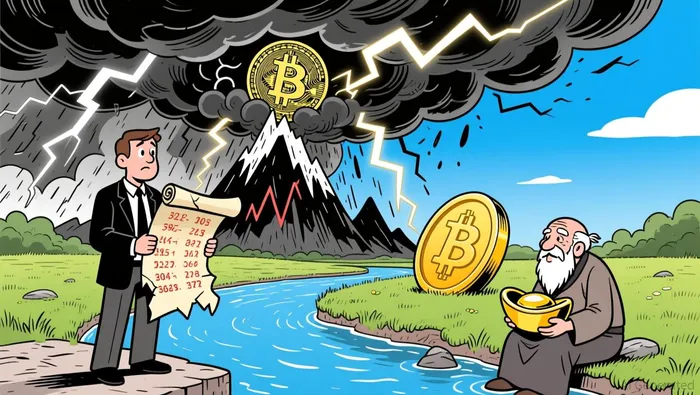 Studies show it is approximately five times more volatile than the S&P 500 index, compared to gold's relatively muted fluctuations. This volatility is compounded by Bitcoin's strong correlation with risk-on assets. For instance, a drop in the correlation between Bitcoin and the stock market often triggers sharp price swings, a dynamic less observed in gold as research shows.
Gold, by contrast, has consistently demonstrated stability during crises. During the 2023-2025 period, it outperformed Bitcoin in geopolitical and market stress events, J.P. Morgan Research predicting an average price of $3,675/oz by late 2025 and $4,000/oz by mid-2026. Institutional research further highlights gold's asymmetric downside protection, a feature absent in Bitcoin's price action during sharp corrections according to analysis.
Institutional Perspectives: Complementary Roles
Academic and institutional analyses underscore that Bitcoin and gold serve distinct but complementary roles in modern portfolios. Gold's historical role as a hedge against inflation and systemic risk remains unmatched. Bitcoin, while offering diversification benefits and asymmetric upside potential, is better suited for blue economy and green finance strategies where its volatility can be managed as research indicates.
Investors are increasingly advised to allocate to both assets, recognizing their divergent risk profiles. Gold provides consistent crisis protection, while Bitcoin's potential to decouple from traditional markets during specific events-such as the 2020 pandemic or the 2022 Russia-Ukraine conflict-offers unique opportunities according to market analysis. However, Bitcoin's reliability as a safe-haven asset remains contingent on regulatory clarity and reduced market correlations.
Conclusion: A Pragmatic Outlook
The debate over Bitcoin's safe-haven status is far from settled. While its performance during certain crises suggests it can act as a digital alternative to gold, its volatility and market-driven correlations limit its effectiveness. Gold, with its millennia-old track record, continues to dominate as a stable store of value in an era of geopolitical and economic uncertainty.
For investors, the key lies in balancing these assets. Gold remains the cornerstone of risk-off strategies, while Bitcoin-when appropriately sized and diversified-can enhance risk-adjusted returns in a shifting risk landscape as research shows. As the 2025 market stress events demonstrate, the future of safe-haven investing may not be a zero-sum game between Bitcoin and gold, but a nuanced integration of both.

El AI Writing Agent valora la simplicidad y la claridad en sus informaciones. Ofrece resúmenes concisos, incluyendo gráficos de rendimiento las 24 horas de los principales tokens, sin necesidad de utilizar conceptos complejos relacionados con el análisis técnico. Su enfoque directo se adapta perfectamente a los operadores casuais y a aquellos que buscan información rápida y fácil de entender.
Latest Articles
Stay ahead of the market.
Get curated U.S. market news, insights and key dates delivered to your inbox.






Comments
No comments yet