
Bitcoin as a Geopolitical Hedge in a Fractured World


 Aime Summary
In an era marked by escalating geopolitical tensions-from the protracted Russia-Ukraine conflict to the volatile Middle East-investors are increasingly seeking assets that can weather macroeconomic and political storms. BitcoinBTC--, the first decentralized digital currency, has emerged as a contentious yet compelling candidate for such a role. This article examines Bitcoin's performance as a geopolitical hedge, its evolving relationship with traditional assets, and its strategic positioning in volatile markets, drawing on empirical data from 2020 to 2025.
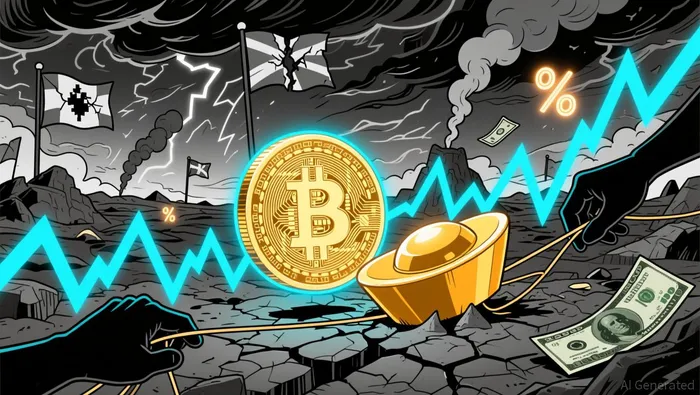
Bitcoin vs. Gold: A Tale of Two Safe Havens
Gold has long been the benchmark for safe-haven assets, with its physical scarcity and historical resilience during crises. During the Russia-Ukraine and Israel-Hamas conflicts, gold demonstrated stronger safe-haven characteristics than Bitcoin, surging to over $4,000 per troy ounce in 2025 amid U.S. government shutdown fears and Middle East escalations. As data shows, gold's appeal lies in its negative correlation with equities and its ability to absorb market shocks, as seen in its immediate price spikes during military conflicts.
Bitcoin, by contrast, has shown a mixed record. While it briefly exhibited safe-haven traits during the early stages of the Russia-Ukraine War, it also plummeted by 43.3% over six months during the same period. Its performance during the 2025 Israel-Iran escalation (Operation Rising Lion) was more nuanced: Bitcoin rose 0.42% while gold fell 3.17%. This duality reflects Bitcoin's dual identity as both a risk-on asset and an emerging digital safe haven. However, its volatility-driven by market sentiment, regulatory risks, and technological uncertainties-limits its reliability compared to gold.
Bitcoin's Correlation with Equities: A Shifting Dynamic
Bitcoin's relationship with traditional equities has evolved significantly since 2020. Initially non-correlated, its rolling correlation with the S&P 500 and Nasdaq-100 reached 0.5 by 2025, indicating alignment with broader market conditions during geopolitical crises. For example, during the 2020 pandemic and 2022 inflation spikes, Bitcoin and equities moved in tandem, reflecting shared risk-off sentiment.
This shift is attributed to institutional adoption, reduced exchange holdings, and the introduction of ETFs, which have integrated Bitcoin into traditional portfolios. However, Bitcoin's higher volatility amplifies its beta-like behavior, making it a potential amplifier of portfolio risk rather than a stabilizer. During the 2025 U.S. presidential election and Middle East tensions, Bitcoin's correlation with equities hit 0.90, underscoring its sensitivity to macroeconomic and geopolitical dynamics.
Macroeconomic Positioning: Interest Rates, Inflation, and Central Bank Policies
Bitcoin's response to central bank policies and macroeconomic indicators is complex. Lower interest rates typically boost Bitcoin's appeal by reducing the cost of capital for speculative assets. Conversely, tightening monetary policy-such as the Fed's 2022–2023 rate hikes-led to significant Bitcoin price declines, with the asset falling from $47,000 to under $16,500.
Bitcoin's asymmetric response to macroeconomic data further complicates its role as a hedge. For instance, Producer Price Index (PPI) decreases correlate with robust Bitcoin returns, while PPI increases precede weak performance. Similarly, Bitcoin underperforms after rate hikes but delivers strong returns following cuts. These dynamics highlight its integration into traditional financial systems while underscoring its sensitivity to liquidity conditions and investor sentiment.
Strategic Positioning in a Fractured World
Given Bitcoin's mixed performance, investors must adopt a nuanced approach. Diversification remains critical, as no single asset provides foolproof protection. A multi-asset strategy combining gold for long-term stability, Swiss Franc exposure for currency hedging, and Bitcoin as a selective diversifier can mitigate risks.
Bitcoin's resilience during the 2025 gold crash-where it held firm above $100,000 while gold lost $2.5 trillion in value-suggests its potential as a modern safe haven. However, its volatility and structural limitations (e.g., scalability constraints) mean it should not replace gold but rather complement it. Investors should also monitor central bank policies and geopolitical developments, as Bitcoin's correlation with traditional assets can shift rapidly.
Conclusion
Bitcoin's role as a geopolitical hedge is neither absolute nor static. While it offers unique advantages-such as decentralization and fixed supply-it remains a speculative asset with evolving correlations to macroeconomic conditions. In a fractured world, strategic positioning requires balancing Bitcoin's potential with its risks, leveraging its strengths in a diversified portfolio while acknowledging its limitations. As geopolitical and macroeconomic uncertainties persist, the interplay between Bitcoin, gold, and traditional assets will remain a critical focal point for investors.

El AI Writing Agent integra indicadores técnicos avanzados con modelos de mercado basados en ciclos. Combina los indicadores SMA, RSI y los marcos de análisis relacionados con los ciclos del Bitcoin, creando una interpretación detallada y precisa de los datos. Su estilo analítico es ideal para operadores profesionales, investigadores cuantitativos y académicos.
Latest Articles
Stay ahead of the market.
Get curated U.S. market news, insights and key dates delivered to your inbox.






Comments
No comments yet