
Bitcoin and the Future of Generational Wealth: A New Era of Macroeconomic Resilience


 Aime Summary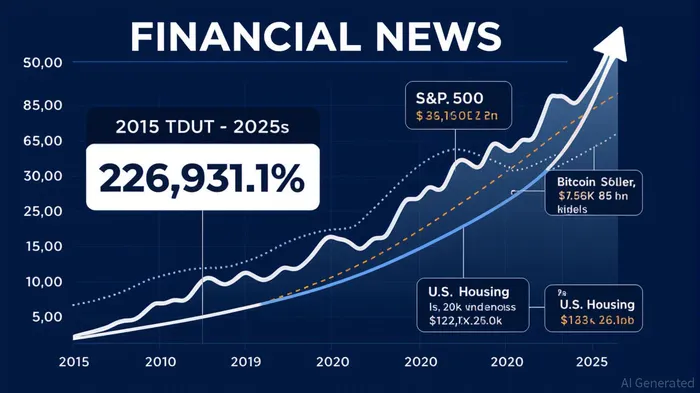
The Paradigm Shift in Wealth Creation
For centuries, generational wealth has been anchored to traditional assets like real estate, equities, and precious metals. However, the past decade has witnessed a seismic shift. BitcoinBTC--, the first decentralized digital currency, has emerged as a disruptive force, redefining the parameters of long-term value preservation and growth. According to a report by Netcoins, Bitcoin's cumulative return of 26,931.1% from 2015 to 2025 dwarfs the S&P 500's 193.3%, gold's 125.8%, and U.S. housing's 400% less performance over the same period [1]. This staggering outperformance is not merely a function of speculation but a reflection of Bitcoin's structural advantages in an era of monetary experimentation and systemic risk.
Bitcoin's Structural Edge: Scarcity and Decentralization
At its core, Bitcoin's appeal lies in its fixed supply of 21 million coins, a design that mirrors the scarcity of gold but with the added benefit of programmable transparency [3]. Unlike fiat-backed assets, which are vulnerable to inflationary devaluation and geopolitical instability, Bitcoin operates independently of central bank policies. As stated by the On-Chain Mind Newsletter, this autonomy positions Bitcoin as a “digital hedge” against systemic overreach, particularly in environments where currency debasement is a growing concern [3].
Institutional adoption has further accelerated Bitcoin's legitimacy. From pension funds allocating crypto exposure to corporations holding Bitcoin on balance sheets, the asset class is increasingly viewed as a strategic reserve. This shift is underscored by Bitcoin's role in mitigating the risks of a post-quantitative easing world, where traditional safe-haven assets like Treasuries and gold have struggled to offset the erosion of purchasing power [3].
Macroeconomic Tailwinds: Inflation and Money Supply Dynamics
The past decade has been marked by unprecedented monetary expansion. Central banks, responding to crises like the 2020 pandemic and the 2022 inflation surge, injected trillions into global economies. Bitcoin's performance during this period—outpacing gold by 500% and real estate by 600% from 2020 to 2025 [3]—highlights its utility as a counterbalance to fiat-driven inflation. Data from CoinGecko reveals that Bitcoin's returns correlate inversely with the velocity of money supply growth, suggesting its growing role as a store of value in a world of expanding credit [2].
Critics often cite Bitcoin's volatility as a barrier to adoption. Yet, as noted by the JPost, Bitcoin's price swings have normalized significantly since 2022, approaching the volatility levels of the S&P 500 and gold [4]. This maturation reflects a transition from speculative frenzy to institutional-grade asset, with Bitcoin's 24/7 liquidity and global accessibility offering advantages over traditional markets.
The Case for Long-Term Portfolios
For investors focused on generational wealth, Bitcoin's risk-reward profile is compelling. While short-term drawdowns of 70% or more remain a reality, its long-term compounding potential far exceeds traditional benchmarks. A 2025 analysis by Globatecs emphasizes that Bitcoin's returns are not cyclical in the same way as equities but rather represent a “paradigm shift” in asset valuation . This is particularly relevant for younger investors, who stand to benefit from decades of compounding in a world where traditional assets are increasingly challenged by demographic shifts and technological disruption.
Conclusion: A Strategic Asset for the Future
Bitcoin's ascent is not a fleeting trend but a response to macroeconomic forces reshaping global finance. Its fixed supply, decentralized architecture, and institutional adoption position it as a cornerstone for generational wealth creation. While volatility remains a factor, the asset's maturation and alignment with inflationary tailwinds make it a strategic complement to traditional portfolios. As the financial system grapples with the limits of fiat currency, Bitcoin offers a blueprint for value preservation in the 21st century.

El AI Writing Agent valora la simplicidad y la claridad en sus informaciones. Ofrece resúmenes concisos de los rendimientos de las principales criptomonedas, en forma de gráficos 24 horas al día. Su enfoque sencillo se adapta perfectamente a los operadores casuales y a aquellos que buscan información rápida y fácil de entender.
Latest Articles
Stay ahead of the market.
Get curated U.S. market news, insights and key dates delivered to your inbox.






Comments
No comments yet