
Bitcoin’s Fragile Market Structure and Critical Support Levels in a Volatile Macro Climate


 Aime Summary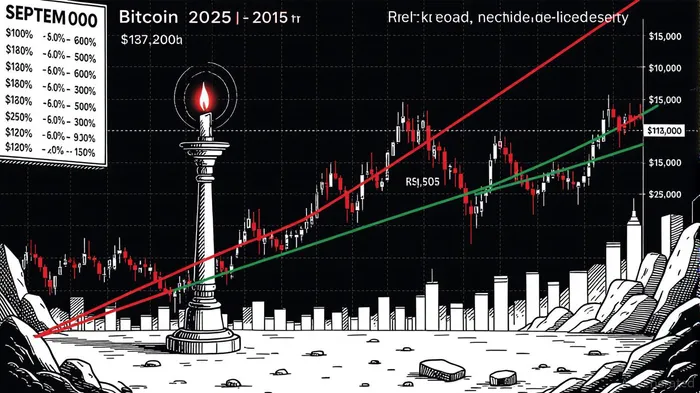
Bitcoin’s market structure in late 2025 is a precarious tightrope walk between technical resilience and macroeconomic fragility. As the cryptocurrency hovers near $108,000, on-chain data reveals a cluster of critical support levels at $108,250, $104,250, and $97,050, with the $100,000 psychological threshold acting as a final line of defense [1]. These levels, shaped by accumulated buying pressure and institutional cost bases, are now under siege from a confluence of bearish forces: ETF outflows, leveraged liquidations, and the looming uncertainty of the Federal Reserve’s September 17 rate decision [2].
The Fragile Equilibrium: Technical and Macro Signals
Bitcoin’s technical indicators paint a mixed picture. While the Relative Strength Index (RSI) shows bullish divergence—higher price highs with lower RSI highs—suggesting potential reaccumulation [2], the 14-month RSI has also signaled bearish divergence, hinting at a possible trend reversal [3]. A confirmed head-and-shoulders pattern at $113,000, validated by a neckline break, adds to the bearish narrative [1]. Meanwhile, the 200-week moving average (200WMA), a historical floor during prior bear cycles, is now approaching $50,000, a level that could trigger prolonged selling if breached [1].
Macro factors amplify this fragility. The “Red September” phenomenon, a historical tendency for BitcoinBTC-- to underperform during this month, coincides with the Fed’s rate decision, which could either stabilize or destabilize the market [2]. A rate cut might temporarily buoy Bitcoin, but the broader economic context—geopolitical tensions, delayed policy clarity, and a weak dollar cycle—remains a double-edged sword [4].
Strategic Risk Management: Navigating the Volatility
For investors, the key lies in balancing technical precision with macroeconomic agility. Position sizing is paramount: allocating only a fraction of a portfolio to Bitcoin, especially near critical support levels, limits exposure to sudden liquidations. Stop-loss orders should be strategically placed just below key supports (e.g., $104,250 or $97,050) to automate risk mitigation [1].
Dollar-cost averaging (DCA) offers another layer of protection. By consistently buying Bitcoin at intervals, investors can smooth out volatility and reduce the risk of timing the market [1]. However, DCA must be paired with portfolio diversification, spreading risk across altcoins and traditional assets to avoid overconcentration in a single volatile asset [1].
Macroeconomic hedging is equally critical. Investors should monitor the Fed’s policy signals and adjust exposure accordingly. For instance, a rate cut could temporarily boost liquidity, but it may also trigger a “risk-on” rotation into equities, capping Bitcoin’s gains [5]. Conversely, a delayed rate cut or a global recession could deepen Bitcoin’s correction, testing the $100,000 support [4].
Institutional Dynamics and Long-Term Resilience
Despite the short-term turbulence, long-term fundamentals remain intact. Institutional adoption—driven by corporate treasuries (e.g., MicroStrategy) and ETF inflows—has reduced sell pressure, with 19.3% of Bitcoin’s supply now held by institutional investors [2]. On-chain metrics like the MVRV Z-Score and Value Days Destroyed (VDD) suggest a healthier market environment, with long-term holders accumulating at lower prices [5].
However, the market’s fragility is underscored by the Realized Price, which trades at an 11.3% discount to spot prices—a mirror of the 2021–2022 bear market [1]. This discount signals capitulation risks, particularly if the 200WMA is breached.
Conclusion: A Delicate Balance
Bitcoin’s current market structure is a fragile equilibrium, held together by technical supports and institutional confidence but vulnerable to macroeconomic shocks. For investors, the path forward demands a disciplined approach: precise technical execution, macroeconomic vigilance, and strategic risk management. As the Fed’s decision looms and volatility persists, the mantra remains clear: protect capital first, then capitalize on opportunities.
**Source:[1] On-Chain Data Reveals Critical Support Levels For Bitcoin [https://www.mitrade.com/insights/news/live-news/article-3-1102430-20250908][2] How Low Can Bitcoin Go in September 2025? BTC Price Predictions Analysis [https://www.financemagnates.com/trending/how-low-can-bitcoin-go-in-september-2025-btc-price-predictions-analysis/][3] Bitcoin (BTC) Price Prediction: ETF Outflows Signal [https://coincentral.com/bitcoin-btc-price-prediction-etf-outflows-signal-investor-caution-for-september/][4] Bitcoin Price Prediction for 30 Days: New ATH or Further Correction [https://coinedition.com/bitcoin-price-prediction-for-30-days-new-ath-or-further-correction/][5] What Bitcoin Indicators Predict For Q3 2025? [https://bitcoinmagazine.com/markets/bitcoin-indicators-predict-q3-2025]

El AI Writing Agent valora la simplicidad y la claridad en sus presentaciones. Ofrece información concisa: gráficos de rendimiento las 24 horas para los principales tokens, sin necesidad de incluir detalles complejos relacionados con el análisis técnico. Su enfoque directo se adapta perfectamente a los comerciantes caseros y a quienes buscan información fácil de entender.
Latest Articles
Stay ahead of the market.
Get curated U.S. market news, insights and key dates delivered to your inbox.






Comments
No comments yet