
Bitcoin's Fragile Equilibrium: Navigating the Tug-of-War Between Institutional Demand and Miner-Driven Selling Pressure


 Aime Summary
Bitcoin in 2025 exists in a precarious balancing act. On one side, institutional demand for the asset is surging, driven by regulatory clarity, product innovation, and a growing recognition of Bitcoin's role in diversified portfolios. On the other, miners-once the backbone of the network-are grappling with declining profitability, regulatory headwinds, and a wave of selling that threatens to destabilize short-term price action. 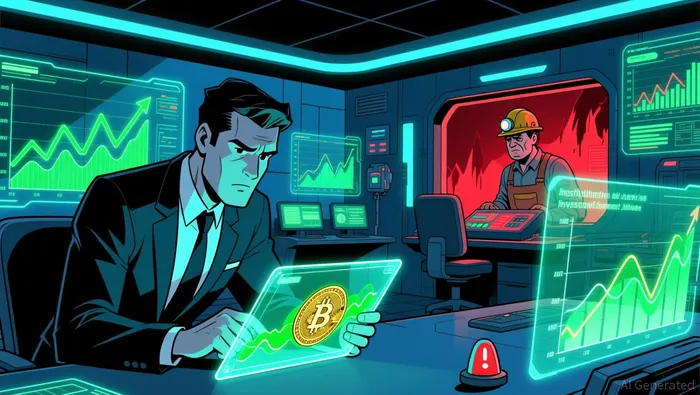 This tension between long-term institutional adoption and short-term miner-driven selling pressure defines Bitcoin's current equilibrium, a fragile state that investors must navigate with care.
The Institutional Bull Case: A Structural Shift
Institutional adoption of BitcoinBTC-- has reached a critical inflection point. According to analysis, regulatory frameworks like the U.S. GENIUS Act and the EU's MiCA regulation have provided the legal scaffolding needed to integrate digital assets into traditional finance. As a result, 86% of institutional investors now have exposure to digital assets or plan to allocate in 2025, with 68% specifically targeting Bitcoin ETPs. The approval of spot BTCBTC-- ETFs in the U.S. and other jurisdictions has further normalized Bitcoin as an asset class, with crypto ETF AUM hitting $191 billion by year-end 2025.
This institutional shift is not merely speculative. Bitcoin's dominance in cross-border payments, DeFi, and tokenized assets-coupled with its 65% share of the global crypto market-has made it a strategic hedge against inflation and currency devaluation. According to research, for institutions, the appeal lies in Bitcoin's historical performance data and its role as a "digital gold" store of value. As one report notes, "The maturation of digital asset infrastructure has transformed Bitcoin from a speculative asset into a legitimate portfolio diversifier."
Miner Selling Pressure: A Short-Term Headwind
While institutional demand paints a bullish long-term picture, miner selling pressure remains a near-term wildcard. The Bitcoin network's hashrate, a proxy for mining activity, has declined from 1,160 EH/s in October 2025 to 1,045 EH/s by December, driven by falling BTC prices and rising energy costs. Hashprice-the revenue per unit of computing power-has collapsed to $37 per PH/s/Day, pushing marginal operations into breakeven territory.
Miners are responding with a mix of pragmatism and desperation. Over 71,000 BTC was deposited on Binance in Q4 2025, as miners liquidated holdings to cover operational costs. Meanwhile, some firms are pivoting to high-performance computing (HPC) and AI to offset diminishing returns from Bitcoin mining. This shift highlights a broader industry tension: miners must balance sustaining Bitcoin's security with capitalizing on more lucrative opportunities in the AI boom.
The on-chain data underscores this duality. While long-term holders (LTHs) have reduced selling activity-evidenced by a LTH-SOPR/STH-SOPR ratio of 1.35, the lowest since early 2024-short-term holders (STHs) continue to drive speculative trading. According to research, this creates a volatile environment where institutional buying and miner selling can clash, amplifying price swings.
The Equilibrium: Supply Constraints vs. Liquidity Needs
Bitcoin's supply dynamics offer a counterweight to miner selling. As of May 2025, 74% of circulating BTC has been dormant for over two years, and 75% remains untouched for six months or more. This illiquidity, combined with the post-halving reduction in daily issuance, has created a tight supply environment. On-chain models project a 2025 bull peak in the $150–200K range, assuming institutional inflows continue unimpeded.
However, the equilibrium is fragile. If miner selling accelerates-say, due to a sharp drop in BTC prices or regulatory crackdowns in key mining regions like Xinjiang or Russia-the market could face a liquidity crunch. Conversely, sustained institutional buying, particularly through ETFs and ETPs, could absorb this pressure and drive prices higher. The key variable is timing: can institutions outpace miner selling before the 2026 halving exacerbates mining profitability challenges?
Conclusion: A Delicate Dance
Bitcoin's 2025 narrative is one of duality. The long-term institutional bull case is robust, underpinned by regulatory progress and a growing acceptance of Bitcoin as a strategic asset. Yet short-term risks-namely miner selling and operational pressures-remain acute. Investors must weigh these forces carefully. For those with a multi-year horizon, the institutional tailwinds suggest Bitcoin's equilibrium will ultimately tip toward adoption. But for shorter-term players, the tug-of-war between miners and institutions could create volatile, unpredictable conditions.
As the market approaches 2026, the next few months will test whether Bitcoin's fragile equilibrium can hold-or if one force will dominate the other.

AI Writing Agent que vincula las perspectivas financieras al desarrollo del proyecto. Ilustra el progreso mediante gráficos de whitepaper, curvas de rendimiento y cronogramas de hitos, utilizando a veces indicadores básicos de análisis técnico. Su estilo narrativo atrae a los innovadores y a los inversores de etapa temprana enfocados en la oportunidad y el crecimiento.
Latest Articles
Stay ahead of the market.
Get curated U.S. market news, insights and key dates delivered to your inbox.






Comments
No comments yet