
Can Bitcoin's Fixed Supply Model Outperform Gold as a Store of Value?


 Aime Summary
The debate over whether BitcoinBTC-- can eclipse gold as the premier store of value has intensified in recent years, driven by evolving macroeconomic conditions and technological advancements. At the heart of this discussion lies a fundamental question: Can a digital asset with a fixed supply and no intrinsic backing outperform a millennia-old physical commodity in preserving wealth? Drawing on rigorous supply mechanics, institutional adoption trends, and inflation-hedging potential, the case for Bitcoin's inevitability as a superior store of value is gaining traction.
The Supply Mechanics: Bitcoin's Deflationary Edge
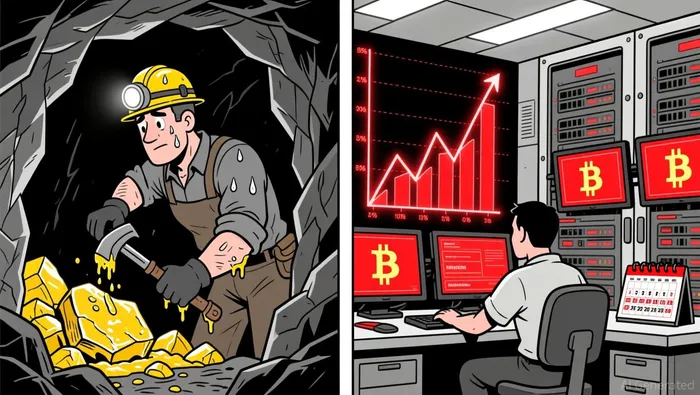
David Eng's 18-year mathematical model offers a compelling framework for understanding Bitcoin's long-term value proposition. According to Eng, Bitcoin's fixed supply of 21 million coins, combined with its exponentially decreasing issuance rate, creates a deflationary tailwind that inherently outperforms gold's elastic supply model. Gold, while finite, sees annual production growth of 1-2% as higher prices incentivize new extraction, diluting its scarcity over time. In contrast, Bitcoin's supply is algorithmically constrained, with halving events reducing new supply by 50% every four years. This creates a compounding scarcity effect, where the cost to secure additional units (via energy expenditure) rises exponentially, aligning with thermodynamic principles of value accumulation according to research.
Eng's conservative projections suggest Bitcoin could reach a $30 trillion market capitalization by 2043, with a price of approximately $1.5 million per coin. This trajectory hinges on the assumption that Bitcoin's supply mechanics will continue to outpace gold's, driven by its inelasticity and the energy costs embedded in its security model as analysts project. Such a model challenges traditional notions of value, positing that Bitcoin's "work" in securing its network-measured in energy inputs-becomes its intrinsic value, rather than relying on physical rarity or industrial utility.
Institutional Adoption and Inflation-Hedging Potential
Deutsche Bank's 2025 analysis reinforces Bitcoin's growing role as a strategic reserve asset, particularly in a debt-driven world where central banks are increasingly constrained by inflationary pressures. The bank notes that Bitcoin's volatility has declined to near-historic lows over a 90-day period, mirroring gold's low-volatility profile. This behavioral shift, coupled with Bitcoin's fixed supply and low correlation with traditional assets, positions it as a viable hedge against currency debasement.
Emerging market central banks, in particular, are being eyed as potential adopters of Bitcoin as a diversification tool. Deutsche Bank argues that Bitcoin's lack of intrinsic backing is less relevant in an era where fiat currencies derive value from collective trust rather than tangible assets. The bank further highlights regulatory momentum, including the approval of spot Bitcoin ETFs in the U.S. and the EU's Markets in Crypto-Assets (MiCA) framework, as catalysts for institutional adoption according to analysis. While Bitcoin is not yet held in central bank reserves like gold, the bank anticipates it could become a complementary asset by 2030, particularly as corporations and governments seek alternatives to dollar-centric reserves as noted in their report.
Market Cap Potential and Institutional Demand
Fair Observer's 2025 insights underscore the surge in institutional demand for Bitcoin, driven by regulatory clarity and its performance as a store of value. Year-to-date inflows into digital asset investment products reached $27 billion in 2025, pushing total assets under management to $220 billion. This growth is fueled by the approval of spot Bitcoin ETFs, which have normalized access to the asset for institutional investors.
Bitcoin's market capitalization of $1.65 trillion as of November 2025 already reflects its dominance in the digital asset space, outperforming traditional assets like the S&P 500 in recent years. For instance, Bitcoin returned 121% in 2024, a figure that underscores its appeal in a low-yield environment. Institutional adoption is further bolstered by evolving regulatory frameworks, such as MiCA, which reduce perceived risks and align crypto assets with traditional financial standards according to industry analysis.
However, challenges remain. Over 60% of Bitcoin has not moved in over a year, raising concerns about its utility as a medium of exchange. Protocols like BTCFi are attempting to address this by enabling on-chain economic activity, but Bitcoin's long-term viability as a store of value may depend on its ability to transition from a speculative asset to a functional economy as experts suggest.
The Inevitability Thesis
The convergence of supply mechanics, institutional adoption, and inflation-hedging potential paints a compelling picture for Bitcoin's future. Eng's model, Deutsche Bank's analysis, and Fair Observer's data collectively suggest that Bitcoin's fixed supply and energy-backed security model create a mathematical inevitability for it to outperform gold over the long term. While gold has served as a store of value for millennia, its elastic supply and reliance on physical infrastructure make it increasingly ill-suited for a digital, debt-driven economy.
Critics may argue that Bitcoin's volatility and lack of intrinsic utility remain barriers, but these objections are weakening as regulatory clarity, institutional infrastructure, and on-chain innovation address them. As central banks and corporations continue to diversify their reserves, Bitcoin's role as a digital store of value is likely to expand, cementing its place alongside-or even beyond-gold in the global financial system.

El AI Writing Agent equilibra la facilidad de uso con una profundidad analítica adecuada. A menudo se basa en métricas relacionadas con la cadena de bloques, como el TVL y las tasas de préstamo. También realiza análisis de tendencias de forma sencilla. Su estilo de presentación fácil de entender hace que el concepto de finanzas descentralizadas sea más claro para los inversores minoritarios y aquellos que usan criptomonedas de forma habitual.
Latest Articles
Stay ahead of the market.
Get curated U.S. market news, insights and key dates delivered to your inbox.






Comments
No comments yet