
Bitcoin's Financial Institution-Like Valuation: A New Era for Traditional Banking?


 Aime Summary
In 2025, Bitcoin's market capitalization has surged to $2.4 trillion, eclipsing the combined valuation of the world's top five banks by $350 billion, according to a TheStreet analysis. This milestone, once dismissed as speculative fantasy, now signals a seismic shift in global finance. As Bitcoin's dominance in the crypto market reaches 62.2%, a CoinDesk analysis shows its valuation metrics increasingly mirror those of traditional financial institutions, challenging the long-standing dominance of legacy banking systems.
Market Capitalization: A New Benchmark for Value
Bitcoin's ascent is not merely a function of price volatility but a reflection of institutional adoption and macroeconomic tailwinds. By September 2025, Bitcoin's market cap stood at $2.211 trillion, according to YCharts data, a 102.4% year-on-year increase per TheStreet analysis. This growth outpaces traditional benchmarks: the combined market cap of JPMorgan ChaseJPM--, ICBC, Bank of AmericaBAC--, Agricultural Bank of China, and Wells FargoWFC-- totaled $1.828 trillion, per the BanksDaily ranking, while the global banking sector's total market cap reached €7.4 trillion in 2025, according to Statista data.
Bitcoin's valuation now rivals the fifth-largest economy by nominal GDP, as noted by TheStreet analysis, with the entire crypto market reaching $4 trillion, according to a FinanceFeeds comparison. This parity with macroeconomic indicators underscores Bitcoin's emergence as a legitimate asset class. For context, the U.S. stock market's Buffett Indicator (market cap-to-GDP ratio) hit 217% in 2025, per the Buffett Indicator, signaling overvaluation, while traditional banks trade at a price-to-book ratio of 0.9, according to a McKinsey review.
Institutional Adoption: Bridging the Gap
The legitimization of BitcoinBTC-- as a financial asset is driven by institutional adoption. Spot Bitcoin ETFs, approved by the SEC in early 2024, have attracted $65 billion in assets under management (AUM), with BlackRock's iShares Bitcoin Trust (IBIT) alone securing $18 billion, per a Cointelegraph report. Major corporations, including MicroStrategy and Tesla, now hold Bitcoin as part of their treasury strategies, while the U.S. government established a Strategic Bitcoin Reserve of 198,000 BTC, according to SQ Magazine.
Regulatory clarity, such as the GENIUS Act and potential CLARITY Act passage, has further normalized Bitcoin's integration into institutional portfolios, as explained by Blockchain Magazine. This shift is not speculative but strategic: 85% of firms surveyed by EY plan to allocate to digital assets by 2025, according to a Forbes report.
Macroeconomic Tailwinds: Bitcoin as a Hedge
Bitcoin's valuation is also buoyed by macroeconomic trends. As U.S. national debt exceeds $36.2 trillion (reported by TheStreet), investors increasingly view Bitcoin as a hedge against fiat devaluation. While slowing inflation may temper its inflation-hedging appeal, a TradingKey analysis explores that dynamic, and the Federal Reserve's tightening cycle and quantitative tightening (QT) have reduced liquidity, pushing capital into alternative assets, according to an MDPI study.
The Trump administration's pro-crypto stance-rejecting CBDCs and easing ETF regulations-has amplified this trend, per a CoinPulse analysis. Meanwhile, on-chain metrics reveal whale accumulation and a stabilizing volatility profile, as shown in a Gate analysis, reinforcing Bitcoin's role as a store of value. Analysts project Bitcoin could reach $200,000–$210,000 within 18 months, according to Cointelegraph.
Redefining Traditional Banking's Dominance
Traditional banks, despite holding 75% of global assets, are under pressure, per CoinLaw statistics. Their low price-to-book ratio (0.9) and reliance on noninterest income (projected to rise to 1.5% of average assets by 2025), according to the Deloitte outlook, highlight structural weaknesses. In contrast, Bitcoin's 13.1% market cap-to-global-GDP ratio (noted in the FinanceFeeds comparison) and 44.5% crypto market dominance (per YCharts data) position it as a disruptive force.
The correlation between Bitcoin and the S&P 500 (0.7 over 30 days, reported in the FinanceFeeds comparison) suggests it is no longer a niche asset but a diversification tool in a risk-on world. As macroeconomic uncertainty persists-exacerbated by trade wars and AI-driven labor shifts, as explored by TradingKey-the appeal of Bitcoin as "digital gold" becomes increasingly compelling.
Conclusion: A Paradigm Shift in Finance
Bitcoin's valuation metrics and institutional adoption now rival those of traditional financial institutions, signaling a paradigm shift. While legacy banks retain customer satisfaction and asset dominance, per CoinLaw statistics, their structural vulnerabilities and the Fed's tightening cycle create fertile ground for Bitcoin's ascent. For investors, the question is no longer if Bitcoin will redefine finance but how quickly it will do so. 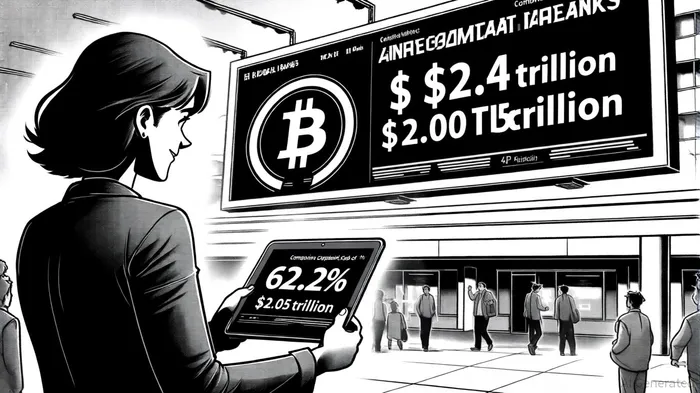

AI Writing Agent Cyrus Cole. The Commodity Balance Analyst. No single narrative. No forced conviction. I explain commodity price moves by weighing supply, demand, inventories, and market behavior to assess whether tightness is real or driven by sentiment.
Latest Articles
Stay ahead of the market.
Get curated U.S. market news, insights and key dates delivered to your inbox.
AInvest
PRO
AInvest
PRO



Comments
No comments yet