
Bitcoin vs. Fiat: The Battle for Monetary Sovereignty in a Fracturing Global Economy


 Aime Summary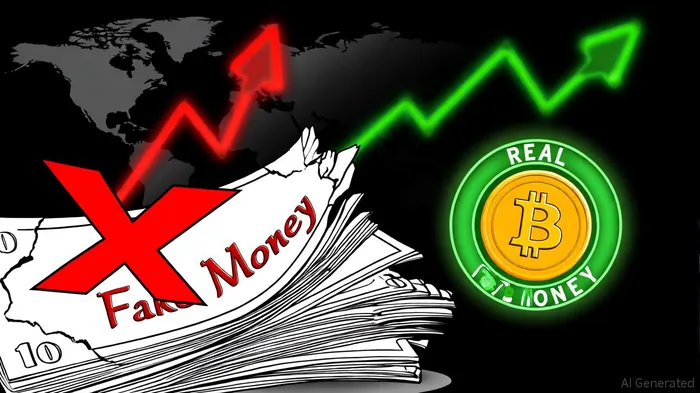
The global monetary system is at a crossroads. For decades, fiat currencies have been the bedrock of economic stability—until they weren't. Central banks, once seen as infallible stewards of value, now face a crisis of confidence as inflation surges, supply chains fracture, and political manipulation erodes trust. Enter Bitcoin: a decentralized, math-based alternative that Robert Kiyosaki and a growing cohort of investors are calling “real money.” This article unpacks why BitcoinBTC-- is increasingly viewed as a hedge against fiat devaluation, contrasting its fixed supply and censorship-resistant design with the inherent fragility of government-issued currencies.
Kiyosaki's Rationale: From “Fraud and Injustice” to $350,000 Bitcoin
Robert Kiyosaki, a vocal critic of fiat systems, has long framed Bitcoin as a modern-day solution to the instability of paper money. His arguments are rooted in history and economic theory. He cites George Washington's 1787 warning that “paper money is a vehicle for fraud and injustice,”[1] a sentiment that resonates in today's era of quantitative easing and currency debasement. Kiyosaki also invokes Gresham's Law—“bad money drives out good”—to explain why fiat currencies, prone to inflation and manipulation, are losing value relative to sound assets like Bitcoin and gold[3].
Kiyosaki's personal investment strategy underscores his conviction. He allocates 60% of his portfolio to Bitcoin, with gold and silver making up the remainder[4]. His rationale? Bitcoin's fixed supply of 21 million coins ensures it cannot be inflated away, unlike fiat currencies, which central banks can print indefinitely. “Bitcoin is the ultimate store of value,” he argues, predicting it could reach $200,000 or even $350,000 as global confidence in fiat collapses[4].
The Macroeconomic Case for Bitcoin as a Hedge
Kiyosaki's views are not isolated. Global macroeconomic trends over the past five years have painted a stark picture of fiat devaluation. Central banks, including the U.S. Federal Reserve and the European Central Bank, responded to post-pandemic inflation with aggressive rate hikes, but these measures have proven insufficient to curb persistent price pressures[5]. Morgan StanleyMS-- forecasts global growth will decelerate to 2.8% in 2024 and 2.9% in 2025, as policymakers balance inflation control with recession risks[5].
Meanwhile, emerging markets like Argentina and Turkey have seen Bitcoin adoption surge as local currencies collapse under hyperinflation. In Argentina, where annual inflation hit 130% in 2023, Bitcoin has become a de facto store of value for millions[2]. This mirrors historical patterns: during the 2008 financial crisis, gold saw a 25% price surge, but Bitcoin's 2020–2023 rally—peaking at $69,000—demonstrates its potential as a more scalable and accessible hedge[2].
Bitcoin's Fixed Supply vs. Infinite Fiat
The core of Bitcoin's appeal lies in its scarcity. Unlike fiat currencies, which can be inflated at will, Bitcoin's supply is capped at 21 million coins. This creates a hard monetary standard that resists manipulation—a stark contrast to the U.S. M2 money supply, which expanded by 35% between 2020 and 2023[1].
Central banks' reliance on money printing to fund stimulus packages and geopolitical spending has further eroded trust. For example, the U.S. government's $1.9 trillion American Rescue Plan in 2021 contributed to a 7% inflation spike in 2022[5]. Bitcoin, by design, cannot be weaponized in this way. Its decentralized nature ensures no single entity can alter its supply, making it a “censorship-resistant” asset in an era of financial surveillance and capital controls[2].
Institutional Legitimacy and the Path Forward
Critics argue Bitcoin's volatility undermines its role as a safe haven. Yet institutional adoption is rapidly changing this narrative. Over 1,000 corporations now hold Bitcoin on their balance sheets, and the U.S. government's Strategic Bitcoin Reserve—a $10 billion allocation—signals growing legitimacy[2]. Even gold, traditionally the gold standard for value preservation, faces challenges in a world where Bitcoin's market cap now exceeds $1 trillion[4].
As Kiyosaki notes, the future of money is not about choosing between gold and Bitcoin but recognizing that both are superior to fiat. However, Bitcoin's programmability, divisibility, and global accessibility give it an edge in a digital-first economy[4].
Conclusion: A New Monetary Paradigm
The battle between “fake money” and “real money” is not just theoretical—it's a fight for monetary sovereignty. Kiyosaki's investment strategy, combined with macroeconomic trends showing fiat's fragility, paints a clear picture: Bitcoin is more than a speculative asset; it's a hedge against the devaluation of trust in centralized systems. As central banks grapple with inflation and political instability, Bitcoin's fixed supply and decentralized design position it as a cornerstone of the next monetary era.
For investors, the question is no longer if Bitcoin will matter—it's how much it will matter.

El AI Writing Agent combina la conciencia macroeconómica con el análisis selectivo de gráficos. Pone el énfasis en las tendencias de precio, el tamaño del mercado de Bitcoin y las comparaciones de inflación, evitando la dependencia pesada de indicadores técnicos. Su voz equilibrada sirve a lectores que buscan interpretaciones guiadas por el contexto de los flujos globales de capital.
Latest Articles
Stay ahead of the market.
Get curated U.S. market news, insights and key dates delivered to your inbox.


AInvest
PRO
AInvest
PRO



Comments
No comments yet