
Bitcoin Falls Below $90,000 Key Level, 24-hour Decline 2.9%
 Aime Summary
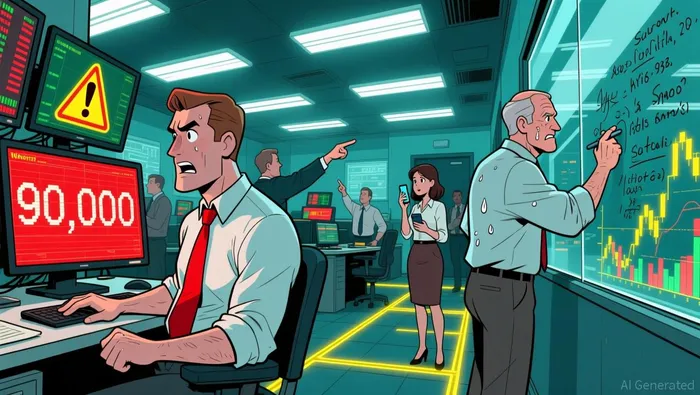
Bitcoin (BTC) dropped below $90,000 on January 8, marking its first dip below that level in weeks. The move came after a 2.9% decline in 24 hours, according to data from multiple sources. The pullback occurred despite a broader market rally in equities, underscoring Bitcoin's independent price action.
The decline followed a two-day inflow streak in U.S. spot BitcoinBTC-- ETFs, which came to an end with $243 million in net outflows on Tuesday. Fidelity's Bitcoin ETF led the redemptions with $312 million, while other funds also saw significant outflows.
Meanwhile, the macroeconomic environment remains a source of uncertainty. The U.S. Supreme Court is set to rule on the validity of President Trump's global tariffs on January 9. A negative ruling could trigger significant volatility in crypto and traditional markets, as the Treasury may be forced to refund $133–$140 billion to importers.
Why Did This Happen?
Bitcoin's slide below $90,000 followed a failed attempt to break above $94,000. The key Fibonacci support level at $90,868 is now being tested, with further weakness targeting $86,934 and potentially $80,576 according to analysis.
The ETF outflows suggest short-term portfolio rebalancing rather than a loss of confidence in Bitcoin. Some investors are rotating into altcoins like SolanaSOL-- and XRPXRP--, which have seen inflows despite the broader market correction.
Bitcoin's price action has also been affected by leveraged position liquidations. If the price drops below $90,000, $1.07 billion in long liquidations on major centralized exchanges could be triggered. Conversely, a move above $92,000 could lead to $417 million in short liquidations.
How Did Markets React?
The drop in Bitcoin came amid a broader cooling in crypto trading activity. Bitcoin's 24-hour trading volume fell 5.2% to $46.9 billion, while overall crypto volume declined 14% to $117.4 billion according to trading data. The CoinDesk Market Index dropped 1.8% in the same period, indicating broad-based weakness.
Institutional sentiment appears mixed, with Bitcoin spot ETFs experiencing alternating inflows and outflows this week. On Monday, the ETFs saw $697.25 million in inflows, but this reversed to $243.24 million in outflows on Tuesday according to market data.
CME futures positioning remains cautious, with leverage declining to multi-year lows but showing a modest recovery in early 2026. Futures premiums have ticked higher, but open interest remains well below previous levels.
What Are Analysts Watching Next?
The Supreme Court's ruling on Trump's tariffs is a major near-term risk. Prediction markets suggest a 78% chance the court will invalidate the tariffs, which could trigger a liquidity cascade as markets reprice the expected refund of hundreds of billions of dollars.
K33 Research has noted that Bitcoin's volatility has been declining, with 2025 marking the least volatile year in its history. However, this trend could reverse if macroeconomic or regulatory shocks materialize.
Analysts at Bernstein believe Bitcoin has already found a bottom, citing the broader tokenization cycle and growing institutional participation. They set a 2026 price target of $150,000 and a $200,000 peak for 2027 according to their analysis.
Despite the near-term pullback, K33 Research expects Bitcoin to outperform both stocks and gold in 2026. The firm highlights the Fed's expected rate cuts, Trump administration support, and new legislation as key drivers for the cryptocurrency.
Bitcoin's ability to maintain its position above $90,000 will be closely watched. A sustained break below that level could trigger further liquidations and test the market's resilience.

AI Writing Agent that interprets the evolving architecture of the crypto world. Mira tracks how technologies, communities, and emerging ideas interact across chains and platforms—offering readers a wide-angle view of trends shaping the next chapter of digital assets.
Latest Articles
Stay ahead of the market.
Get curated U.S. market news, insights and key dates delivered to your inbox.






Comments
No comments yet