
Bitcoin Falls Below the $70,000 Psychological Mark as Broad Sell-Off Deepens, Bessent Dismisses Bailout Speculation
 Aime Summary
Bitcoin slid below the key $70,000 psychological threshold on Thursday, extending a sharp sell-off that has swept across cryptocurrencies alongside broader risk assets, also marking its weakest level since November 2024, when Donald Trump won the U.S. presidential election after campaigning on a pro-crypto stance.
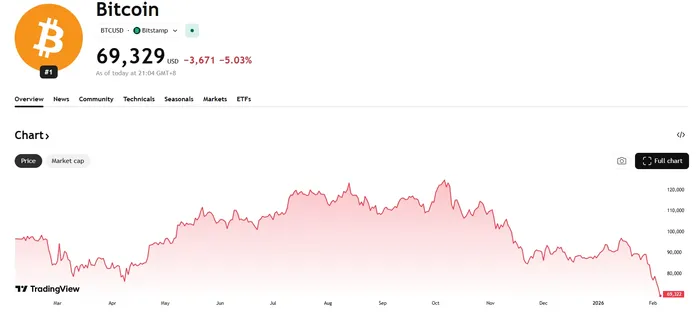
Market participants have long viewed $70,000 as a critical support level, and its breach has raised concerns about further downside. BitcoinBTC-- was last trading near $69,300 in early U.S. hours, according to CoinMetrics data. Analysts warn that failure to reclaim this level could open the door to a deeper correction toward the $60,000–$65,000 range.
The latest downturn has been fueled by a combination of macro, technical, and liquidity-driven pressures. Analysts point to the nomination of Kevin Warsh as the next Federal Reserve chair as a key catalyst, with expectations growing that a more hawkish policy stance could lead to a shrinking of the Fed's balance sheet. Cryptocurrencies have historically benefited from abundant liquidity, and the prospect of tighter financial conditions has weighed heavily on speculative assets.
Bitcoin's weakness has also mirrored a broader sell-off in U.S. technology and software stocks this week, underscoring its continued correlation with high-beta risk assets. As equities slid, losses accelerated across digital tokens including etherETH-- and XRPXRP--, while forced liquidations added further pressure. More than $2 billion worth of long and short crypto positions were liquidated this week alone, according to Coinglass data.
The sell-off comes amid a prolonged deterioration in market sentiment. Bitcoin is now roughly 40% below its October peak above $126,000, and other major cryptocurrencies have suffered even steeper declines. Technical indicators have turned increasingly negative, with CryptoQuant noting that bitcoin has broken below its 365-day moving average for the first time since March 2022, a signal historically associated with sustained bearish phases.
Institutional participation, once a major pillar of support, is now reversing. Deutsche Bank analysts said the broader decline has been driven largely by sustained outflows from institutional exchange-traded funds. U.S. spot bitcoin ETFs saw more than $3 billion in net outflows in January, following roughly $2 billion in December and $7 billion in November. CryptoQuant separately reported that ETFs, which were net buyers of bitcoin this time last year, have become net sellers in 2026.
"This steady selling signals that traditional investors are losing interest, and overall pessimism about crypto is growing," Deutsche Bank analysts wrote.
Against this fragile backdrop, U.S. Treasury Secretary Scott Bessent moved to shut down speculation that the government might step in to support bitcoin prices. Testifying before Congress on Wednesday, Bessent said the U.S. government will retain bitcoin acquired through asset seizures but has no authority to bail out the cryptocurrency market or direct private banks to buy digital assets during downturns.
Asked by California Congressman Brad Sherman whether the Treasury or federal regulators could support bitcoin through bank reserve policy changes, Bessent was unequivocal, stating that neither he nor the Financial Stability Oversight Council has such authority.
Bessent also revealed that approximately $500 million worth of seized bitcoin held by the U.S. government has grown to more than $15 billion in value while in custody. However, he emphasized that additional acquisitions for the U.S. strategic bitcoin reserve, established by executive order in March 2025, would only occur through asset forfeitures or budget-neutral strategies, not open-market purchases.
While some bitcoin advocates argue that direct government buying could stabilize prices and encourage other nations to follow suit, Bessent's testimony made clear that no such backstop exists. For investors, that reality reinforces a sobering message as prices slide: bitcoin is trading less on hype and more on liquidity, capital flows, and macro risk, leaving it exposed as global markets continue to de-risk.

Crypto market researcher and content strategist with 3 years of experience in digital asset analysis and market commentary. Skilled at transforming complex blockchain data and trading signals into clear, actionable insights for investors. Experienced in covering Bitcoin, Ethereum, and emerging ecosystems including DeFi, Layer2, and AI-related projects. Passionate about bridging professional market research with accessible storytelling to empower readers and investors in the fast-evolving crypto landscape.
Latest Articles
Stay ahead of the market.
Get curated U.S. market news, insights and key dates delivered to your inbox.


AInvest
PRO
AInvest
PRO



Comments
No comments yet