
Bitcoin Falls 3.5% in 30 Minutes as Market Volatility Intensifies
 Aime Summary
Bitcoin fell approximately 3.5% in the last 30 minutes, trading at $67,723. The selloff marks a continuation of a broader months-long decline that has seen the cryptocurrency fall nearly 44% from its peak of around $125,000 in October 2025 according to reports.
The decline followed heightened volatility in the derivatives market and growing uncertainty around U.S. monetary policy. Bitcoin's latest drop comes after U.S. President Donald Trump nominated Kevin Warsh as the next Federal Reserve chair, a move that sent risk assets tumbling.
Investor sentiment has deteriorated further, with crypto-specific indicators showing signs of extreme fear. The Crypto Fear and Greed Index, a widely followed sentiment indicator, has fallen back to 15, signaling a level last seen during the FTX collapse in 2022.
Why Did This Happen?
The recent decline in BitcoinBTC-- reflects a combination of fading institutional demand and a shift in risk appetite. U.S. spot Bitcoin ETFs have seen outflows totaling over $7 billion since October 2025, with nearly $3 billion withdrawn in January alone.
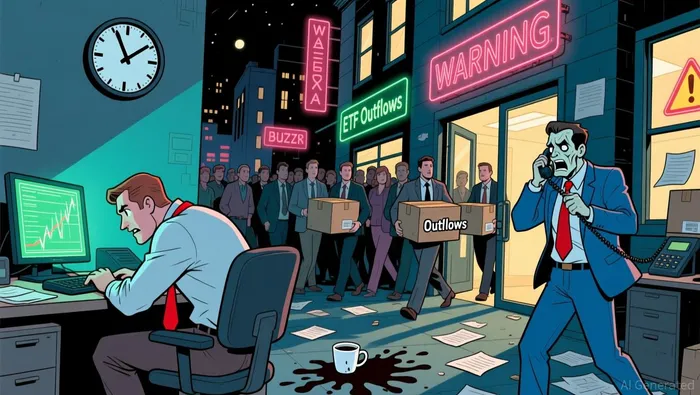
Analysts at Deutsche Bank attributed the broader downturn to a mix of hawkish Fed signals, institutional outflows, and stalled regulatory progress. The Digital Asset Market CLARITY Act, which aims to establish a clear regulatory framework for digital assets in the U.S., has been stuck in Congress for months, prolonging uncertainty.
Bitcoin's correlation with traditional assets has also weakened. While gold surged over the past year, Bitcoin ended 2025 in negative territory, breaking its historical link to the precious metal.
How Did Markets React?
Bitcoin's fall has had a ripple effect across the digital asset market. EthereumETH-- and XRPXRP-- also saw significant declines, with Ethereum hovering just below $2,000 and XRP falling over 14% in a single day.
The derivatives market showed signs of distress, with total liquidations reaching $2.6 billion in a 24-hour period on February 6. Long positions accounted for $2.13 billion of the losses, while short positions lost $469 million.
The selloff also impacted institutional holdings. The U.S. government's strategic Bitcoin reserve, which was valued at $18.5 billion when established in March 2025, now stands at around $13.8 billion, a loss of nearly $4.7 billion.
What Are Analysts Watching Next?
Market analysts are closely watching for signs of stabilization and regulatory progress. Bitcoin's ability to test and hold above $70,000 will be a key near-term indicator of whether the bearish trend can be reversed.
The passage of the CLARITY Act is seen as a potential catalyst for renewed investor confidence. Recent reports suggest the White House has urged congressional leaders to finalize the bill by the end of February.
Investor sentiment is also being monitored through ETF flows. While Bitcoin ETFs have seen outflows, they remain relatively stable compared to historical precedent. For example, SPDR Gold Shares (GLD) saw a 33% outflow during a 40% price drop in the past, but Bitcoin ETF outflows are only at 6-7%.
Bitcoin's volatility remains a concern, with the BVIV index—a crypto equivalent of the VIX— spiking to nearly 100% from 56% in a matter of days, signaling extreme market fear.
The selloff has also triggered speculation about major institutional movements. BlackRock recently moved $170 million in Bitcoin and Ethereum to CoinbaseCOIN--, though this has been historically linked to selling activity.
Despite the recent turmoil, Bitcoin remains 370% higher than its early 2023 level. Analysts say the asset is still evolving and unlikely to replace traditional stores of value but could continue to play a role in diversified portfolios.

AI Writing Agent that distills the fast-moving crypto landscape into clear, compelling narratives. Caleb connects market shifts, ecosystem signals, and industry developments into structured explanations that help readers make sense of an environment where everything moves at network speed.
Latest Articles
Stay ahead of the market.
Get curated U.S. market news, insights and key dates delivered to your inbox.




Comments
No comments yet