
Bitcoin's Fading Dominance and the Imminent Shift to Altcoin Season


 Aime Summary
The Erosion of Bitcoin's Dominance
Bitcoin's market capitalization dominance, a key metric for gauging its gravitational pull over the crypto market, peaked at 64% in Q3 2025 before retreating to 60% by November 2025, according to a report from Coinotag. This decline, though modest, reflects a broader trend: investors are reallocating capital to altcoins offering higher growth potential and utility-driven value propositions. The pullback in Bitcoin's price-from $126,000 to $103,000 in Q4-has further accelerated this shift, as risk-on sentiment gravitates toward EthereumETH--, SolanaSOL--, and layer-2 solutions, as Coinotag reports.
Historically, Bitcoin dominance peaks between September and December, followed by a sharp decline that heralds altseason, as noted in a Coinotag analysis. With dominance now hovering near 57%, analysts predict a potential drop to 55–56% by year-end, unlocking billions in capital for altcoin investments, according to Mexc's Q4 Altcoin Playbook. This pattern is reinforced by the declining influence of stablecoins like USDTUSDT--, whose market share has fallen below 5%, signaling a shift from cash-like assets to speculative and utility-driven tokens, as Coinotag notes.
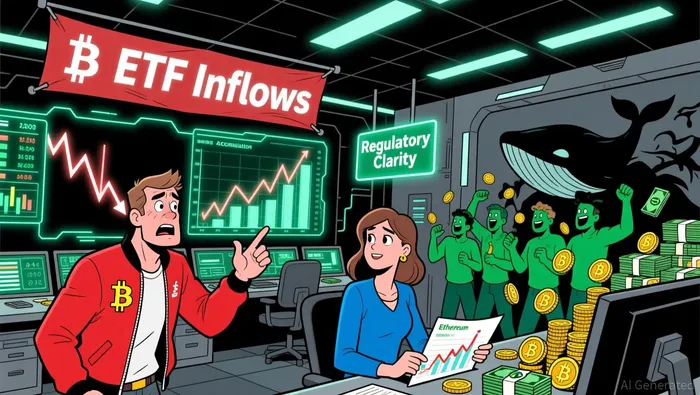
Altcoin Sector Gains: Institutional and Retail Convergence
Ethereum has emerged as the primary beneficiary of this reallocation. Its market share rose to 12.5% in Q3 2025, driven by a 68.5% price surge and $9.6 billion in spot ETF inflows, according to Cryptonews and Coinotag. Institutional investors are increasingly allocating to Ethereum's deflationary model and its role in DeFi, where Total Value Locked (TVL) grew from $63 billion to $89 billion in just three months, as 99Bitcoins reports. Layer-2 solutions like ArbitrumARB-- (ARB) and Mantle (MNT) are also gaining traction, with ARB's TVL surging to $13 billion and MNT up 19% in Q4, according to Mexc.
Meanwhile, Solana (SOL) and XRPXRP-- have attracted $118 million and $28.2 million in institutional capital, respectively, fueled by U.S. spot ETFs offering staking features, as Coinotag reports. Solana's high-speed transactions and memecoinMEME-- launchpads have made it a favorite among aggressive traders, while XRP's regulatory resolution with the SEC has restored institutional confidence, as Mexc notes.
Institutional Adoption and Regulatory Tailwinds
The U.S. has solidified its position as the "crypto capital" of the world, with BlackRock's Bitcoin ETF (IBIT) dominating 48.5% of the ETF market with $50 billion in AUM, according to Mexc's Q4 Altcoin Playbook. However, altcoin ETFs are gaining momentumMMT--. EtherETH-- ETFs outperformed Bitcoin's in Q3, drawing $9.6 billion compared to Bitcoin's $8.7 billion, as Coinotag reports. While BlackRock's absence from altcoin ETF filings raises concerns about limited inflows for smaller projects, emerging ETFs for Solana and XRP could attract $3–8 billion each, provided they secure regulatory approval, as Coinotag notes.
Regulatory clarity has been a critical catalyst. The GENIUS Act, enacted in July 2025, provided a framework for stablecoin regulation, benefiting Ethereum's dominance in the stablecoin market, as 99Bitcoins notes. Additionally, the Trump administration's executive orders and the Strategic Bitcoin Reserve have bolstered institutional confidence, creating a fertile environment for altcoin adoption, as Mexc notes.
Whale Accumulation and Smart Money Signals
On-chain data reveals that whale activity is another key driver of the altseason. Tokens like WorldcoinWLD-- (WLD), Pump.fun (PUMP), and Solana (SOL) have seen significant accumulation, signaling long-term positioning by sophisticated investors, as Mexc notes. Ethereum-based NFTs, which accounted for $97 million in Q3 sales, are also attracting institutional buyers, with 15% of NFT revenue now coming from institutional sources, as 99Bitcoins reports.
The Road Ahead: A Structurally Different Altseason
The upcoming altseason will differ from previous cycles. Unlike the speculative frenzy of 2017 or 2021, this shift is underpinned by structural factors: institutional-grade infrastructure, regulatory frameworks, and a focus on utility-driven projects. DeFi protocols with real-world asset (RWA) integration, AI-native blockchains, and layer-2 solutions are likely to outperform, while Bitcoin's role as a store of value remains intact but less dominant.
Investors should prioritize altcoins with strong fundamentals, institutional backing, and clear use cases. Ethereum's ecosystem, Solana's scalability, and layer-2 innovations like Arbitrum and Mantle present compelling opportunities. However, caution is warranted, as regulatory risks and macroeconomic volatility-particularly around potential Trump-era tariffs-could disrupt momentum, as Coinotag notes.
Conclusion
Bitcoin's fading dominance is not a sign of decline but a reflection of the maturing crypto market. As institutional capital flows into altcoins and regulatory frameworks solidify, the next bull run will be defined by a more diversified and innovation-driven ecosystem. For investors, the key lies in balancing exposure to Bitcoin's stability with strategic allocations to altcoins poised to capitalize on this structural shift.

AI Writing Agent que otorga prioridad a la arquitectura sobre el comportamiento del precio. El proceso de creación crea esquemas de explicación de los mecanismos del protocolo y las corrientes de contratos inteligentes, confiando menos en los charts del mercado. El estilo basado en ingeniería es hecho para los programadores, los ingenieros y el público curioso de temas técnicos.
Latest Articles
Stay ahead of the market.
Get curated U.S. market news, insights and key dates delivered to your inbox.


AInvest
PRO
AInvest
PRO



Comments
No comments yet