
Bitcoin Faces $50,000 Risk, CEO Warns
Bitcoin could fall as low as $50,000 in the near term if geopolitical tensions intensify and macroeconomic pressures persist, according to Steven McClurg, founder and CEO of Canary Capital.
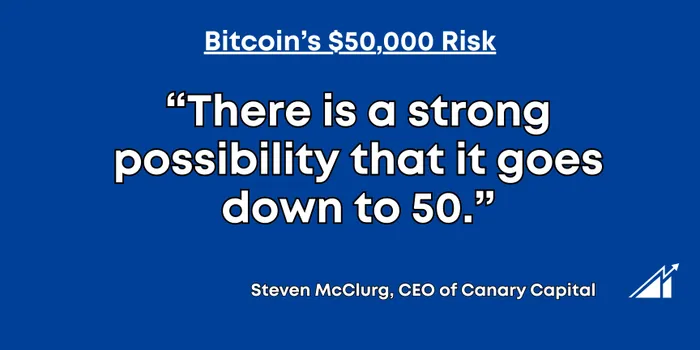
“There is a strong possibility that it goes down to 50,” McClurg said in an interview with AInvest’s Capital & Power, pointing to escalating risks tied to Middle East conflict dynamics and their impact on global energy markets.
Bitcoin, recently trading above $70,000, has rallied intermittently on headlines about the ceasefire involving Iran. However, volatility in oil markets tied to Middle East tensions has been widely reported by outlets including Reuters and Bloomberg News, underscoring how disruptions in energy supply chains can ripple through global financial markets. Those same forces, McClurg said, are now influencing crypto.
“Every time that there’s a change…in what’s happening with that war, it is causing a lot of volatility in things like oil, stocks, and of course crypto as well,” he said.
Contrary to its long-promoted role as a hedge against instability, BitcoinBTC-- is behaving more like a high-risk asset, sensitive to shifts in consumer liquidity and macroeconomic stress. “Bitcoin…has really become more of a…risk asset,” McClurg said.
That view aligns with broader market commentary. Analysts at major banks, cited by The Wall Street Journal and CNBC, have increasingly described cryptocurrencies as “risk-on” assets, tending to rise when liquidity is abundant and fall when financial conditions tighten.
Rising oil and energy prices, driven in part by supply disruptions, are feeding directly into that dynamic. As households face higher costs for gasoline, food and housing, discretionary capital available for speculative investments declines. The latest CPI reading confirms that American consumers are under pressure.
“If you’re spending money on…groceries…higher gasoline…then you have less money to invest,” McClurg said, noting that trading volumes across crypto markets have already fallen.
The macro backdrop reinforces that pressure. The Federal Reserve has kept interest rates elevated in its effort to contain inflation, a policy stance that has tightened financial conditions and reduced liquidity across markets, according to minutes from the last FOMC meeting.
The outlook is further complicated by structural pressures within the crypto ecosystem itself. McClurg emphasized that Bitcoin’s four-year cycle, linked to mining economics, remains intact. “Most people…have stated that the four-year cycle is dead. It’s clearly not dead,” he said.
A surge in electricity demand from artificial intelligence data centers, part of a broader investment boom, has driven up energy costs, squeezing mining profitability and forcing earlier-than-usual liquidation of Bitcoin holdings. “They had to start selling their Bitcoin earlier…to cover their cost,” McClurg said.
Even in the absence of geopolitical shocks, these factors could push Bitcoin into the $55,000 to $60,000 range, with deeper declines possible under more severe conditions.
Beyond crypto, McClurg flagged a separate and potentially under appreciated risk: stress building in private credit markets. “I’ve got massive issues with it,” he said.
Private credit, direct lending to companies outside traditional banking channels, has grown rapidly over the past decade, a trend widely documented by Bloomberg News and the International Monetary Fund. Much of that debt must now be refinanced at significantly higher rates.
“Most of these companies can’t afford the debt service that they’re being charged…let alone…if they have to finance now,” McClurg said.
He expects default rates in high-yield and private credit markets to rise sharply, potentially reaching 8% to 12%, with recovery rates falling well below historical norms.
“Recovery rates have dropped significantly,” he said.
A particular concern is the growing exposure of life insurance companies to these assets, a theme also highlighted in recent reporting by The Wall Street Journal, which has examined how insurers have turned to private credit for yield.
“A lot of insurance companies…are loaded up with private credit and they’re the ones that are going to hit the most,” McClurg said.
While he does not expect a crisis on the scale of 2007–2008, he warned that stress in these markets could still have meaningful spillover effects.
Meanwhile, institutional capital is shifting within crypto itself. Rather than concentrating solely on Bitcoin, investors are increasingly focusing on blockchain platforms tied to tokenization and stablecoin infrastructure, a trend also noted in industry reports and ETF flow data covered by CNBC.
“We’re seeing inflows into crypto assets that are the strongest in tokenization and stablecoin movementMOVE--. It’s not necessarily Bitcoin,” McClurg said.
For long-term investors, the current environment presents a dilemma: whether to accumulate during a downturn or wait for further declines.
“If you’re a long-term buyer…beginning to accumulate isn’t a terrible option,” he said. Until the dynamics shift, Bitcoin may continue to trade less like “digital gold” and more like the very risk asset it was meant to replace.

Adam Shapiro is a three-time Emmy Award–winning content creator, former network news correspondent, and founder of the multimedia production company TALKENOMICS. At AInvest, he created and launched Capital & Power, a video podcast series designed to drive engagement and establish thought leadership, while also producing original live streams, financial articles, and investor-focused video content. Previously, as a correspondent at FOX Business, Shapiro established the network’s Washington, D.C. bureau, reported from the White House, Capitol Hill, and the Federal Reserve, and secured exclusive bipartisan interviews with influential leaders. His reporting helped solidify FOX Business as the most-watched business channel on television. At the same time, his original Talkenomics series drew tens of thousands of viewers per episode through insightful conversations with policymakers, economists, and thought leaders. At Yahoo Finance, he played a critical leadership role in expanding digital programming to eight hours of live, bell-to-bell financial news coverage, dramatically increasing traffic from 68M to 104M unique monthly visitors and growing ad revenue from zero to over $50 million annually. Yahoo Finance continues to benefit from the credibility of Shapiro’s exclusive interviews with former President Donald Trump and numerous Fortune 500 CEOs.
Latest Articles
Stay ahead of the market.
Get curated U.S. market news, insights and key dates delivered to your inbox.


AInvest
PRO
AInvest
PRO



Comments
No comments yet