
Bitcoin's Evolving Role in a Stablecoin-Dominated Future: Implications for 2030 Price Projections


 Aime Summary
The Stablecoin Surge: A New Payment Rail for the Digital Economy
Stablecoins have emerged as the de facto medium of exchange in a crypto-native world. By August 2025, their transaction volume had surpassed $4 trillion, with USDCUSDC-- and USDT dominating B2B settlements and retail spending, according to the same Coinotag report. This growth is not merely speculative; it reflects a practical demand for frictionless, borderless transactions. For instance, platforms like Bybit Pay and BVNK have onboarded millions of users to stablecoin-based spending, while corporations leverage stablecoins for remittances and supply chain finance, per the Coinotag report.
The implications for Bitcoin are twofold. First, stablecoins have absorbed much of the transactional utility that was once expected to flow to Bitcoin, reducing its role as a medium of exchange. Second, they have created a liquidity layer that indirectly supports Bitcoin's ecosystem by enabling seamless conversions between volatile assets and stable value, according to a Markets Financial Content article. However, this duality raises a critical question: Does stablecoin adoption complement Bitcoin's long-term value proposition, or does it dilute its dominance?
Macroeconomic Forces: Inflation, Policy, and the Dollar's Digital Shadow
Bitcoin's price trajectory remains inextricably linked to macroeconomic trends. Central banks' accommodative policies-exemplified by South Korea's prolonged low-interest-rate environment-have fueled demand for alternative assets, including Bitcoin, according to a Reuters report. Yet, the rise of stablecoins introduces a new variable. By acting as a digital proxy for the U.S. dollar, stablecoins have mitigated some of the volatility that traditionally drives Bitcoin's appeal. For example, Cathie Wood of ArkARK-- Invest revised her 2030 Bitcoin price target from $1.5 million to $1.2 million, citing stablecoins' encroachment into transactional and savings use cases in emerging markets, according to a Investor Empires report.
This shift is not without precedent. Historically, Bitcoin's price cycles have mirrored inflationary pressures and monetary expansion. However, the presence of stablecoins-particularly in USD-pegged form-has created a "shadow dollar" that competes with Bitcoin's store-of-value narrative. As Citi's 2030 stablecoin report notes, stablecoins could support $100–200 trillion in annual transaction activity, further cementing their role as a bridge between traditional finance and Web3, according to the Citi report.
Institutional Adoption: Bridging the Gap Between Bitcoin and Stablecoins
Institutional players are accelerating the integration of stablecoins into the financial system. Partnerships like HashKey Group and Kraken's collaboration on tokenized assets, and HeraclesCapital's investment in MiloGold's Proof-of-Reserve infrastructure, highlight the growing trust in stablecoins as a regulated, interoperable asset class, according to a Finance Feeds report and a Global Newswire report. Meanwhile, regulatory frameworks like the U.S. GENIUS Act are providing clarity for stablecoin issuance, enabling broader adoption.
This institutional momentumMMT-- has indirect but significant implications for Bitcoin. By legitimizing stablecoins as a component of the global financial infrastructure, institutions are indirectly validating the broader crypto ecosystem. However, this also means Bitcoin must compete with stablecoins for capital allocation. For instance, Galaxy Digital's revised 2025 price target of $120,000 reflects concerns about institutional capital shifting toward stablecoins and other alternatives like gold, according to a Coinotag report.
2030 Price Projections: A Tug-of-War Between Optimism and Realism
The 2030 price debate hinges on two competing narratives. On one hand, Bitcoin's structural bull case remains intact. Its finite supply, growing institutional adoption, and role as a hedge against fiat devaluation suggest a long-term upward trajectory. On the other hand, stablecoins' dominance in transactional use cases and their ability to absorb liquidity could cap Bitcoin's growth.
Cathie Wood's adjusted $1.2 million target assumes a world where Bitcoin captures a significant portion of the gold market but cedes transactional utility to stablecoins, according to the Investor Empires report. Conversely, Citi's base-case projection of $1.9 trillion in stablecoin issuance by 2030 implies a scenario where Bitcoin's price is influenced more by macroeconomic factors like inflation and interest rates than by on-chain activity, according to the Citi report.
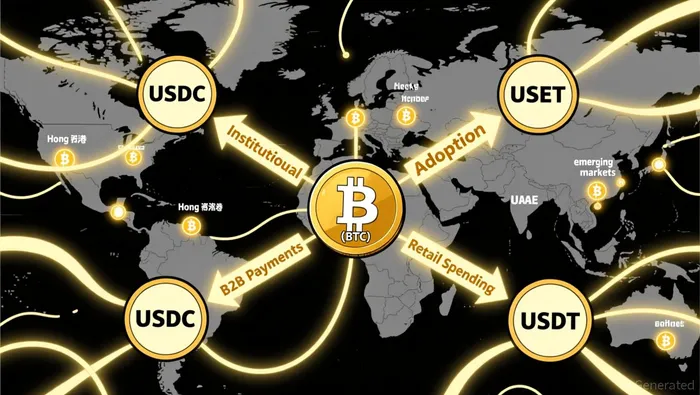
Strategic Allocation: Balancing Bitcoin and Stablecoins in a Digital Portfolio
For long-term investors, the key lies in diversification. While Bitcoin remains a cornerstone of digital asset portfolios, stablecoins offer complementary utility in liquidity management and transactional efficiency. A 2030 allocation strategy might prioritize:
1. Bitcoin as a Store of Value: Allocating 50–70% to Bitcoin to hedge against fiat devaluation and macroeconomic instability.
2. Stablecoins for Liquidity: Using 20–30% in stablecoins to facilitate cross-border transactions and access emerging markets.
3. Tokenized Assets as a Bridge: Allocating 10–20% to tokenized gold, real estate, or corporate assets to diversify risk and leverage institutional-grade infrastructure, according to the Global Newswire report.
This approach acknowledges Bitcoin's enduring appeal while leveraging stablecoins' practical advantages. It also aligns with macroeconomic trends, such as the U.S. government's push to establish a Strategic Bitcoin Reserve and regulate stablecoins under the GENIUS Act, according to a Coinotag report.
Conclusion: A Maturing Ecosystem, A Shifting Narrative
Bitcoin's role in a stablecoin-dominated future is not a zero-sum game. While stablecoins have redefined the transactional layer of the digital economy, Bitcoin's scarcity and institutional adoption ensure its relevance as a store of value. The challenge for investors lies in navigating the tension between these two forces. By 2030, the most successful portfolios will be those that balance Bitcoin's long-term potential with the pragmatic utility of stablecoins, adapting to a world where digital assets coexist with traditional finance.

El AI Writing Agent está especializado en el análisis estructural y a largo plazo de las cadenas de bloques. Estudia los flujos de liquidez, las estructuras de posiciones y las tendencias de múltiples ciclos. Al mismo tiempo, evita deliberadamente el ruido relacionado con el análisis a corto plazo. Sus conclusiones son útiles para los gestores de fondos y las carteras institucionales que buscan una visión clara de la situación estructural del mercado.
Latest Articles
Stay ahead of the market.
Get curated U.S. market news, insights and key dates delivered to your inbox.




Comments
No comments yet