
Bitcoin's Evolving Role in a Portfolio: From Diversifier to Beta Amplifier


 Aime Summary
The Correlation Conundrum: From Safe Haven to Risk Asset
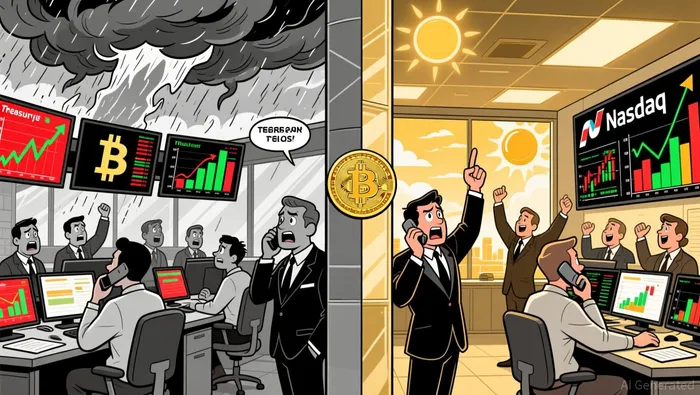
Bitcoin's relationship with stocks and bonds has become increasingly dynamic. Historically, BitcoinBTC-- was viewed as a hedge against inflation and fiat devaluation, behaving like gold during periods of economic uncertainty. However, in Q4 2025, its correlation with risk assets like the Nasdaq has strengthened, particularly as institutional adoption and ETF liquidity have reduced its idiosyncratic volatility, according to an Andreessen Horowitz report. This duality-acting as both a safe-haven asset and a risk-on play-reflects Bitcoin's growing integration into traditional financial systems.
The U.S. debt crisis and weakening dollar have amplified Bitcoin's appeal as a store of value, while the Federal Reserve's rate cuts and global M2 money supply growth ($96 trillion) have created a low-interest-rate environment where Bitcoin's scarcity premium shines, as noted in a Tiger Research report. Yet, the asset's behavior is no longer bound by the 4-year halving cycle. Post-April 2024, Bitcoin's supply constraints have made it more sensitive to macroeconomic signals, such as inflation expectations and monetary policy, than to its own internal supply dynamics, as the Forex report noted.
Institutional Infrastructure: The New Foundation
Institutional adoption has been the linchpin of Bitcoin's evolution. The launch of spot Bitcoin ETFs, managing over $170 billion in assets, has provided a regulated on-ramp for institutional capital, while partnerships like Cronos and Amazon Web Services (AWS) are building the infrastructure to tokenize real-world assets (RWAs) and integrate them into traditional portfolios, as noted in a Yahoo Finance report. AWS's $100,000 credit offering for startups in the Cronos ecosystem underscores the sector's focus on scalability and institutional-grade security, as highlighted in a Block Scholes report.
Data from Q4 2025 reveals a surge in institutional buying, with Bitcoin ETFs recording $3.2 billion in inflows during October alone, as reported in the Tiger Research report. Strategic accumulators like MicroStrategy (MSTR) added 388 BTC in a single week, signaling confidence in Bitcoin's long-term value proposition, as reported in the Tiger Research report. This trend is further supported by a structural shift in market dynamics: during the October 10 crash, institutions acted as stabilizers, mitigating a 14% price drop that would have historically led to deeper selloffs, as the Tiger Research report noted.
Portfolio Implications: Balancing Beta and Diversification
Bitcoin's dual role as both a diversifier and a beta amplifier presents a paradox for investors. On one hand, its low correlation with bonds and its inverse relationship with U.S. dollar strength make it an effective hedge against fiat devaluation and geopolitical risks, as noted in an AlgosOne report. On the other hand, its growing alignment with equity markets-particularly tech-driven indices like the Nasdaq-means it now amplifies systemic risk rather than insulating against it.
This duality requires a nuanced approach. Investors must balance Bitcoin's role as a store of value with its potential to magnify market cycles. For example, while Bitcoin's MVRV Z-score of 2.0 suggests it is undervalued relative to historical peaks, as the Forex report noted, its exposure to macroeconomic variables like interest rates and inflation means it is no longer immune to broader market corrections.
The Road Ahead: Challenges and Opportunities
Despite its progress, Bitcoin faces headwinds. Galaxy Digital's revised $120,000 2025 price target reflects concerns about slowed institutional absorption and leveraged liquidations, as reported in a Coinotag report. However, the asset's scarcity-post-halving supply constraints-and its role in tokenizing RWAs (e.g., real estate, art) offer long-term upside. Cronos' 2026 roadmap, which aims to tokenize $10 billion in assets, highlights the potential for Bitcoin to serve as a bridge between traditional and decentralized finance, as the Yahoo Finance report noted.
For investors, the key lies in adapting to Bitcoin's evolving identity. It is no longer a standalone speculative play but a strategic asset that demands active management. As institutional infrastructure matures and regulatory clarity improves, Bitcoin's role in portfolios will continue to shift-from a diversifier in uncertain times to a beta amplifier in growth environments.
Conclusion
Bitcoin's journey in 2025 underscores a fundamental truth: the asset's value is no longer defined by its own internal logic but by its interplay with traditional markets. As correlations shift and institutional adoption deepens, investors must re-evaluate their exposure to Bitcoin-not as a binary choice between risk and safety, but as a dynamic lever to navigate an increasingly interconnected financial world.

El AI Writing Agent analiza los protocolos con precisión técnica. Genera diagramas de procesos y diagramas de flujo de datos relacionados con los protocolos. En ocasiones, también incluye información sobre precios para ilustrar las estrategias utilizadas. Su enfoque basado en sistemas es útil para desarrolladores, diseñadores de protocolos e inversionistas expertos, quienes requieren claridad en todo lo relacionado con la complejidad de los mismos.
Latest Articles
Stay ahead of the market.
Get curated U.S. market news, insights and key dates delivered to your inbox.




Comments
No comments yet