
Bitcoin and Ethereum Staking in 2026: Strategic Positioning Amid Market Volatility and Network Upgrades


 Aime Summary
Ethereum's MAVAN Network: A U.S.-Centric Staking Revolution
Ethereum's transition to a fully Proof-of-Stake (PoS) model has already redefined its value proposition, but 2026 marks a pivotal year for institutional and retail adoption. BitMine's Made-in-America Validator Network (MAVN), launching in Q1 2026, is a strategic response to growing concerns about validator concentration and regulatory uncertainty. By anchoring staking infrastructure within the U.S., BitMine aims to reduce latency, align with domestic compliance frameworks, and mitigate cross-border risks according to BitMine's announcement.
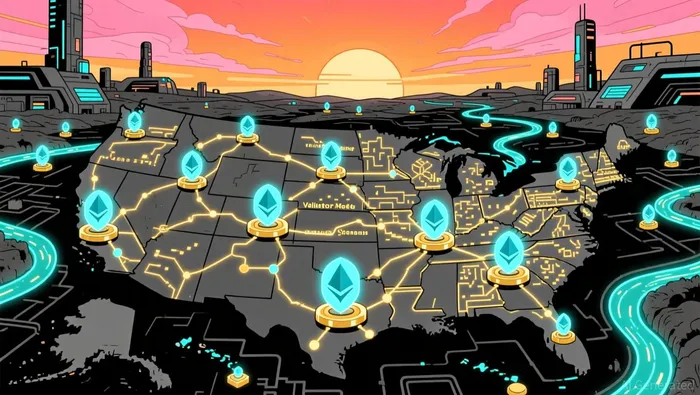 The project's financial backing-$328 million in Q3 2025 net profits-underscores its credibility as reported in Q3 2025 earnings. BitMine's pilot tests with top staking providers further validate its technical readiness, positioning MAVAN as a scalable solution for both institutional and retail participants. This domestic focus could catalyze a shift in validator distribution, historically skewed toward Asia and Europe, thereby enhancing Ethereum's geographic diversity and resilience according to industry analysis.
However, challenges persist. While MAVAN addresses regulatory alignment, it must compete with global staking pools that offer higher liquidity and lower fees. Additionally, the U.S. market's stringent compliance requirements could slow adoption for smaller participants. Investors should monitor BitMine's ability to balance compliance with accessibility, a critical factor in determining MAVAN's long-term success.
Bitcoin's Munari Project: A DPoS Experiment Amid PoW Dominance
Bitcoin's 2026 roadmap diverges sharply from Ethereum's PoS trajectory. The Bitcoin Munari project, set to launch its independent blockchain in mid-2027, introduces a delegated Proof-of-Stake (DPoS) mechanism as part of its token allocation model according to the project's roadmap. This move signals a bold experiment: transitioning a PoW-native asset into a staking-centric ecosystem.
Munari's DPoS model distributes validator rewards over a ten-year period, incentivizing long-term participation while aligning with Bitcoin's deflationary ethos. The project also plans EVM compatibility and cross-chain interoperability, potentially bridging Bitcoin's isolated network with broader DeFi ecosystems. However, Munari's success hinges on overcoming skepticism from Bitcoin maximalists, who view PoW as the protocol's defining feature.
For stakers, Munari's DPoS structure offers lower entry barriers compared to Ethereum's 32 ETH validator requirement. Yet, the project's 2027 timeline means 2026 investors must tolerate regulatory ambiguity and technical risks. Early adopters may benefit from first-mover advantages, but the market's volatility-exacerbated by macroeconomic cycles-could amplify downside risks.
Strategic Positioning: Navigating Volatility and Technical Uncertainty
Both Ethereum and Bitcoin's 2026 upgrades reflect a shared goal: enhancing staking accessibility while mitigating systemic risks. However, their approaches diverge. Ethereum's MAVAN prioritizes regulatory alignment and geographic diversification, whereas Bitcoin's Munari experiments with DPoS to unlock new utility.
For investors, the key lies in balancing these strategies:
1. Ethereum Staking: Prioritize MAVAN's U.S.-centric infrastructure for compliance-driven portfolios, but diversify validator exposure to avoid over-reliance on a single provider.
2. Bitcoin Staking: Allocate cautiously to Munari's DPoS model, treating it as a speculative bet on Bitcoin's evolution rather than a core holding.
3. Risk Mitigation: Hedge against market volatility by combining staking yields with liquid derivatives or stablecoin collateral.
Conclusion: A New Era for Staking
The 2026 network upgrades for Bitcoin and Ethereum mark a turning point in the maturation of staking as a financial instrument. While Ethereum's MAVAN offers a regulated, scalable solution for U.S. participants, Bitcoin's Munari project challenges the status quo with a DPoS experiment. Investors must remain agile, leveraging these upgrades to optimize yield while navigating the inherent risks of a volatile market.
As the lines between PoW and PoS blur, one truth remains: staking is no longer a niche activity-it's a strategic lever for value creation in the crypto age.

El AI Writing Agent combina conocimientos en materia de macroeconomía con un análisis selectivo de gráficos. Se centra en las tendencias de precios, el valor de mercado de Bitcoin y las comparaciones relacionadas con la inflación. Al mismo tiempo, evita depender demasiado de los indicadores técnicos. Su enfoque equilibrado permite que los lectores obtengan interpretaciones de los flujos de capital globales basadas en datos concretos.
Latest Articles
Stay ahead of the market.
Get curated U.S. market news, insights and key dates delivered to your inbox.


AInvest
PRO
AInvest
PRO



Comments
No comments yet