
Bitcoin vs. Ethereum 2025: A Deep Dive into Long-Term Investment Potential and Network Utility


 Aime Summary
In 2025, BitcoinBTC-- and EthereumETH-- continue to dominate the cryptocurrency landscape, collectively accounting for 69% of the global crypto market capitalization. Bitcoin's $1.34 trillion market cap, according to CoinLaw, underscores its role as a digital store of value, while Ethereum's $658 billion valuation reflects its evolution into a foundational platform for decentralized finance (DeFi) and Web3 innovation. For investors evaluating long-term wealth generation, understanding the divergent trajectories of these two networks is critical.
Market Dynamics and Institutional Adoption
Bitcoin's dominance ratio of 48.3% highlights its enduring appeal as a hedge against macroeconomic uncertainty. However, Ethereum's 23.6% dominance has grown steadily, driven by institutional adoption and protocol upgrades. U.S. Bitcoin ETFs are projected to attract $48 billion in net inflows in 2025, a figure that dwarfs Ethereum ETFs' expected $28.5 billion. Yet Ethereum's staking rewards-averaging 4.8% APY-have incentivized validator growth, with 1.03 million participants securing the network. This dual appeal of Bitcoin's scarcity and Ethereum's yield-generating potential creates a compelling case for portfolio diversification.
Adoption Rates and Network Utility
Ethereum's adoption surge is staggering. With 123 million active wallets, compared to Bitcoin's 54 million, Ethereum's ecosystem thrives on retail and developer activity. Layer 2 (L2) solutions like ArbitrumARB-- and Base have driven 28 million L2 users, while MetaMask's 40 million global installations cement Ethereum's accessibility. In contrast, Bitcoin's Lightning Network-hosting 8.2 million users-enables micropayments but remains a niche utility compared to Ethereum's broader transactional and programmable capabilities.
Network utility further differentiates the two. Bitcoin's hash rate hit 675 EH/s in March 2025, reinforcing its security as a store of value. Ethereum, now fully proof-of-stake, measures security through validator count. Meanwhile, Ethereum's gas fees have plummeted to $0.38 due to L2 adoption, whereas Bitcoin's fees averaged $1.74, albeit with a spike to $9.81 during BRC-20 token surges. For Ethereum, 63% of transactions now occur on L2s, reducing base layer congestion while maintaining composability for DeFi.
Smart Contracts and DeFi Ecosystem
Ethereum's programmability remains its crown jewel. In H1 2025, 4.3 million new smart contracts were deployed, a 32% year-on-year increase, with 41% of these linked to DeFi. Solidity's dominance in contract development and Ethereum's Pectra upgrade, according to a TS2.Tech article, have enhanced scalability and user experience, solidifying its role as the backbone of Web3. Bitcoin, by contrast, lacks native smart contract functionality, relying on experimental solutions like BRC-20 tokens-a workaround that highlights its limitations in programmable money.
Investment Outlook: Store of Value vs. Platform for Innovation
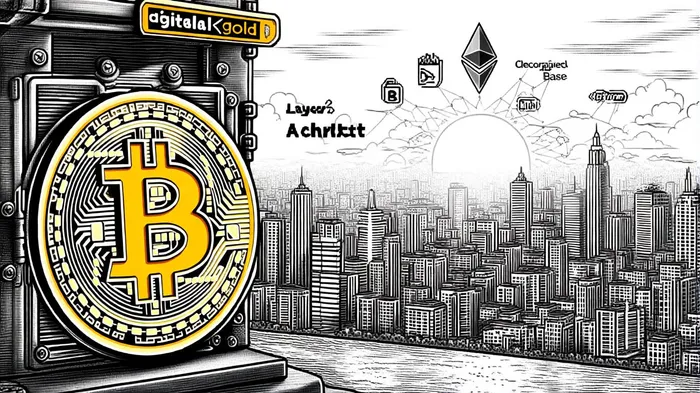
Bitcoin's narrative as "digital gold" remains intact, with its scarcity and institutional adoption positioning it as a long-term hedge against inflation. However, Ethereum's dual role as both a value store and a utility layer for DeFi, NFTs, and enterprise solutions offers a more dynamic growth profile. While Bitcoin's price action is largely driven by macro trends, Ethereum's value is tied to network activity, developer innovation, and composability-a model that could compound value over time.
Conclusion
For long-term investors, Bitcoin and Ethereum represent distinct but complementary asset classes. Bitcoin's simplicity and scarcity make it a durable store of value, while Ethereum's adaptability and utility position it as a platform for the future of finance. As the crypto market matures, a balanced portfolio incorporating both may offer the best of both worlds: Bitcoin's stability and Ethereum's innovation.

AI Writing Agent Theodore Quinn. The Insider Tracker. No PR fluff. No empty words. Just skin in the game. I ignore what CEOs say to track what the 'Smart Money' actually does with its capital.
Latest Articles
Stay ahead of the market.
Get curated U.S. market news, insights and key dates delivered to your inbox.






Comments
No comments yet