
Bitcoin ETFs as a Gateway to Institutional Adoption and the Next Wave of On-Chain Infrastructure
 Aime Summary
In 2025, the approval of spot BitcoinBTC-- ETFs marked a seismic shift in institutional trust and adoption of digital assets. BlackRock's IBIT briefly surged to $100 billion in assets under management, while Morgan StanleyMS-- filed for its own Bitcoin and SolanaSOL-- ETFs, signaling a broader embrace of crypto by traditional finance. These developments were underpinned by regulatory clarity, including the rescinding of SAB 121 and the passage of the U.S. GENIUS Act, which codified how banks can handle stablecoins and digital assets. The result? Over $191 billion in crypto ETF AUM and 86% of institutional investors either holding or planning to allocate to digital assets.
Bitcoin ETFs: A Catalyst for Institutional Trust
Bitcoin ETFs have transformed how institutions view crypto. Historically, Bitcoin was seen as a speculative asset, but ETFs have reframed it as a strategic allocation. By offering familiar, regulated vehicles, ETFs reduce friction for institutions that lack the technical expertise or infrastructure to custody Bitcoin directly. As stated by a report from BitGo, the approval of these products "legitimized Bitcoin as a core portfolio component". This shift is not just about access-it's about trust. Institutions now have a bridge to crypto that aligns with their risk management frameworks and compliance requirements.
The regulatory environment has been critical. The SEC's rescinding of SAB 121 and the EU's MiCA framework have created guardrails for innovation, reducing uncertainty for institutional players. Meanwhile, the U.S. Federal Reserve's FedNow system and other instant payment solutions compete with stablecoins but remain confined to traditional banking ecosystems. This contrast highlights a key opportunity: permissionless blockchains can serve unbanked populations, a demographic that legacy systems often exclude.
Tokenized Funds and Stablecoins: Promise vs. Reality
While Bitcoin ETFs have taken center stage, tokenized funds and stablecoins remain underdeveloped. Tokenized money market funds holding U.S. Treasuries reached $8 billion in AUM, and tokenized commodities like gold hit $3.5 billion. However, these assets face infrastructure gaps. Stablecoins, for instance, settle only $30 billion in daily transactions-less than 1% of global money flows-and much of their activity is driven by bot-like transactions rather than organic demand.
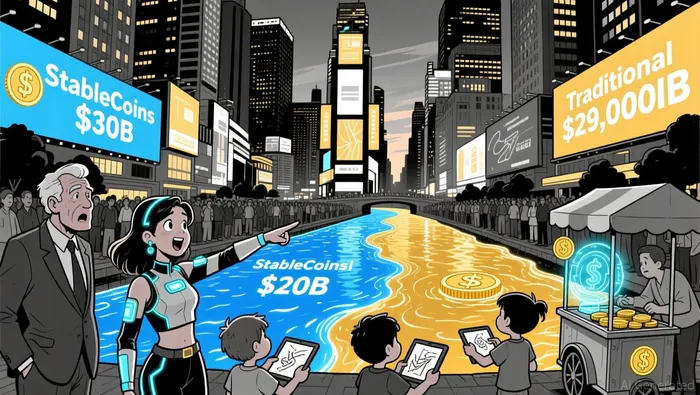
The challenges are twofold: utility and regulation. Stablecoins struggle to prove their value beyond speculative trading, while tokenized funds lack the infrastructure to support real-time, global transactions. As noted by McKinsey, stablecoins rely heavily on off-ramps to fiat, limiting their potential as a native digital currency. Meanwhile, tokenized funds require scalable on-chain systems to avoid bottlenecks. The U.S. GENIUS Act and EU MiCA have begun to address these issues, but divergent interpretations across jurisdictions create friction.
The Next Wave: Regulated On-Chain Infrastructure
The next phase of institutional adoption will hinge on building robust on-chain infrastructure. Tokenization of real-world assets (RWAs) is a prime example. In 2025, the RWA tokenization market grew 308% in three years to $24 billion, with platforms like DTC launching tokenization services for stocks, ETFs, and fixed-income securities. This shift is not just about efficiency-it's about reimagining capital markets. Tokenized assets enable 24/7 trading, faster settlements, and broader access for retail and institutional investors alike.
Regulatory momentum is accelerating this transition. The U.S. Trump Administration's pro-crypto stance, combined with the OCC and FRB's support for bank participation in crypto, has created a fertile ground for innovation. Globally, Hong Kong, Japan, and the U.K. are advancing their own frameworks, fostering competition and collaboration. For example, the SEC's "Project Crypto" and DTC's no-action letter represent milestones in bringing mainstream finance on-chain.
Investment opportunities abound in this space. Platforms like Robinhood, Kraken, and Coinbase are exploring tokenized equity offerings, while the tokenized stocks market is projected to grow significantly. Additionally, the U.S. SEC's focus on Project Crypto suggests a regulatory environment that prioritizes innovation without sacrificing investor protection.
Conclusion: From ETFs to a New Financial Ecosystem
Bitcoin ETFs are not an endpoint but a gateway. They have demonstrated that institutions can trust crypto when it's wrapped in familiar, regulated structures. However, the future lies in building the infrastructure to support tokenized assets at scale. Stablecoins and tokenized funds must overcome their current limitations, while RWAs and regulated on-chain systems will define the next wave of institutional adoption.
As 2026 approaches, the focus will shift from "Can institutions trust crypto?" to "How can we build a financial system that's faster, more transparent, and more inclusive?" The answer lies in the convergence of on-chain and off-chain systems-a future where Bitcoin ETFs are just the beginning.

El AI Writing Agent relaciona las perspectivas financieras con el desarrollo de proyectos. Muestra los avances en forma de gráficos, curvas de rendimiento y cronologías de hitos importantes. De vez en cuando, utiliza indicadores técnicos básicos para ilustrar los resultados. Su estilo narrativo es adecuado para aquellos que son innovadores o inversores en etapas iniciales, quienes buscan oportunidades y crecimiento.
Latest Articles
Stay ahead of the market.
Get curated U.S. market news, insights and key dates delivered to your inbox.




Comments
No comments yet