
Bitcoin ETFs Gain Primary Influence as Institutional Buying Shapes BTC Price Dynamics
 Aime Summary
Bitcoin ETFs have become the primary driver of BTCBTC-- price movements, replacing on-chain activity as a key indicator according to analysis. ETF inflows have brought in $1.2 billion in early 2026, but BTC has failed to break out of its $87,000–$90,000 range, highlighting potential disconnection between capital flows and price action as reported. Large whales are increasing exchange activity, potentially signaling selling pressure in a low-volume market, which could trigger sharp price swings according to data.
Bitcoin ETFs are now the dominant force influencing Bitcoin's price. Institutional capital flows have overtaken on-chain metrics as the primary determinant of BTC price movements, signaling a transition in the market's maturity as noted. The recent surge in ETF inflows, totaling $1.2 billion, has yet to translate into a breakout, raising questions about the effectiveness of these funds in directly moving the price according to analysis.
This dynamic suggests a divergence between institutional buying and the broader market's reaction, potentially due to market liquidity and structural factors. Analysts note that sustained ETF inflows could absorb circulating supply and affect liquidity, altering the volatility profile of the market over time according to reports. However, in the short term, even moderate selling pressure could lead to significant price corrections, particularly in a low-volume environment as observed.
Whale activity and institutional buying are playing a crucial role in Bitcoin's value proposition in 2026. Cold storage accumulation by large stakeholders has increased by 56,227 BTC ($5.3 billion) since mid-December 2025, even as prices remain in a range 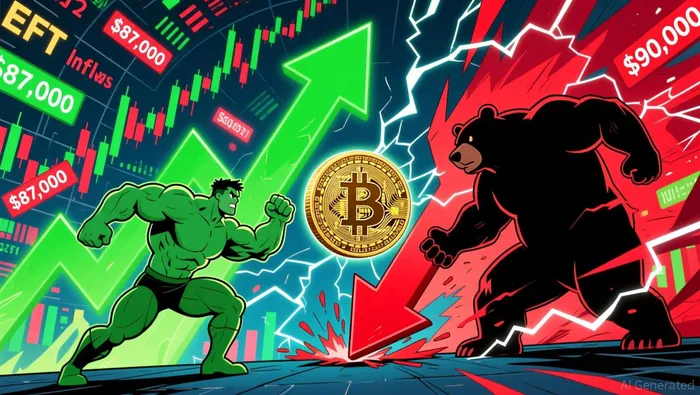 . This divergence between retail and institutional behavior is a recurring pattern that often precedes major market cycles. However, experts caution that on-chain data can be distorted by exchange wallet reorganizations, which may misrepresent whale accumulation as reported.
Why Are ETFs Becoming the Main Price Driver for Bitcoin?
Bitcoin ETFs have rapidly gained traction in 2026 as they continue to attract billions in inflows. This institutional adoption reflects a broader shift in the market as BitcoinBTC-- becomes integrated into traditional financial systems according to analysis. ETFs provide a regulated, familiar vehicle for investors, which has helped attract capital from large financial institutions and retail investors alike. The increased institutional presence has also led to a stronger correlation between BTC and traditional financial indicators like interest rates and macroeconomic trends as noted.
The maturation of Bitcoin as an asset class is evident in the reduced influence of on-chain activity and retail-driven dynamics. On-chain metrics such as network congestion and transaction fees have declined significantly, indicating a more stable and less volatile market environment according to reports. This shift is also supported by the increased cold storage of Bitcoin, which suggests that large stakeholders are accumulating and holding long-term, rather than engaging in frequent trading as observed.
What Risks Do ETFs and Whale Activity Pose to BTC Price Stability?
Despite the positive inflows, ETF-driven markets come with inherent risks. Analysts warn that high demand from ETFs could absorb circulating supply, reducing the liquidity available for traders according to analysis. This could lead to tighter trading conditions, where even moderate selling pressure could trigger sharp price corrections . Additionally, the recent surge in whale activity on exchanges has raised concerns about potential selling pressure, especially in a low-volume environment where liquidity is thin according to data.
Bitcoin's recent price action underscores these risks. Despite the influx of $1.2 billion into ETFs, BTC has remained range-bound, suggesting that these inflows may not be sufficient to push the price higher without broader market support as noted. The Q4 2025 leverage reset, which saw a sharp liquidation event, has left the market more resilient, but it also highlights the potential for sudden volatility if leverage levels rise again according to reports. Traders and investors are now closely watching whale activity and ETF inflows for signs of stability or potential selling pressure as observed.
What Role Do Institutional Buyers Play in BTC's Long-Term Outlook?
Institutional buying is reshaping the Bitcoin market, with major financial players like JPMorgan and Citi now offering crypto-native products according to data. These developments indicate a more mature market with increased participation from traditional finance. Institutional investors are also contributing to long-term price stability by accumulating and holding Bitcoin in cold storage as reported. This trend is often seen as a precursor to larger market cycles, where retail investors take profits while institutions continue to buy the dip according to analysis.
However, the recent Q4 2025 leverage reset serves as a cautionary tale. The sharp drop from $126,000 to $86,000 was exacerbated by excessive leverage in the market, leading to a forced liquidation event that erased significant open interest according to reports. This event acted as a "nuclear bomb" for the market, purging excessive debt and creating a more resilient structure as noted. As 2026 progresses, the reduced leverage levels and increased institutional presence suggest a market that is less prone to abrupt collapses according to analysis.

Blending con el conocimiento tradicional de comercio con las últimas ideas criptográficas.
Latest Articles
Stay ahead of the market.
Get curated U.S. market news, insights and key dates delivered to your inbox.


AInvest
PRO
AInvest
PRO



Comments
No comments yet