
Bitcoin ETFs Cross $50 Billion Milestone: The Dawn of Institutional Legitimacy in Crypto
The crypto market has long been synonymous with volatility, speculation, and retail-driven manias. But a quiet revolution is underway: BitcoinBTC-- ETFs, once a distant regulatory dream, have now surpassed $50 billion in assets under management (AUM), marking a pivotal shift toward institutional legitimacy. This milestone isn't just about numbers—it's a sign that Bitcoin is evolving from a fringe asset into a mainstream investment vehicle. Here's why the $50 billion threshold matters, and what it means for investors.
The Institutional Stamp of Approval
The meteoric rise of BlackRock's iShares Bitcoin Trust (IBIT) epitomizes this shift. Launched in January 2024, IBITIBIT-- has already amassed $76 billion in AUM, holding 700,000 BTC—or roughly 3.3% of Bitcoin's total supply. With $52.9 billion in net inflows, it now accounts for 56% of all U.S. Bitcoin ETF holdings, outpacing even legacy crypto accumulators like MicroStrategyMSTR--. The message is clear: institutions are now the primary drivers of Bitcoin's growth.
Why does this matter? Institutional capital brings discipline, risk management, and—critically—stability. Unlike retail investors prone to panic selling or FOMO-driven buying, institutions approach Bitcoin as a long-term store of value, akin to gold or real estate. This dynamic has already started to temper Bitcoin's historically wild swings.
Volatility Declines: A Sign of Maturity
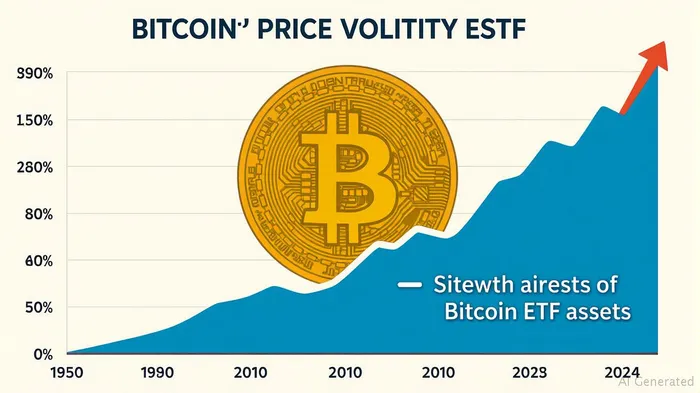
Bitcoin's volatility has long been its Achilles' heel. But as ETFs grow, the asset's price movements are beginning to mirror those of traditional markets. Since the launch of IBIT, Bitcoin's 30-day volatility has fallen by 40%, aligning more closely with equities like the S&P 500. This isn't a coincidence. Institutional adoption creates a deeper, more liquid market, reducing the impact of small trades on price.
From Speculative Mania to Strategic Allocation
The $50 billion milestone isn't just about size—it's about composition. ETFs like IBIT and Fidelity's FBTC (which holds 203,000 BTC) are structured to appeal to pension funds, endowments, and family offices. These entities demand transparency, custody solutions, and tax clarity—features Bitcoin ETFs now provide. Grayscale's GBTC, once the largest Bitcoin holder, has seen its holdings shrink by 70% as investors pivot to more compliant ETF structures.
This transition has two key implications:
1. Lower systemic risk: ETFs reduce the need for institutional investors to hold Bitcoin on unregulated exchanges, mitigating hacking and fraud risks.
2. Increased legitimacy: Regulators are more likely to accept Bitcoin as a credible asset class when it's managed through traditional financial channels.
The Case for Strategic Allocation
For investors, Bitcoin ETFs now present a compelling opportunity. Here's why:
- Diversification benefits: Bitcoin's low correlation with stocks and bonds (currently around -0.1) makes it a hedge against traditional market downturns.
- Access to institutional-grade tools: ETFs handle custody, tax reporting, and compliance, lowering the barrier for non-crypto-savvy investors.
- Supply dynamics: With ETFs holding nearly 6% of Bitcoin's total supply, they're becoming a price-support mechanism. As institutions accumulate, the asset's scarcity value strengthens.
The Bottom Line
Bitcoin's evolution from a speculative curiosity to an institutional darling is irreversible. The $50 billion ETF milestone isn't just a number—it's proof that Bitcoin is now a legitimate asset class. For investors, this is a call to action.
Recommendation: Consider allocating 1-3% of a diversified portfolio to Bitcoin via ETFs like IBIT or FBTC. This provides exposure to a digital asset with proven scarcity and institutional backing, while avoiding the operational risks of direct ownership. The crypto market's future isn't about getting rich quick—it's about building resilient, long-term wealth.
Bitcoin's next chapter isn't about moon shots. It's about maturity—and that's a trend worth betting on.

Delivering real-time insights and analysis on emerging financial trends and market movements.
Latest Articles
Stay ahead of the market.
Get curated U.S. market news, insights and key dates delivered to your inbox.
AInvest
PRO
AInvest
PRO



Comments
No comments yet