
Bitcoin ETFs Cross $50 Billion AUM: The Institutional Stamp of Approval for Digital Assets
The institutional adoption of BitcoinBTC-- ETFs has reached a historic inflection point: as of July 2025, cumulative net inflows into U.S. spot Bitcoin ETFs surpassed $50 billion, with total assets under management (AUM) exceeding $130 billion. This milestone marks a pivotal shift in the perception of digital assets, signaling their transition from speculative instruments to a legitimate, regulated asset class. For investors, this is not merely a financial milestone—it's a clarion call to reassess crypto's role in their portfolios.
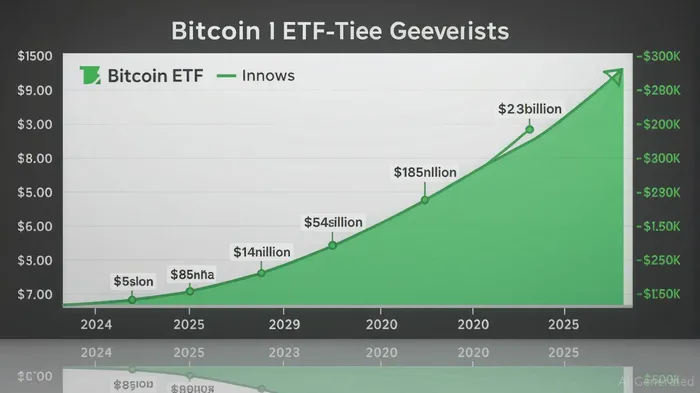
The Institutional Surge: Why Bitcoin ETFs Are Attracting Big Money
The $50 billion inflow milestone is driven by institutional investors—asset managers, corporate treasuries, and hedge funds—seeking exposure to Bitcoin's price appreciation while adhering to regulatory standards. Key contributors include:
- BlackRock's iShares Bitcoin Trust (IBIT): Holds $76.3 billion (58% of Bitcoin ETF AUM), making it the largest crypto ETF globally.
- Fidelity's FBTC: Attracts $22.05 billion, leveraging Fidelity's institutional trust.
- Corporate Treasuries: Companies like Figma ($70 million allocated to Bitcoin ETFs) and MicroStrategyMSTR-- (597,000 BTC holdings) are diversifying reserves into Bitcoin, signaling corporate confidence in its store-of-value role.
Why ETFs Are the Catalyst for Mainstream Adoption
Bitcoin ETFs have dismantled barriers that once confined crypto to niche markets:
- Regulatory Compliance: ETFs adhere to SEC standards, offering audited holdings and transparent pricing.
- Liquidity & Accessibility: Trading on regulated exchanges like NYSE, Bitcoin ETFs allow investors to participate without managing private keys or navigating decentralized exchanges.
- Risk Mitigation: ETFs reduce exposure to hacking, custody failures, and volatility. Bitcoin's price volatility has dropped by 40% since the first ETF launch in 2024, as institutional demand stabilizes the market.
As Rachael Lucas, Head of Research at BTC Markets, noted, “Institutional inflows reflect strategic allocations, not speculative gambles. Bitcoin is now a macro-asset for diversification, not just a tech experiment.”
Regulatory Milestones: From Skepticism to Acceptance
The SEC's January 2024 approval of spot Bitcoin ETFs was a watershed moment, ending a decade-long regulatory stalemate. Since then:
- Over 76 crypto ETFs are listed in the U.S., with EthereumETH-- ETFs adding $4.7 billion in AUM.
- The SEC's July 2025 guidance under Chair Paul Atkins signals openness to staked Solana ETFs and XRP ETFs, broadening the crypto ETF universe.
Crucially, the SEC's focus on “generic listing standards” aims to streamline approvals, reducing the risk of arbitrary rejections. This clarity has drawn $5.6 billion in inflows across Bitcoin and Ethereum ETFs in Q2 2025 alone.
The Investment Case: Bitcoin as a Core Portfolio Holding
For investors, Bitcoin ETFs offer a compelling value proposition:
- Store of Value: With a $108,000 price (July 2025 high), Bitcoin outperforms gold ETFs like GLDGLD-- ($175 billion AUM), capturing 76% of gold's AUM in just 18 months.
- Inflation Hedge: Bitcoin's capped supply (21 million coins) contrasts with fiat currencies inflated by central banks.
- Diversification: Bitcoin's -0.1 correlation with equities/bonds makes it a rare uncorrelated asset, enhancing portfolio resilience.
Risks and Considerations
- Regulatory Uncertainty: While progress is clear, risks remain around custody standards and valuation accuracy.
- Market Volatility: Bitcoin's price swings (e.g., $105k–$112k in July /2025) require disciplined risk management.
- Leveraged Products: Avoid ETFs like BITXBITX-- (2x leverage) or SBIT (UltraShort), which amplify losses in downturns.
Conclusion: Allocate Now, or Risk Missing the Boat
The $50 billion Bitcoin ETF milestone is not an endpoint—it's a harbinger of crypto's integration into global finance. Institutional adoption has already transformed Bitcoin into a $1.1 trillion asset, and ETFs are the gateway to this growth.
Investment Strategy:
1. Core Position: Allocate 1–3% of a balanced portfolio to Bitcoin ETFs (e.g., IBITIBIT-- or FBTC) for diversification.
2. Wait for Dips: Use pullbacks below $100,000 as buying opportunities, given ETF-driven demand.
3. Avoid Speculative ETFs: Stick to regulated, transparent products; avoid leveraged or altcoin ETFs until they prove their stability.
As Bitcoin ETFs mature, they'll attract pensions, endowments, and retail investors alike. Those who act now can secure a foothold in what may become the defining asset of the 21st century.
The crypto train has left the station—but there's still room on the ETF car.

Delivering real-time insights and analysis on emerging financial trends and market movements.
Latest Articles
Stay ahead of the market.
Get curated U.S. market news, insights and key dates delivered to your inbox.


AInvest
PRO
AInvest
PRO



Comments
No comments yet