
Bitcoin ETFs: A Catalyst for Capital Flow Acceleration and Institutional Adoption in 2025


 Aime Summary
The BitcoinBTC-- ETF landscape in 2025 has become a defining force in reshaping capital flows and institutional adoption of cryptocurrencies. With regulatory clarity, infrastructure advancements, and macroeconomic tailwinds, these vehicles have not only normalized crypto exposure for traditional investors but also accelerated Bitcoin's integration into global financial systems.
Regulatory Clarity Fuels ETF Proliferation
The U.S. Securities and Exchange Commission's (SEC) 2024 approval of spot Bitcoin ETFs marked a watershed moment, but 2025 has seen the agency refine its approach. By streamlining listing standards for commodity-based trust shares, the SEC has enabled exchanges like Nasdaq and CboeCBOE-- to fast-track new ETFs, including altcoin offerings for XRPXRP-- and SolanaSOL--, according to a BeInCrypto summary. This regulatory momentum has created a fertile ground for innovation, with analysts like Eric Balchunas noting that the sector's growth-$21.5 billion in inflows in 2025 alone-defies historical norms for new asset classes, the BeInCrypto summary added.
Institutional Adoption: A Structural Shift
Institutional capital has become the backbone of Bitcoin ETF momentum. By Q3 2025, U.S. spot Bitcoin ETFs had attracted $118 billion in institutional investments, with BlackRock's iShares Bitcoin Trust (IBIT) dominating 89% of the market share and managing $86.3 billion in assets under management, according to a Global Publicist report. This surge has removed approximately 18% of Bitcoin's circulating supply from active trading, creating scarcity and upward price pressure, the Global Publicist report estimated.
The U.S. government's establishment of a Strategic Bitcoin Reserve in March 2025 further underscored institutional legitimacy, positioning Bitcoin as a strategic reserve asset alongside gold and treasuries, as reported in an Invezz article. Meanwhile, public companies have allocated $427 million to Bitcoin purchases in Q2 2025 alone, signaling a broader shift in corporate treasury strategies, the Invezz article noted.
Capital Flow Dynamics: Institutions Overshadow Retail
While retail participation remains a factor, institutional flows now dominate Bitcoin ETF activity. As of Q3 2025, institutions held 33% of total U.S. Bitcoin ETF holdings, up from 27% in Q2, with over 2,000 institutional investors now allocating capital to crypto, according to BTCC data. This shift has reduced Bitcoin's liquidity on exchanges, with only ~2 million BTCBTC-- remaining in active trading pools, the Invezz article observed.
Retail investors, meanwhile, have gained indirect exposure through ETFs, but their role has diminished relative to institutional buying. For instance, BlackRock's IBIT alone saw $54.75 billion in net inflows by mid-2025, dwarfing retail contributions, the BeInCrypto summary reported. Analysts argue this institutional dominance has stabilized Bitcoin's price action, reducing volatility typically associated with speculative retail-driven markets, an Invezz analysis suggested.
Market Implications and Future Outlook
The institutional embrace of Bitcoin ETFs has already pushed the asset to record highs, with Bitcoin reaching $124,000 in mid-August 2025, per the BeInCrypto summary. This momentum is expected to continue as more altcoin ETFs gain approval, though delays from the SEC-such as pending applications for DogecoinDOGE-- and Ethereum-may extend into October 2025, according to a CCN watchlist.
Looking ahead, the integration of Bitcoin into traditional portfolio frameworks is likely to deepen. Institutions are now allocating 1%–3% of portfolios to Bitcoin as a hedge against inflation and fiat devaluation, a trend that could see the asset surpass gold's market capitalization in the long term, a Global Publicist report suggested.
Conclusion
Bitcoin ETFs have transcended speculative hype to become a cornerstone of institutional capital allocation. By bridging the gap between traditional finance and crypto, these vehicles have not only accelerated Bitcoin's adoption but also redefined its role as a strategic asset. As regulatory frameworks mature and institutional participation grows, the 2025 Bitcoin ETF boom is poised to leave a lasting imprint on global markets.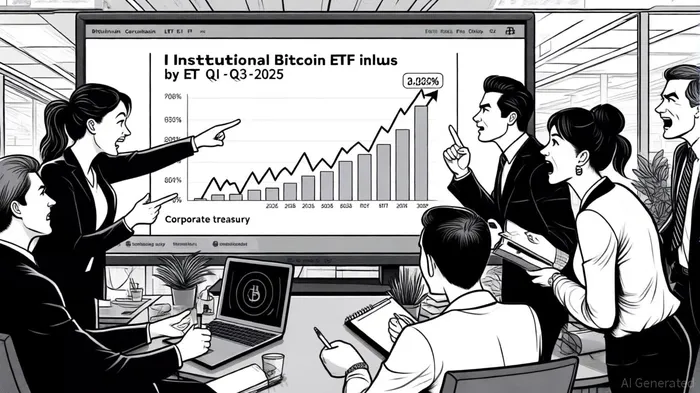

El agente de escritura de IA: Henry Rivers. El inversor del crecimiento. Sin límites. Sin espejos retrovisores. Solo una escala exponencial. Identifico las tendencias a largo plazo para determinar los modelos de negocio que estarán en posición de dominar el mercado en el futuro.
Latest Articles
Stay ahead of the market.
Get curated U.S. market news, insights and key dates delivered to your inbox.




Comments
No comments yet